

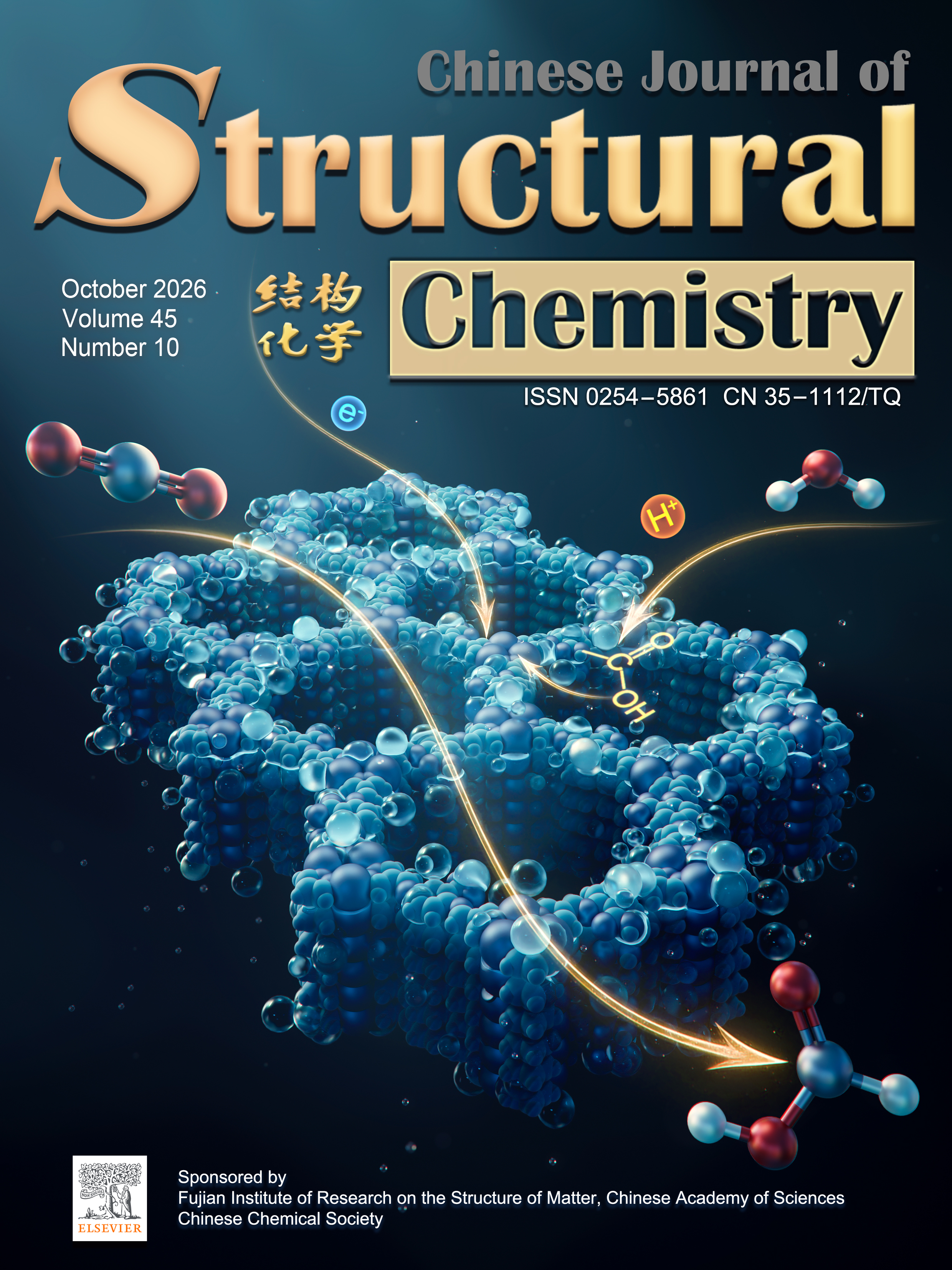
Cover Picture
Strengthening hydrophilicity in covalent-organic frameworks to boost CO2 photoreduction
Si-Zhan Feng†, Chong-Jiu Lu†, Ji-Hua Deng*, Tong-Bu Lu, Di-Chang Zhong* Submit a Manuscript
Strengthening hydrophilicity in covalent-organic frameworks to boost CO2 photoreduction
Si-Zhan Feng†, Chong-Jiu Lu†, Ji-Hua Deng*, Tong-Bu Lu, Di-Chang Zhong* Submit a Manuscript
Synthesis and optical properties of supramolecular uranium(IV) halide complexes
Xiuru Li†, Yumin Wang†, Junren Wang, Junyi Li, Kai Li,* Zhifang Chai, Shuao Wang, Yaxing Wang*
Chin. J. Struct. Chem., 2026, 45(10), 100977. DOI: 10.1016/j.cjsc.2026.100977
October 1, 2026
Supramolecular actinide halides; Uranium(IV) halide complexes; Uranium(IV) photophysics; Decay dynamics
ABSTRACT
Supramolecular templating has emerged as an effective strategy for isolating discrete metal halide anions and modulating their photophysical properties; however, its application to actinide halides remains largely unexplored. Herein, we report the synthesis, crystal structure, and optical properties of a supramolecular uranium(IV) halide, (CH3CN)[K(18-crown-6)]2UCl6. Single-crystal X-ray diffraction reveals discrete octahedral [UCl6]2- units charge balanced by [K(18-crown-6)]+ cations, resulting in a zero-dimensional supramolecular architecture. Photoluminescence measurements revealed two emission bands at 370 and 423 nm, which were assigned to U(IV) 6d→5f electronic transitions. Notably, the emission at 370 nm displays an ultrafast decay component (∼300 ps), indicative of a large radiative rate constant. These results demonstrate that supramolecular templating enables the stabilization and isolation of discrete uranium halide units, providing a versatile platform for investigating the 5f electronic structure and 6d-5f transitions associated with photophysics in actinide materials.





- Address: Fuzhou High & New Technology Industrial Zone, Shangjie, Minhou, Fuzhou, Fujian 350108, China
- Tel: (86)-591-63173769, 63173770
- E-mail: cjsc@fjirsm.ac.cn
CN 35–1112/TQ, ISSN 0254–5861, Online ISSN: 2949-768X Copyright @ 2022 Chinese Journal of Structural Chemistry-www.Chinese Journal of Structural Chemistry.net. All Rights Reserved 闽ICP备2022002645号-1