

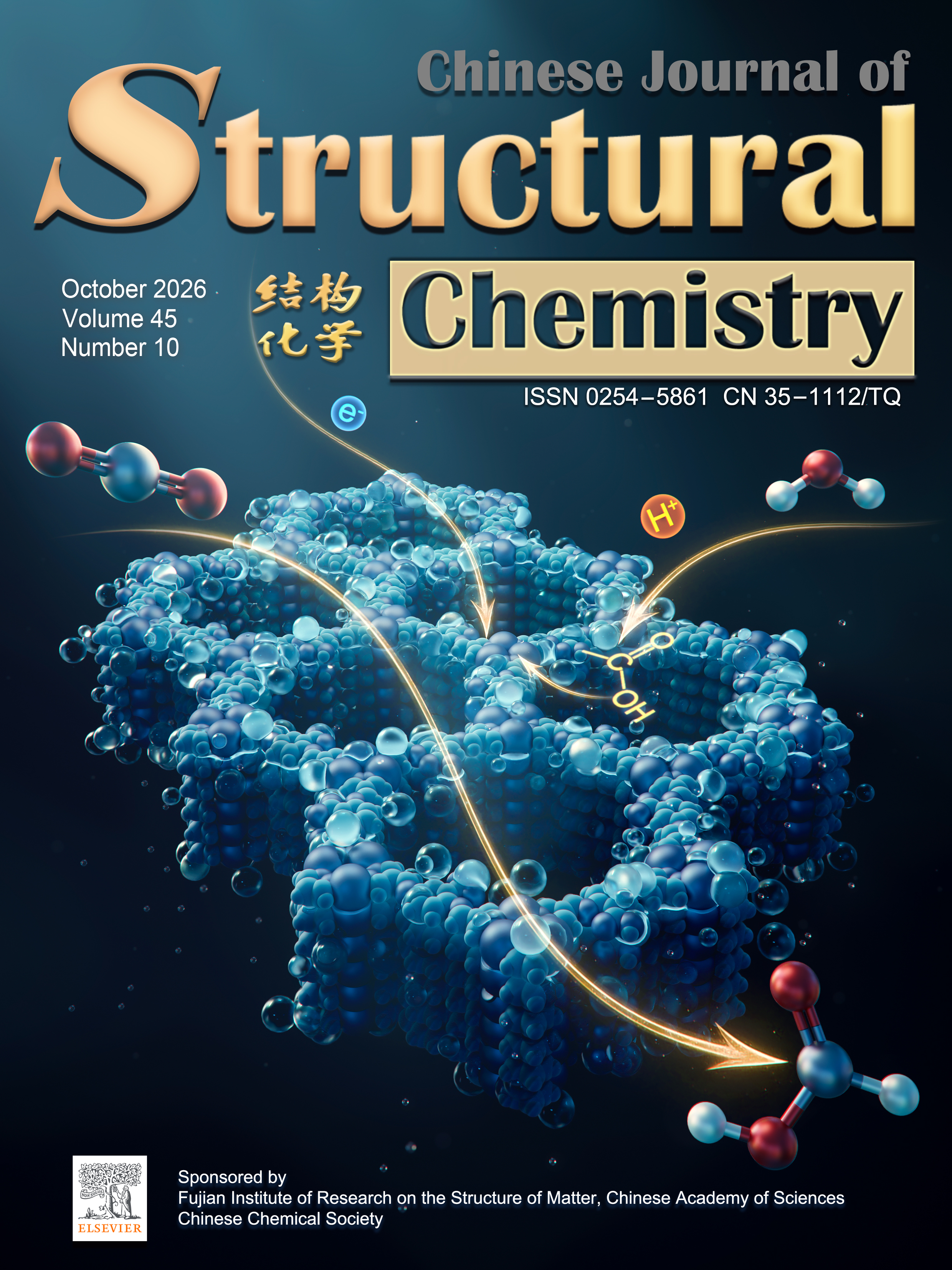
Cover Picture
Strengthening hydrophilicity in covalent-organic frameworks to boost CO2 photoreduction
Si-Zhan Feng†, Chong-Jiu Lu†, Ji-Hua Deng*, Tong-Bu Lu, Di-Chang Zhong* Submit a Manuscript
Strengthening hydrophilicity in covalent-organic frameworks to boost CO2 photoreduction
Si-Zhan Feng†, Chong-Jiu Lu†, Ji-Hua Deng*, Tong-Bu Lu, Di-Chang Zhong* Submit a Manuscript
Cluster-guided Zn8(CH3COO)8-siloxane metal-organic frameworks realize efficient separation of propylene/propane
Haoze Zhu, Miaomiao Yan, Jiong Zhou*
Chin. J. Struct. Chem., 2026, 45(10), 100983. DOI: 10.1016/j.cjsc.2026.100983
October 1, 2026
ABSTRACT
In conclusion, Lu, Li, Zeng, and co-workers innovatively presented a universal strategy that computationally predicted the C3H8 selectivity of Zn-siloxane clusters and then incorporating them as building blocks into various MOF structures. This unique design effectively endows Zn8(CH3COO)8-siloxane cluster-based MOFs with excellent separation potential for C3H8/C3H6 mixtures. Among these MOFs, JNU-66-II exhibits superior performance in adsorption kinetics, desorption kinetics, Δq, Qst, and cycling efficiency compared with previously reported C3H8‑selective MOF materials. Moreover, JNU-66-II achieves the direct cylinder-based collection of polymer-grade C3H6 with a purity of ≥ 99.5% for the first time, establishing a new platform for highly efficient C3H8/C3H6 separation in industry. This work not only provides a new strategy for guiding the design of metal clusters through computation to enhance the selectivity of alkanes rather than that of alkenes, but also significantly promotes the application transformation of MOF-based adsorptive separation technology in actual industrial settings.





- Address: Fuzhou High & New Technology Industrial Zone, Shangjie, Minhou, Fuzhou, Fujian 350108, China
- Tel: (86)-591-63173769, 63173770
- E-mail: cjsc@fjirsm.ac.cn
CN 35–1112/TQ, ISSN 0254–5861, Online ISSN: 2949-768X Copyright @ 2022 Chinese Journal of Structural Chemistry-www.Chinese Journal of Structural Chemistry.net. All Rights Reserved 闽ICP备2022002645号-1