

Just Accepted
Just Accepted Articles have been posted online after technical editing and typesetting for immediate view. The final edited version with page numbers will appear in the Current Issue soon.
Submit a Manuscript

Fast hydrogenolytic debenzylation enabled by hierarchically ordered porosity and accessibly rich Pd(0) sites
Zhe Li, Gui-Long Wang, Xin Feng, Jia-Hui Guo, Lu Bai, Jie Chen*, and Ming-Shui Yao*
https://doi.org/10.1016/j.cjsc.2026.100884
Hydrogenolytic debenzylation; Hierarchically ordered porous structure; Bimetallic catalysts; PdNi nanocatalyst
ABSTRACT
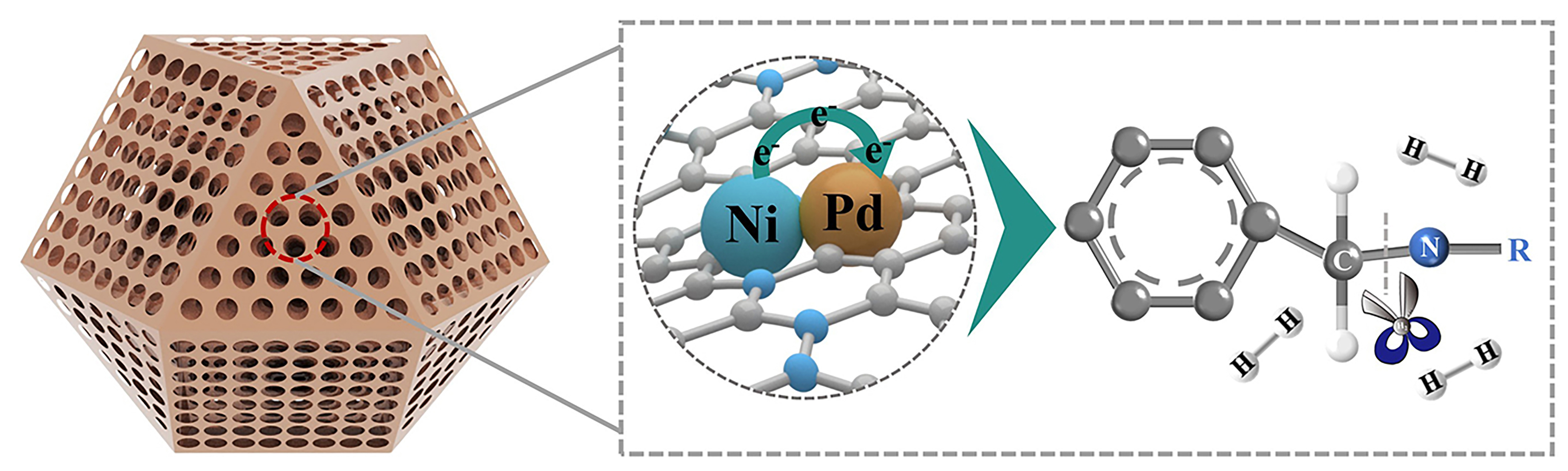
Hydrogenolytic debenzylation is a crucial step to restore the activity of the protected functional groups for targeted compounds while avoiding the formation of by-products. However, conventional methods suffer from low catalytic efficiency due to slow mass transport and/or severe leaching or agglomeration of active species. It highlighted the urgent need to develop catalysts that enable the coexistence of high mass transport and abundant active sites. In this work, as a proof of concept, a series of bimetallic PdM catalysts (M=Fe, Ni, Cu) anchored on hierarchically ordered porous skeletons were developed to enable the fast hydrogenolytic debenzylation of tetraacetyldibenzylhexaazaisowurtzitane (TADBIW) into tetraacetylhexaazaisowurtzitane (TAIW). We demonstrate that a hierarchically ordered macroporous N-doped carbon (DOM-NC) scaffold can simultaneously guarantee rapid diffusion of the bulky substrate (TADBIW) and stabilize electron-rich Pd(0) species when a trace amount of Ni is co-introduced. The resulting PdNi/DOM-NC catalyst delivers 97.3 % yield of TAIW within 2.5 h at an ultra-low Pd loading (Pd: TADBIW = 2.5 wt ‰) and retains >95 % activity after four cycles without detectable Pd loss. Structural and theoretical analyses reveal that (i) the 3DOM architecture shortens diffusion lengths, (ii) adjacent Ni atoms transfer electron density to Pd, increasing the surface Pd(0) fraction, and (iii) the Ni–Pd synergy lowers the H2 dissociation barrier and accelerates the rate-determining second debenzylation step. This study provides new insights into the rational design of highly efficient noble-metal-based heterogeneous catalysts and offers guidance for developing catalysts for other macromolecular hydrogenolysis reactions.




- Address: Fuzhou High & New Technology Industrial Zone, Shangjie, Minhou, Fuzhou, Fujian 350108, China
- Tel: (86)-591-63173769, 63173770
- E-mail: cjsc@fjirsm.ac.cn
CN 35–1112/TQ, ISSN 0254–5861, Online ISSN: 2949-768X Copyright @ 2022 Chinese Journal of Structural Chemistry-www.Chinese Journal of Structural Chemistry.net. All Rights Reserved 闽ICP备2022002645号-1