

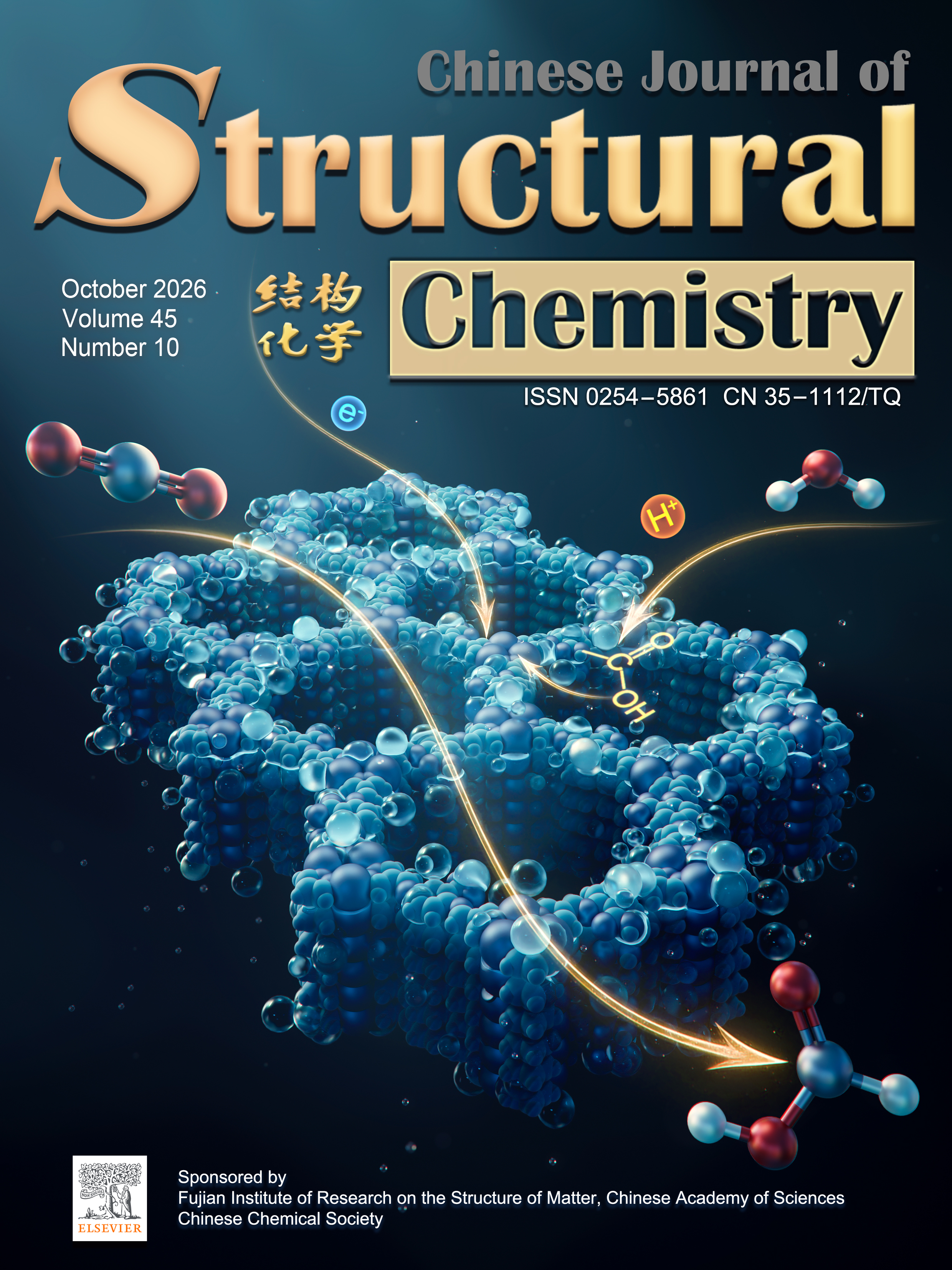
Cover Picture
Strengthening hydrophilicity in covalent-organic frameworks to boost CO2 photoreduction
Si-Zhan Feng†, Chong-Jiu Lu†, Ji-Hua Deng*, Tong-Bu Lu, Di-Chang Zhong* Submit a Manuscript
Strengthening hydrophilicity in covalent-organic frameworks to boost CO2 photoreduction
Si-Zhan Feng†, Chong-Jiu Lu†, Ji-Hua Deng*, Tong-Bu Lu, Di-Chang Zhong* Submit a Manuscript
Poisson-like anisotropic deformation in flexible COFs for highly selective hydrocarbon separation
Sen Liu, Maohuai Wang, Yang Shao, Shuxian Wei, Baojun Wei*, Xiaoqing Lu*
Chin. J. Struct. Chem., 2026, 45(10), 100985. DOI: 10.1016/j.cjsc.2026.100985
October 1, 2026
Flexible covalent organic frameworks; Poisson-like anisotropic deformation; Diffusion selectivity; Machine learning; Hydrocarbon separation
ABSTRACT
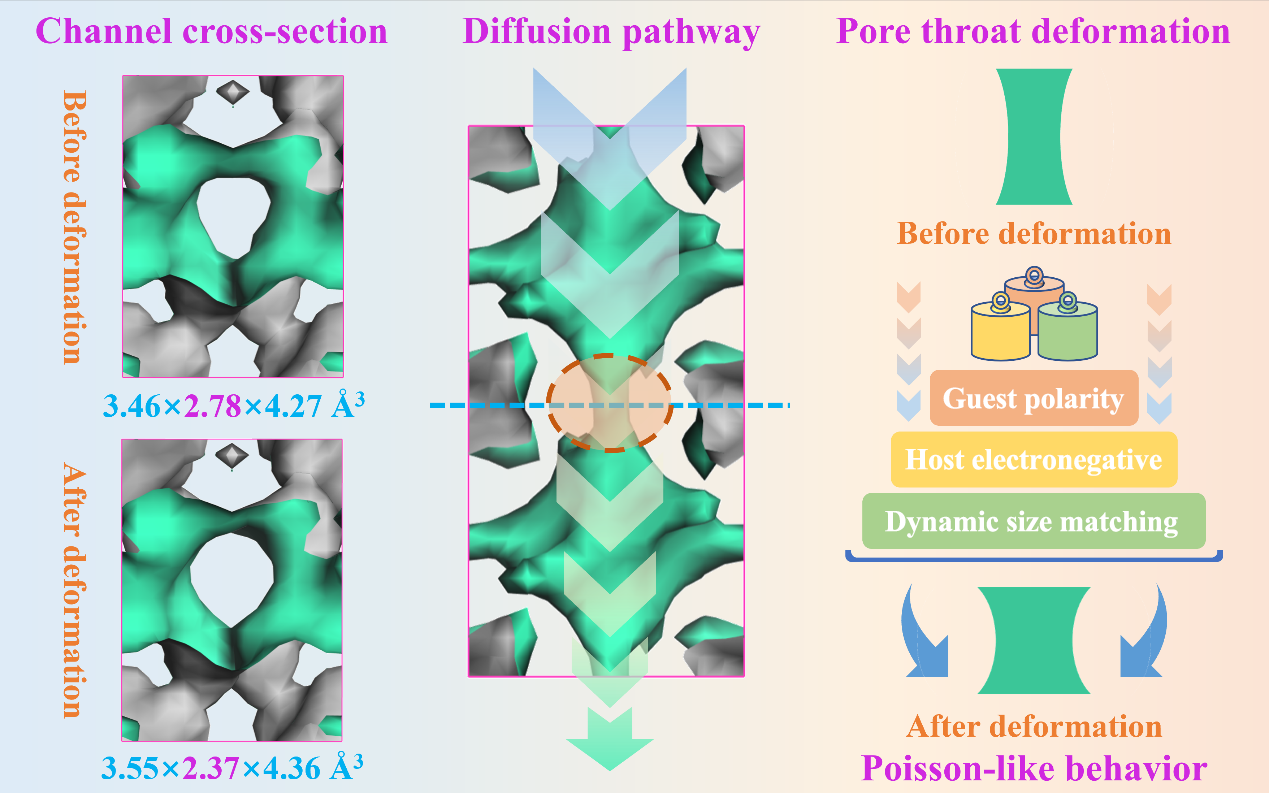
The synergistic engineering of structural flexibility in porous frameworks remains a primary frontier for achieving high-fidelity hydrocarbon separations. This study reports a systematic investigation into the adsorption and diffusion kinetics of C2H2, C2H4, C2H6, and CO2 within a series of functionalized 3D interpenetrated covalent organic frameworks (TFPM-PZIs). Grand Canonical Monte Carlo (GCMC) simulations of adsorption isotherms identify distinct structural flexibility in response to specific guest molecules. To elucidate the underlying physics, we integrated density functional theory (DFT), molecular dynamics (MD), and machine learning (ML) architectures to characterize a unique Poisson-like anisotropic deformation mechanism. Guest-induced framework reorganization manifests as transverse pore expansion along the a- and c-axes, coupled with longitudinal contraction along the diffusion-aligned b-axis. Quantitative analysis reveals that transport energy landscapes are co-regulated by guest quadrupole moments and framework electronegativity gradients. Specifically, –CF3 functionalization induces extreme diffusion barriers for C2H6 (181.01 kJ mol–1), resulting in a benchmark C2H2/C2H6 diffusion selectivity spanning 26 orders of magnitude (4.54×1027). The intrinsic physical logic of this anisotropic response is statistically validated via a random forest model (R2 > 0.959) and SHAP-based feature attribution, which confirms a negative correlation between b-axis dimensions and global pore limiting diameters (PLD). These findings establish a predictive paradigm for the AI-augmented design of stimuli-responsive materials capable of transcending the traditional selectivity-permeability trade-off in complex chemical separations.




- Address: Fuzhou High & New Technology Industrial Zone, Shangjie, Minhou, Fuzhou, Fujian 350108, China
- Tel: (86)-591-63173769, 63173770
- E-mail: cjsc@fjirsm.ac.cn
CN 35–1112/TQ, ISSN 0254–5861, Online ISSN: 2949-768X Copyright @ 2022 Chinese Journal of Structural Chemistry-www.Chinese Journal of Structural Chemistry.net. All Rights Reserved 闽ICP备2022002645号-1