

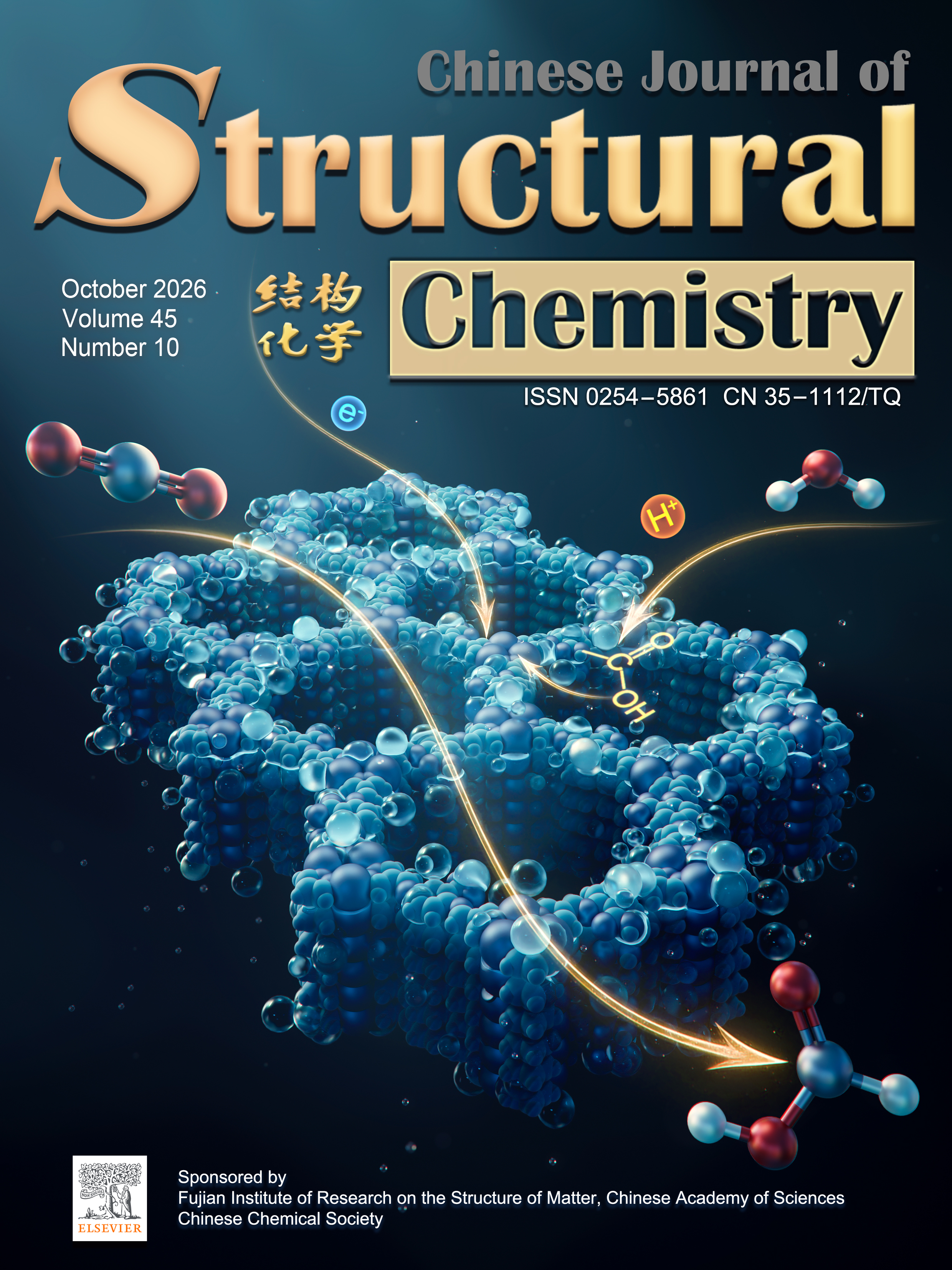
Cover Picture
Strengthening hydrophilicity in covalent-organic frameworks to boost CO2 photoreduction
Si-Zhan Feng†, Chong-Jiu Lu†, Ji-Hua Deng*, Tong-Bu Lu, Di-Chang Zhong* Submit a Manuscript
Strengthening hydrophilicity in covalent-organic frameworks to boost CO2 photoreduction
Si-Zhan Feng†, Chong-Jiu Lu†, Ji-Hua Deng*, Tong-Bu Lu, Di-Chang Zhong* Submit a Manuscript
A rapidly self-healing emissive europium cluster-based supramolecular framework via solvent-driven hierarchical co-assembly
Jianfeng Peng, Wenkang Guo, Zhida Song, Xuejie Zhang, Shuaijun Yang*, Zi-Yi Chen, Xuchuan Jiang*
Chin. J. Struct. Chem., 2026, 45(10), 100987. DOI: 10.1016/j.cjsc.2026.100987
October 1, 2026
Supramolecular assembly framework; Europium clusters; Hierarchical co-assembly; Self-healing; Luminescence
ABSTRACT
Supramolecular frameworks inherently combine superior solution processability with intrinsic self-healing capabilities, positioning them as promising candidates for functional materials. In this study, we achieve the hierarchical assembly of a highly emissive and self-healing cluster-based supramolecular framework (CSF-1) through the synergistic co-assembly of two distinct europium clusters. Starting from simple achiral ligands and Eu/Na salts, a mixture of europium complexes is first synthesized as the precursor. Remarkably, solvent-driven recrystallization of this mixture yields distinct architectures: dichloromethane produces crystals (THC) composed of hexanuclear triple-helical Eu/Na clusters (TH-a), whereas methanol drives the formation of CSF-1, a supramolecular framework composed of hexanuclear triple-helical Eu/Na clusters (TH-b) and propeller-shaped trinuclear Eu clusters (PS-1). Guided by a mortise-and-tenon mechanism, these chiral clusters co-assemble in racemic form to construct CSF-1, which features a two-dimensionally interconnected pore system with a porosity of 46.79%. CSF-1 exhibits exceptional structural dynamism, allowing precise tuning of its porosity and gas uptake capacities simply by varying the room-temperature activation time. Notably, the framework demonstrates rapid and facile self-healing: its thermally collapsed amorphous phase recovers crystallinity within just two minutes of methanol immersion. The versatility of this assembly strategy is further validated by constructing an analogous framework (CSF-2) using ethanol as the assembly medium. Collectively, this work establishes a rational design strategy for functional cluster-based supramolecular frameworks with tunable architectures, opening new avenues for applications in sensing and gas storage.





- Address: Fuzhou High & New Technology Industrial Zone, Shangjie, Minhou, Fuzhou, Fujian 350108, China
- Tel: (86)-591-63173769, 63173770
- E-mail: cjsc@fjirsm.ac.cn
CN 35–1112/TQ, ISSN 0254–5861, Online ISSN: 2949-768X Copyright @ 2022 Chinese Journal of Structural Chemistry-www.Chinese Journal of Structural Chemistry.net. All Rights Reserved 闽ICP备2022002645号-1