


Cover Picture
Recent progress in amorphous metal halides for optoelectronics
Shun-Shun Li, Kaifeng Wu*, Pengfei Cheng* Submit a Manuscript
Recent progress in amorphous metal halides for optoelectronics
Shun-Shun Li, Kaifeng Wu*, Pengfei Cheng* Submit a Manuscript
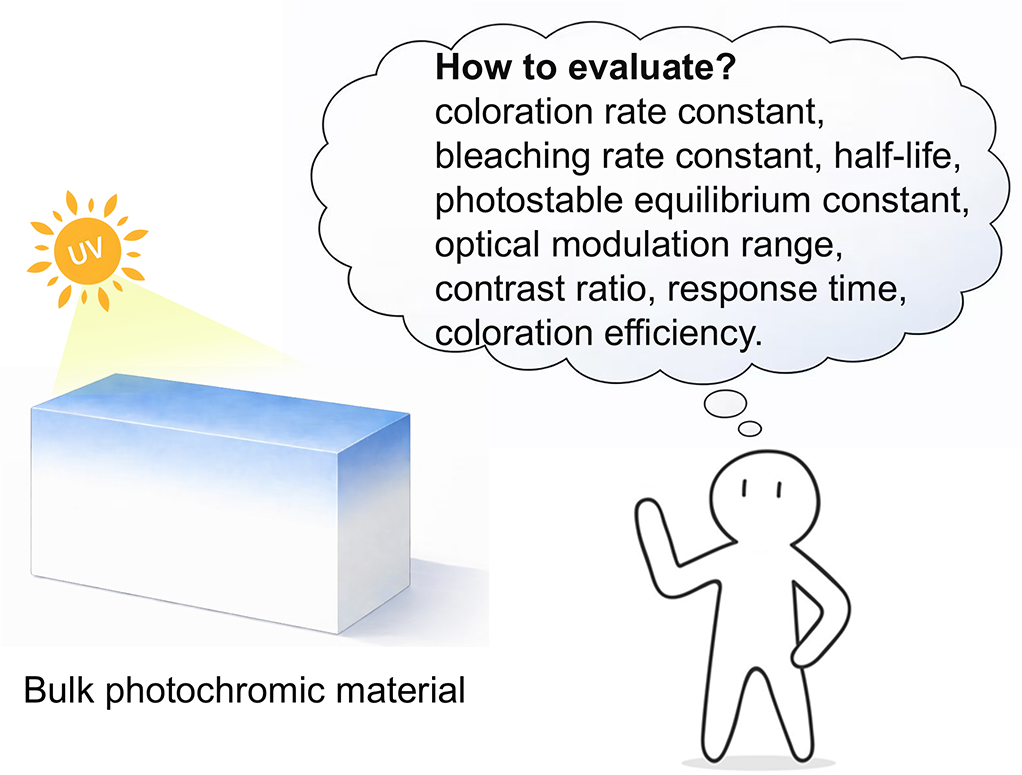
Evaluation of bulk photochromic performance: A case study of RA-Ln-PONb
Wei-Chao Yang, Yi-Ying Li, Cai Sun*
Chin. J. Struct. Chem., 2026, 45(7), 100915. DOI: 10.1016/j.cjsc.2026.100915
July 1, 2026
Photochromism; Bulk materials; Performance evaluation
ABSTRACT
The long-standing absence of standardized assessment protocols for bulk photochromic materials has hindered reliable performance comparisons across studies reported by different research groups. Here, we introduce a standardized testing protocol along with a set of nine key parameters—coloration rate constant, bleaching rate constant, half-life, photostable equilibrium constant, optical modulation range, contrast ratio, response time, cycling stability and coloration efficiency—for evaluating the performance of bulk photochromic materials. Using photochromic inorganic-organic hybrid phosphonate-lanthanide-polyoxoniobates (RA-Ln-PONb, Ln = Dy, Eu, Lu; RA = risedronic acid) as a case study, we successfully validate the rationality of this protocol and demonstrate that these parameters collectively enable a comprehensive, multi-dimensional assessment of photochromic performance. This work provides an important methodological foundation for comparative studies of different bulk photochromic materials.




- Address: Fuzhou High & New Technology Industrial Zone, Shangjie, Minhou, Fuzhou, Fujian 350108, China
- Tel: (86)-591-63173769, 63173770
- E-mail: cjsc@fjirsm.ac.cn
CN 35–1112/TQ, ISSN 0254–5861, Online ISSN: 2949-768X Copyright @ 2022 Chinese Journal of Structural Chemistry-www.Chinese Journal of Structural Chemistry.net. All Rights Reserved 闽ICP备2022002645号-1