

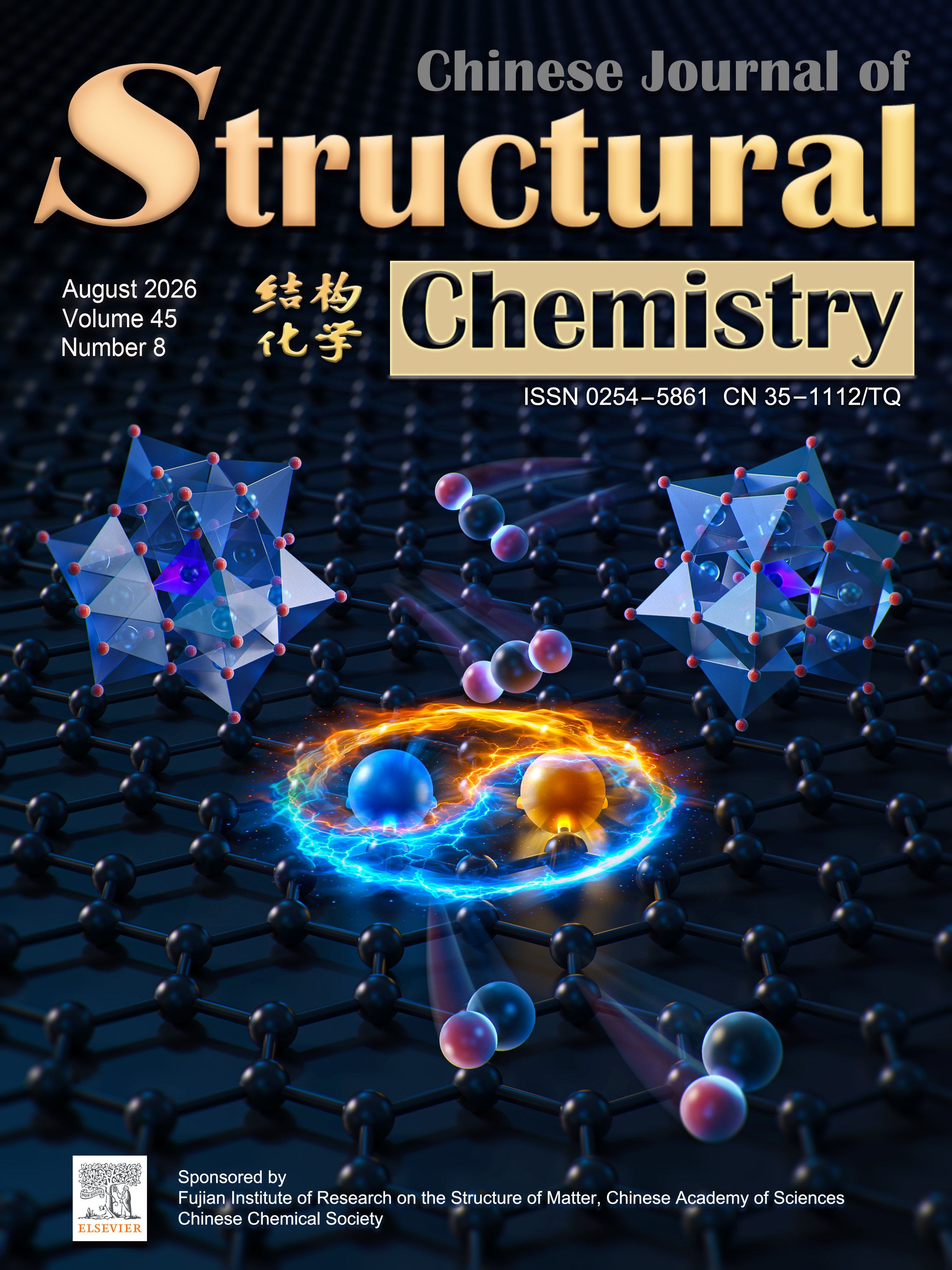
Cover Picture
Boosting efficient electrocatalytic CO2 reduction by two-dimensional polyoxometalate@metal-organic framework composites with asymmetric sites
Teng-Fei Yao, Guo-Ping Yang*, Yao-Yu Wang Submit a Manuscript
Boosting efficient electrocatalytic CO2 reduction by two-dimensional polyoxometalate@metal-organic framework composites with asymmetric sites
Teng-Fei Yao, Guo-Ping Yang*, Yao-Yu Wang Submit a Manuscript
Recent progress on multi-synergistic charge-transfer strategies for efficient triplet up-conversion in narrowband MR-TADF emitters
Zeng-Jiang Yue, Zheng-Yin Du*, Xunwen Xiao*, Xu-Feng Luo*
Chin. J. Struct. Chem., 2026, 45(8), 100945. DOI: 10.1016/j.cjsc.2026.100945
August 1, 2026
Multiple-resonance; Thermally activated delayed fluorescence; CT modulation; Synergistic channel interactions; OLED
ABSTRACT
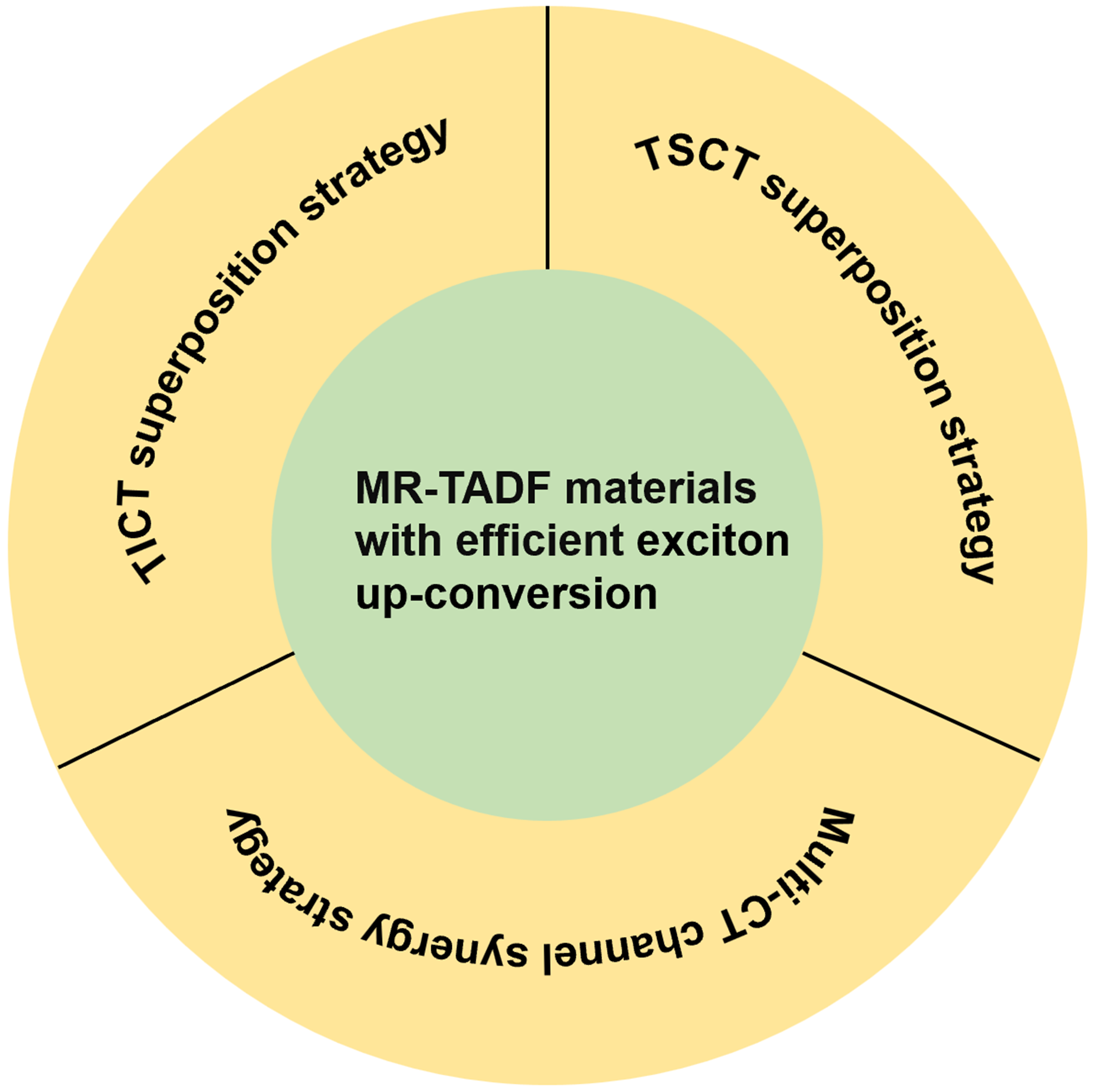
Multiple Resonance Thermally Activated Delayed Fluorescence (MR-TADF) materials have attracted considerable attention due to their attractive narrowband emission characteristics, high luminescence efficiency, and tunable emission colors, showing great potential for advancing narrowband-emission organic light-emitting diodes (OLEDs). To date, research in this field has progressed beyond simply adjusting emission colors, with nearly full-color narrowband emission already achieved. However, the intrinsic molecular design of MR-TADF materials requires a balance between charge-transfer (CT) and local excited (LE) states, resulting in triplet upconversion efficiencies that are generally lower than those of conventional CT-dominated TADF materials, thereby limiting their further application in OLEDs. Currently, several strategies involving synergistic channel interactions have been proposed to optimize the reverse intersystem crossing process, which can be categorized into approaches based on modulated twisted intramolecular charge transfer (TICT), through-space charge transfer (TSCT), and multiple CT channel coupling. This review systematically summarizes the molecular design strategies of MR-TADF materials based on different CT modulation approaches and their progress in OLED applications. Furthermore, it discusses the remaining challenges in this research area and provides an outlook on future development. We believe this review will contribute to accelerating the industrialization of narrowband-emission OLEDs.




- Address: Fuzhou High & New Technology Industrial Zone, Shangjie, Minhou, Fuzhou, Fujian 350108, China
- Tel: (86)-591-63173769, 63173770
- E-mail: cjsc@fjirsm.ac.cn
CN 35–1112/TQ, ISSN 0254–5861, Online ISSN: 2949-768X Copyright @ 2022 Chinese Journal of Structural Chemistry-www.Chinese Journal of Structural Chemistry.net. All Rights Reserved 闽ICP备2022002645号-1