

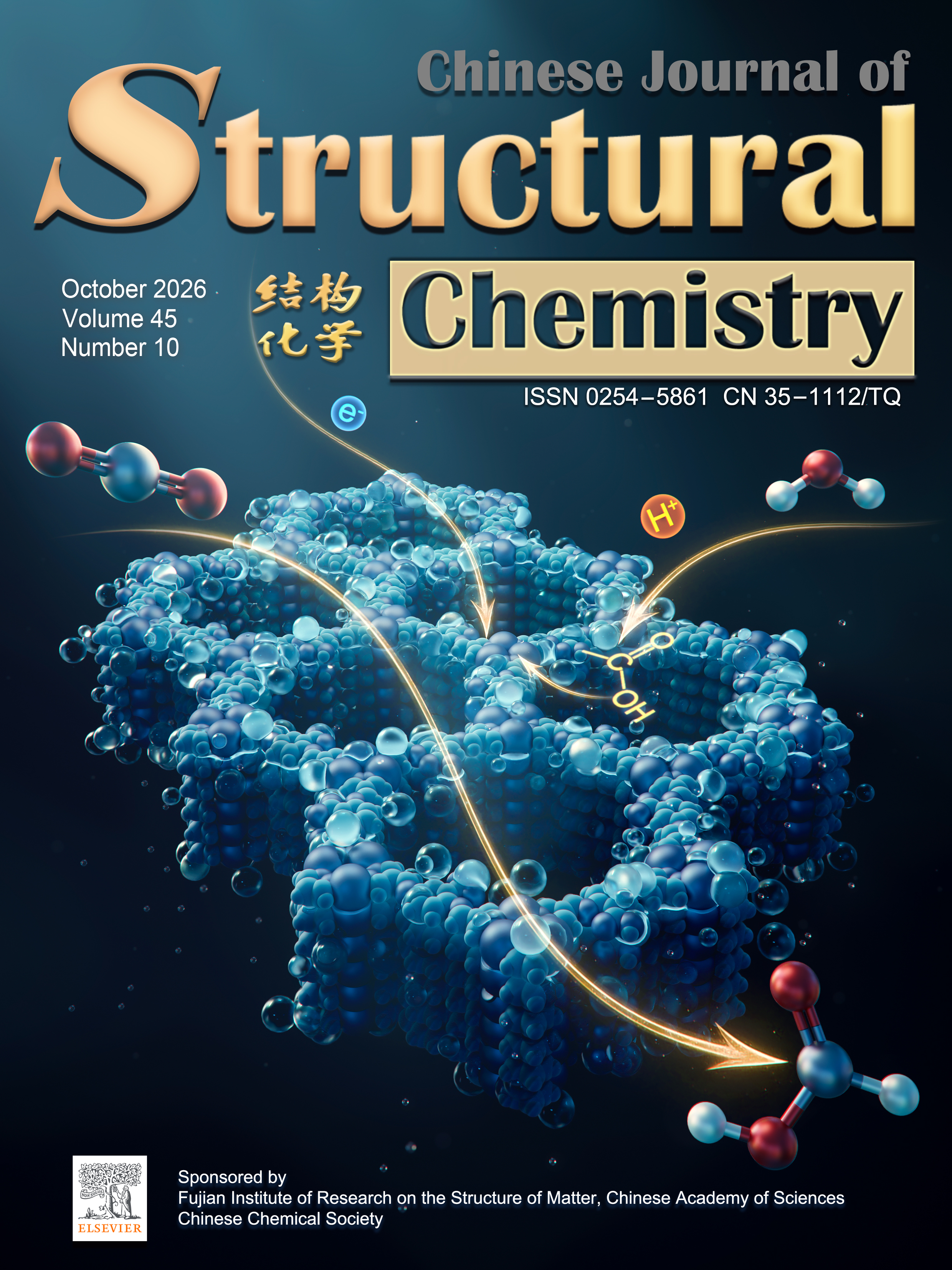
Cover Picture
Strengthening hydrophilicity in covalent-organic frameworks to boost CO2 photoreduction
Si-Zhan Feng†, Chong-Jiu Lu†, Ji-Hua Deng*, Tong-Bu Lu, Di-Chang Zhong* Submit a Manuscript
Strengthening hydrophilicity in covalent-organic frameworks to boost CO2 photoreduction
Si-Zhan Feng†, Chong-Jiu Lu†, Ji-Hua Deng*, Tong-Bu Lu, Di-Chang Zhong* Submit a Manuscript
S-scheme Al6Si2O13/ZnWO4 nanocomposites for photocatalytic degradation of dichlorvos and triazophos/chlorpyrifos mixtures
Jinlei Ye, Guoyuan Xiong, Zuhan Wang, Zhen Li*, Jinfeng Zhang*
Chin. J. Struct. Chem., 2026, 45(10), 100999. DOI: 10.1016/j.cjsc.2026.100999
October 1, 2026
Organophosphorus pesticides; Solar light; Photocatalysts; S-scheme
ABSTRACT
Organophosphorus pesticides, such as dichlorvos (DDVP) and triazophos/chlorpyrifos (TAP/CPF), persist in water, soil, and agricultural products, posing potential risks to ecosystems and human health. Therefore, efficient and stable photocatalytic removal technologies are urgently needed. To overcome the low separation efficiency of photogenerated charge carriers, sluggish interfacial charge transfer, and poor stability of single-component photocatalysts, Al6Si2O13 (ASO)/ZnWO4 (ZWO) nanocomposites were designed and constructed in this study. Combined with in situ X-ray photoelectron spectroscopy, femtosecond transient absorption spectroscopy, Kelvin probe force microscopy, and theoretical calculations, the heterojunction structure, charge-transfer behavior, and photocatalytic mechanism were systematically elucidated. The results showed that after 120 min of simulated solar light irradiation, the removal efficiencies of ZWO, ASO, and 40-ASO/ZWO for DDVP were 50.3%, 43.6%, and 70.5%, respectively, while those for TAP/CPF were 54.4%, 47.2%, and 74.8%, respectively, indicating the superior photocatalytic activity of 40-ASO/ZWO with an S-scheme heterojunction. After five cycles under simulated solar light irradiation, corresponding to a total reaction duration of 600 min, ZWO, ASO, and 40-ASO/ZWO retained 91.8%, 92.7%, and 95.7% of their initial removal efficiency in the DDVP system, and 91.0%, 92.6%, and 98.5%, respectively, in the TAP/CPF system, demonstrating the better cycling stability of 40-ASO/ZWO for both organophosphorus pesticides. This enhanced performance was mainly attributed to the S-scheme heterojunction, which promoted directional interfacial charge separation and transfer, suppressed electron-hole recombination, and improved photocatalytic activity and stability while preserving strong redox capability. This study provides a theoretical basis for food safety, environmental protection, and public health.





- Address: Fuzhou High & New Technology Industrial Zone, Shangjie, Minhou, Fuzhou, Fujian 350108, China
- Tel: (86)-591-63173769, 63173770
- E-mail: cjsc@fjirsm.ac.cn
CN 35–1112/TQ, ISSN 0254–5861, Online ISSN: 2949-768X Copyright @ 2022 Chinese Journal of Structural Chemistry-www.Chinese Journal of Structural Chemistry.net. All Rights Reserved 闽ICP备2022002645号-1