

Just Accepted
Just Accepted Articles have been posted online after technical editing and typesetting for immediate view. The final edited version with page numbers will appear in the Current Issue soon.
Submit a Manuscript

Dual-channel optical decoupling of photochromism and room-temperature phosphorescence via ground-state charge transfer for non-destructive anti-counterfeiting
Yang Hua, Chun-Jie Liu, Yang-Tao Yu, Hang-Hang Guo, Ning-Ning Zhang*, Li Li*
https://doi.org/10.1016/j.cjsc.2026.101008
Charge-transfer; Electron-transfer; Non-destructive anti-counterfeiting; Room-temperature-phosphorescence; Photochromism
ABSTRACT
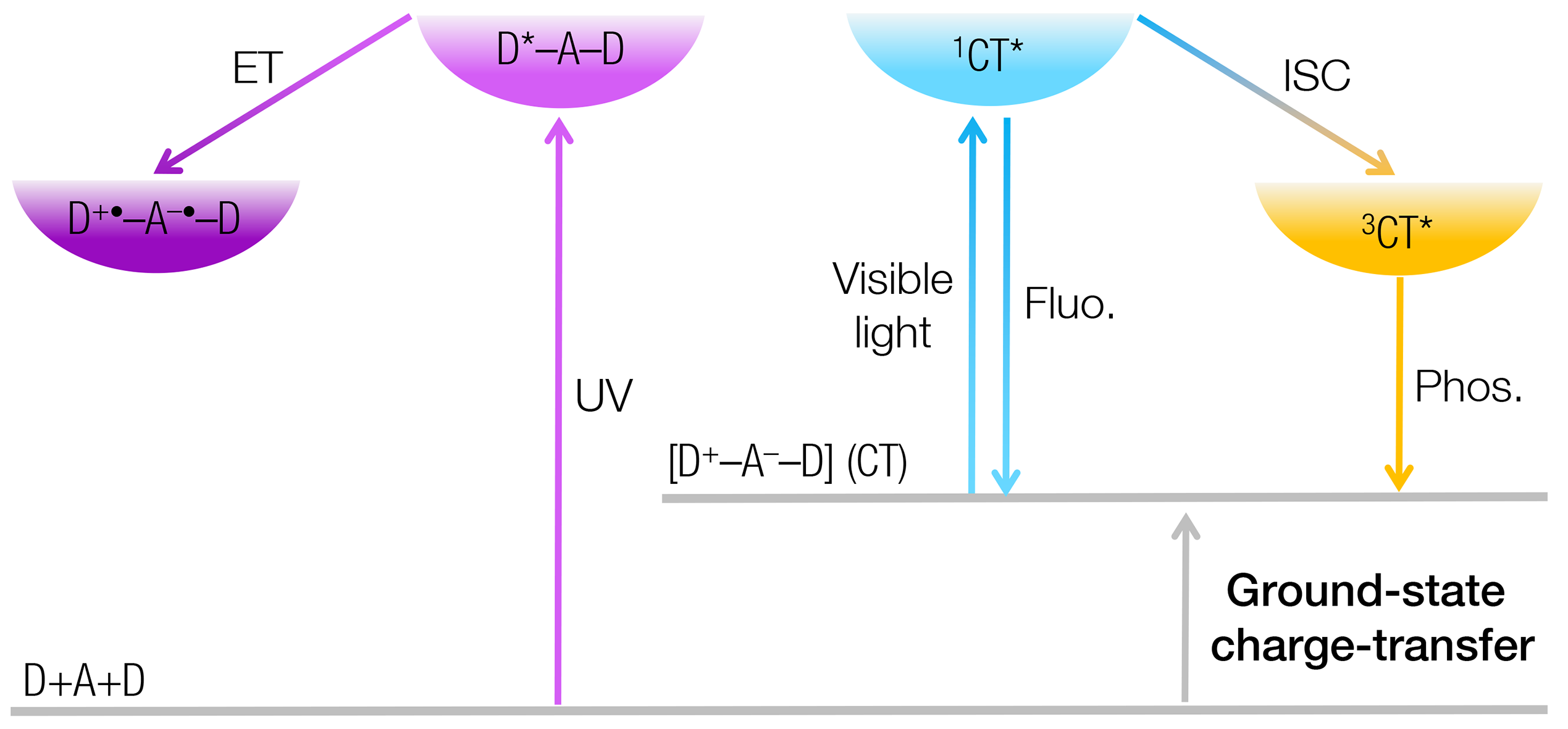
Advanced anti-counterfeiting systems require both continuous non-destructive readout for security certification and dynamic response capabilities to effectively prevent counterfeiting. Materials with dual photochromic and room temperature phosphorescence (PRTP) properties hold promise for advanced anti-counterfeiting, owing to the dynamic variation in both their inherent color and luminescent emission. However, a critical limitation in most existing PRTP systems lies in the identical excitation source required for both photochromism activation and RTP emission, leading to concurrent photochromism that suppresses phosphorescence and impedes continuous non-destructive readout. To address this limitation, this work proposes a decoupling strategy to separate photochromism and RTP into independent optical channels via ground-state charge transfer (CT). The strategy is validated by two reported metalloviologen compounds, whose structure and narrow HOMO–LUMO gap facilitate efficient ground-state CT, and thus create an independent visible-light-activated RTP pathway, while photochromism remains exclusively responsive to UV light. This breakthrough successfully resolves the issue of non-destructive readout in PRTP materials, thereby fulfilling a critical requirement for advanced anti-counterfeiting systems.




- Address: Fuzhou High & New Technology Industrial Zone, Shangjie, Minhou, Fuzhou, Fujian 350108, China
- Tel: (86)-591-63173769, 63173770
- E-mail: cjsc@fjirsm.ac.cn
CN 35–1112/TQ, ISSN 0254–5861, Online ISSN: 2949-768X Copyright @ 2022 Chinese Journal of Structural Chemistry-www.Chinese Journal of Structural Chemistry.net. All Rights Reserved 闽ICP备2022002645号-1