

Just Accepted

Ji-Long Shi, Xianjun Lang*
https://doi.org/10.1016/j.cjsc.2026.101017
ABSTRACT
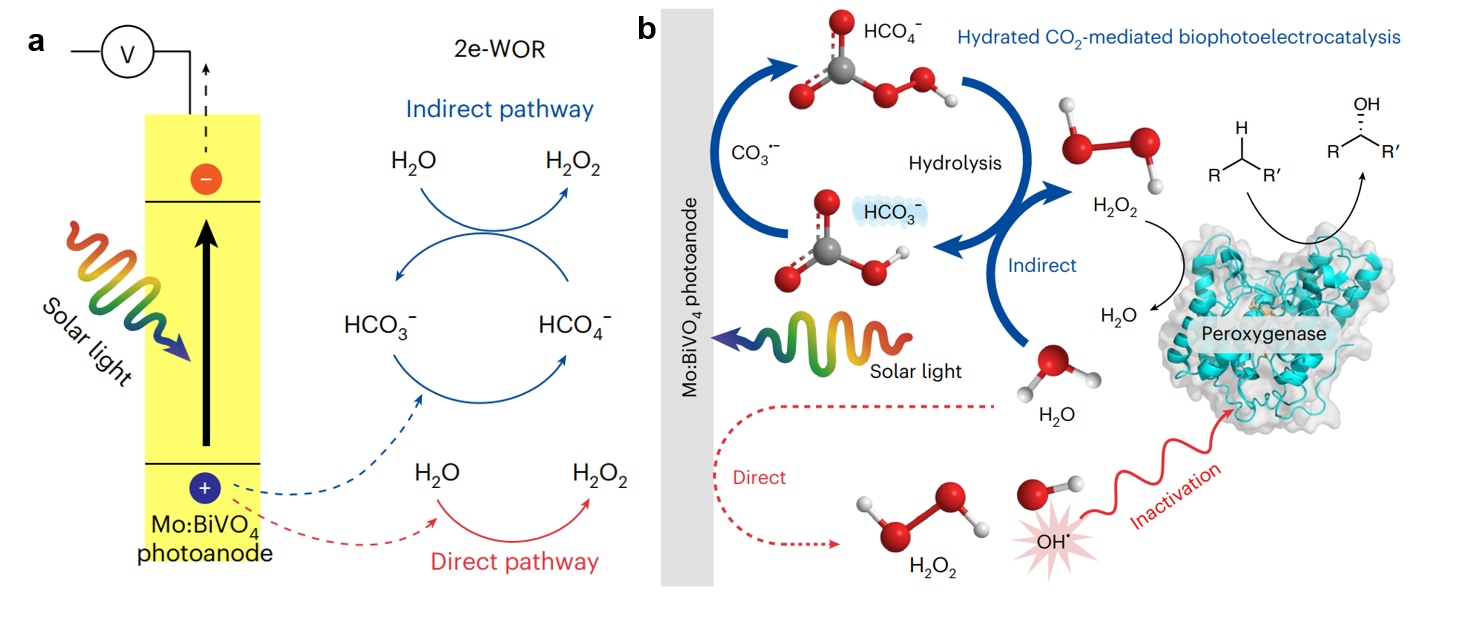
In summary, Park and co-workers
have merged Mo:BiVO4 photoelectrocatalysis with enzyme catalysis,
using HCO3− as a redox mediator, to achieve
stereoselective oxyfunctionalization of C–H bonds.Given the versatility of
enzymes in oxidation reactions, photoelectrocatalysis holds considerable
untapped potential. As in PSII, redox mediators are key to the success of this
scheme, as they relieve the oxidative pressure on the enzymes. In short, redox
mediators — whether organic or inorganic — link photoinduced electron transfer
with the best of redox catalysis across domains, turning solar energy into a
tool for challenging and impactful selective organic transformations. However,
precise spatio-temporal control of local concentration of H2O2 is critical to preventing gradual oxidative deactivation, thereby ensuring the
long-term stability of the enzyme under continuous photoelectrochemical
operation. Looking ahead, expanding the repertoire of robust redox mediators
and engineering more resilient oxygenative biocatalysts could unlock a range of
valuable transformations.




- Address: Fuzhou High & New Technology Industrial Zone, Shangjie, Minhou, Fuzhou, Fujian 350108, China
- Tel: (86)-591-63173769, 63173770
- E-mail: cjsc@fjirsm.ac.cn