

Just Accepted
Just Accepted Articles have been posted online after technical editing and typesetting for immediate view. The final edited version with page numbers will appear in the Current Issue soon.
Submit a Manuscript

Boosting CO oxidation via CuO/TiO2 heterojunction: The key role of enhanced lattice oxygen migration
Zhiguo Wang+, Hui-Juan Wang+, Chao Peng, Tong Yang, Wen Du*, Lang Chen*, Shuang-Feng Yin*
https://doi.org/10.1016/j.cjsc.2026.101042
CO oxidation; CuO/TiO2 heterojunction; Lattice oxygen migration; Interfacial charge distribution
ABSTRACT
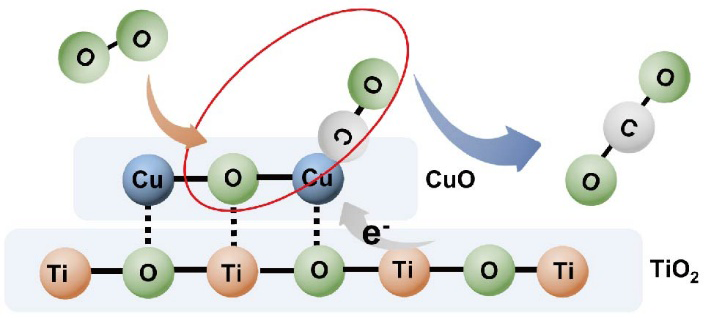
Catalytic oxidation of CO serves as a pivotal technology for environmental remediation, extensively employed in the purification of automotive exhaust and industrial emissions. Nevertheless, the development of catalysts that maintain high activity at low temperatures while remaining independent of noble metals continues to pose a challenge. In this study, a CuO/TiO2 heterojunction catalyst (denoted as CuTi-MMO-T, T = 300, 400, and 500 °C) was successfully synthesized through controlled-temperature calcination of a CuTi-LDH precursor. The optimized CuTi-MMO-400 achieved complete CO conversion at 150 °C under 41,200 mL g-1 h-1. The catalyst maintained 100% CO removal over a broad temperature range of 150–400 °C. The synergistic interfacial effects between CuO and TiO2 significantly promoted CO adsorption on CuO and facilitated lattice oxygen migration, thereby enabling efficient CO oxidation via the Mars–van Krevelen (MvK) mechanism. This work provides mechanistic insight into the activation of lattice oxygen in heterojunction systems, and further lays both a theoretical foundation and a practical design pathway for developing high-performance, noble-metal-free catalysts for low-temperature carbon monoxide oxidation.




- Address: Fuzhou High & New Technology Industrial Zone, Shangjie, Minhou, Fuzhou, Fujian 350108, China
- Tel: (86)-591-63173769, 63173770
- E-mail: cjsc@fjirsm.ac.cn
CN 35–1112/TQ, ISSN 0254–5861, Online ISSN: 2949-768X Copyright @ 2022 Chinese Journal of Structural Chemistry-www.Chinese Journal of Structural Chemistry.net. All Rights Reserved 闽ICP备2022002645号-1