

Just Accepted
Just Accepted Articles have been posted online after technical editing and typesetting for immediate view. The final edited version with page numbers will appear in the Current Issue soon.
Submit a Manuscript

Local structure and dissolution mechanism of ThF4 in FLiBe molten salts
Jianchao Sun, Weijie Hua, Junheng Yingsu, Miao Shen, Xiaobin Fu*, Yuan Qian*
https://doi.org/10.1016/j.cjsc.2026.101046
Molten salts; ThF4 dissolution; Ionic coordination; High-temperature NMR
ABSTRACT
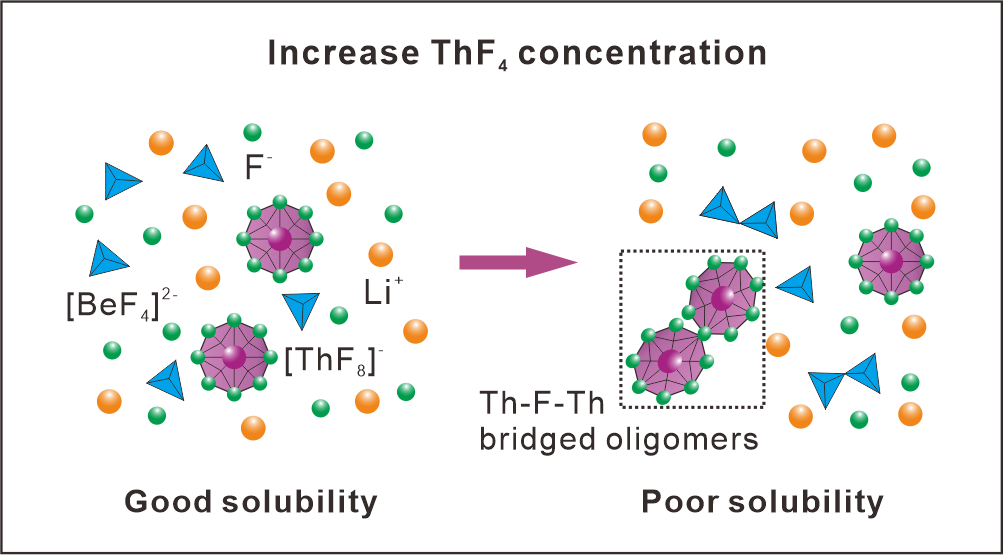
TMSR represents a promising pathway for sustainable nuclear energy, where ThF4 serves as a fuel dissolved in fluoride carrier salts such as FLiBe. However, the solubility and structural behavior of ThF4 in FLiBe remain poorly understood. This study integrates HT-NMR, ss-NMR, and AIMD simulations to systematically investigate the coordination structure and dissolution mechanisms of ThF4 in FLiBe melts. The results show that at low ThF4 concentration (1.2 mol%), Th4+ predominantly exists as isolated coordinated ThF84- complexes with an average Th-F coordination number of approximately 8.0. As the ThF4 concentration increases, the average Th-Th coordination number rises from nearly 0 to approximately 2.0, indicating the progressive formation of fluoride-bridged Th-F-Th oligomers. An independent 19F resonance at +43 ppm is directly observed in the molten state at 600 °C, providing experimental evidence for poorly soluble Th-F-Th oligomeric species that do not participate in rapid ionic exchange. Structural analysis indicates that the formation of these oligomers originates from the depletion of free F- ions and discrete BeF42- units, while the weakened spatial separation effect of Li+ ions further promotes Th-F-Th bridge formation. Concentration-dependent ss-NMR measurements reveal that the characteristic signals of these bridged species emerge above approximately 5.5 mol% ThF4, accompanied by new resonances at -3, 20, and 50 ppm. These oligomeric species exhibit poor solubility, which limits the dissolution of ThF4 in FLiBe. These findings elucidate a molecular-scale mechanism underlying the limited solubility of ThF4 in FLiBe, which offers a valuable method for investigating the structural behavior of other actinide fuels and fission products in molten salts.




- Address: Fuzhou High & New Technology Industrial Zone, Shangjie, Minhou, Fuzhou, Fujian 350108, China
- Tel: (86)-591-63173769, 63173770
- E-mail: cjsc@fjirsm.ac.cn
CN 35–1112/TQ, ISSN 0254–5861, Online ISSN: 2949-768X Copyright @ 2022 Chinese Journal of Structural Chemistry-www.Chinese Journal of Structural Chemistry.net. All Rights Reserved 闽ICP备2022002645号-1