

Just Accepted
Just Accepted Articles have been posted online after technical editing and typesetting for immediate view. The final edited version with page numbers will appear in the Current Issue soon.
Submit a Manuscript

Coverage-driven activity prediction and multiobjective optimization of high-entropy alloy catalysts for hydrogen evolution
Zhong-Zhang Shi, Hang-Biao Lv, Shisheng Zheng*, Jian-Feng Li*
https://doi.org/10.1016/j.cjsc.2026.101051
Hydrogen evolution reaction; High-entropy alloy; Hydrogen coverage; Multiobjective optimization; Machine learning
ABSTRACT
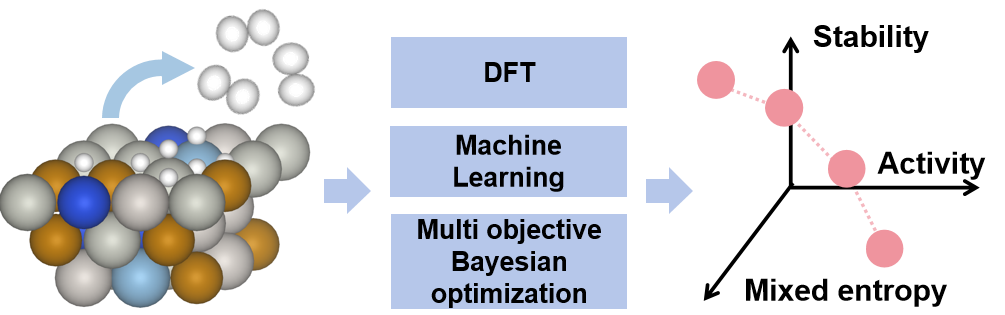
High-entropy alloys (HEAs) have emerged as promising electrocatalysts for the hydrogen evolution reaction (HER) due to their highly tunable compositional and electronic structures. However, conventional HER screening strategies based on single-site hydrogen adsorption free energies fail to capture the strong coverage effects, local-site heterogeneity, and potential-dependent adsorption behavior inherent to HEA surfaces. Here, we develop a coverage-driven machine learning framework for the multiobjective optimization of HEA catalysts for HER. The framework explicitly samples hydrogen-covered surface configurations across different coverages and employs a message passing atomic cluster expansion (MACE) model to rapidly predict coverage-dependent adsorption energetics. By integrating hydrogen coverage, lateral H–H interactions, and neighboring reactive hydrogen-pair statistics, a potential-dependent HER reaction probability model is constructed. Combined with Bayesian multiobjective optimization, the framework simultaneously optimizes catalytic activity, structural stability, and configurational mixing entropy within a ten-element compositional space. The results reveal that hydrogen coverage significantly reshapes activity trends across HEA compositions and enables the identification of Pareto-optimal catalysts balancing activity, stability, and compositional complexity. This work provides a realistic working-state paradigm for the discovery of complex electrocatalytic materials.




- Address: Fuzhou High & New Technology Industrial Zone, Shangjie, Minhou, Fuzhou, Fujian 350108, China
- Tel: (86)-591-63173769, 63173770
- E-mail: cjsc@fjirsm.ac.cn
CN 35–1112/TQ, ISSN 0254–5861, Online ISSN: 2949-768X Copyright @ 2022 Chinese Journal of Structural Chemistry-www.Chinese Journal of Structural Chemistry.net. All Rights Reserved 闽ICP备2022002645号-1