

Just Accepted
Just Accepted Articles have been posted online after technical editing and typesetting for immediate view. The final edited version with page numbers will appear in the Current Issue soon.
Submit a Manuscript

Dual-conformation stimuli-responsive material and its high contrast imaging
Jingming Zhou+, Xia Wang+, Hongmei Wu+, Hong Chen, Wei Liu, Shijie Liu, Weiwei Zhang, Tong Wu, Xinli Wang, Zujin Zhao*, Shijie Zhen*, Lijun Xie*
https://doi.org/10.1016/j.cjsc.2026.101050
Conformational isomerism; Spatial arrangement; Dimethylamino protonation; Multi-stimuli responsiveness; High contrast chromism
ABSTRACT
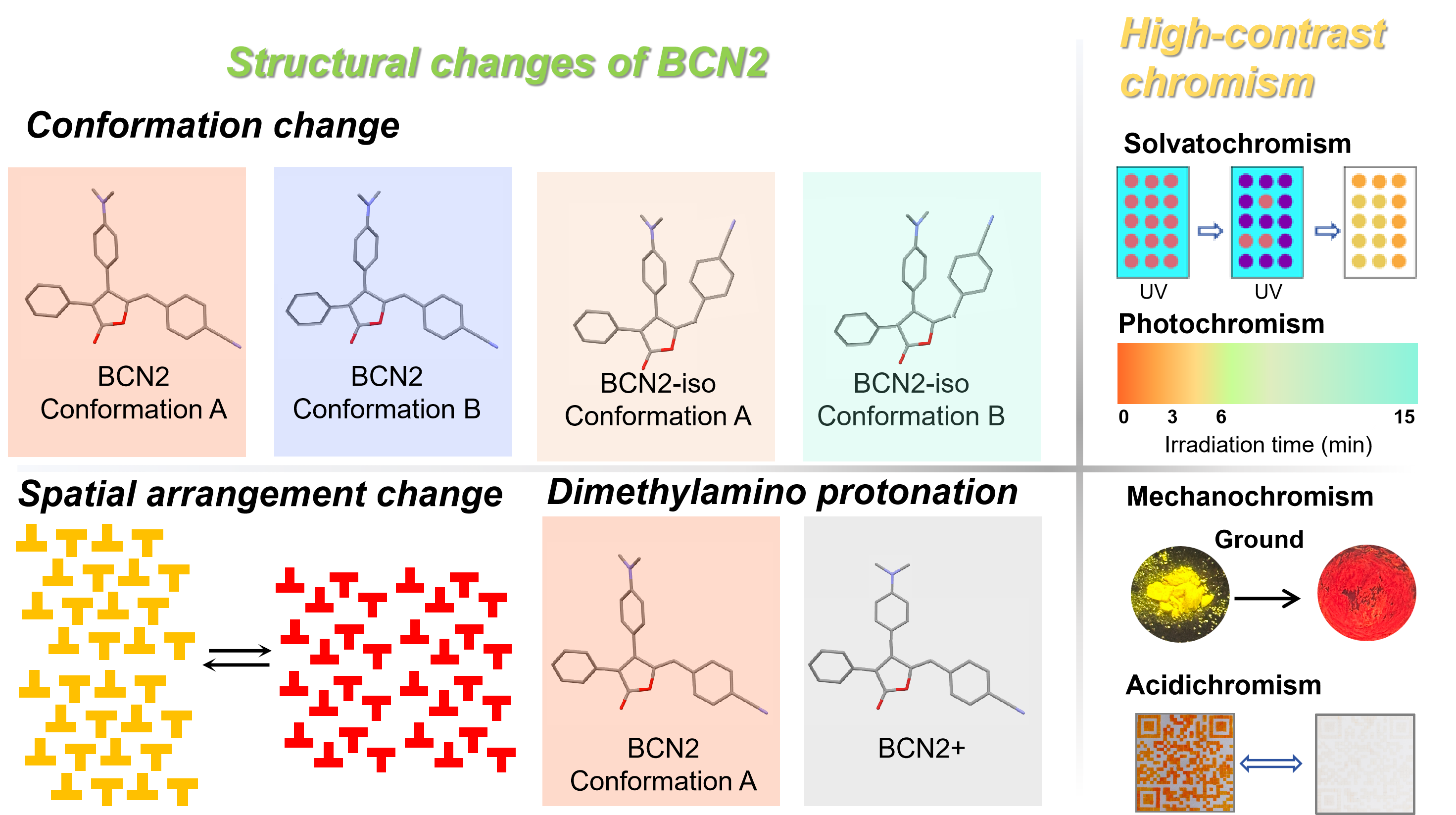
Organic stimuli-responsive chromic materials hold great promise in the fields of information storage, anti-counterfeiting, sensing, and bioimaging. It is of great research significance to enhance the contrast of multi-stimuli-responsive chromic materials through molecular design and elucidating the origins of their high-contrast chromism are of great research significance. In this study, based on a fluorescent scaffold with four conjugated rings derived from rofecoxib, the originally aggregation-caused quenching (ACQ)-active BCN1 was transformed into BCN2, which exhibits aggregation-induced emission (AIE) and multi-stimuli responsive properties, by switching the positions of the donor and acceptor units within the molecule. The multi-stimuli responsiveness of BCN2 originates from three main aspects: (1) conformationally, BCN2 possesses low rotational energy barriers and two coexisting low-energy conformers, and the interconversion between these two conformers under stimulation accounts for its photochromic or solvatochromic behavior. (2) The packing arrangement of BCN2 crystal is susceptible to external mechanical stimuli, leading to high-contrast mechanochromism (emission wavelength shifts exceed 100 nm). (3) The proton sensitivity of the dimethylamino group is the main cause of acidochromism. Thanks to the AIE effect and multi-stimuli responsive characteristics, BCN2 demonstrates potential for applications such as acid sensing, anti-counterfeiting inks, and smart optical encoding. This work focuses on elucidating the mechanism of dual conformations and low-energy barrier rotors in BCN2, which provides a reasonable explanation for the properties of our previously reported rofecoxib-based fluorescent materials and offers a new design strategy for developing high-contrast, multi-stimuli responsive chromic materials in the future.




- Address: Fuzhou High & New Technology Industrial Zone, Shangjie, Minhou, Fuzhou, Fujian 350108, China
- Tel: (86)-591-63173769, 63173770
- E-mail: cjsc@fjirsm.ac.cn
CN 35–1112/TQ, ISSN 0254–5861, Online ISSN: 2949-768X Copyright @ 2022 Chinese Journal of Structural Chemistry-www.Chinese Journal of Structural Chemistry.net. All Rights Reserved 闽ICP备2022002645号-1