

Just Accepted
Just Accepted Articles have been posted online after technical editing and typesetting for immediate view. The final edited version with page numbers will appear in the Current Issue soon.
Submit a Manuscript

Irreversible bandgap reduction of Cu3TeO6 via pressure engineering
Qiqi Su, Ying Chen, Bingqian Shi, Di Mai, Rucheng Dai, Sergey Ivanov, Matthias Weil, Zengming Zhang, Huayun Geng*, Peter Lazor*, Lei Liu*
https://doi.org/10.1016/j.cjsc.2026.101057
Pressure engineering; Bandgap reduction; Structural phase transition; Jahn-Teller effect; Tellurate oxides
ABSTRACT
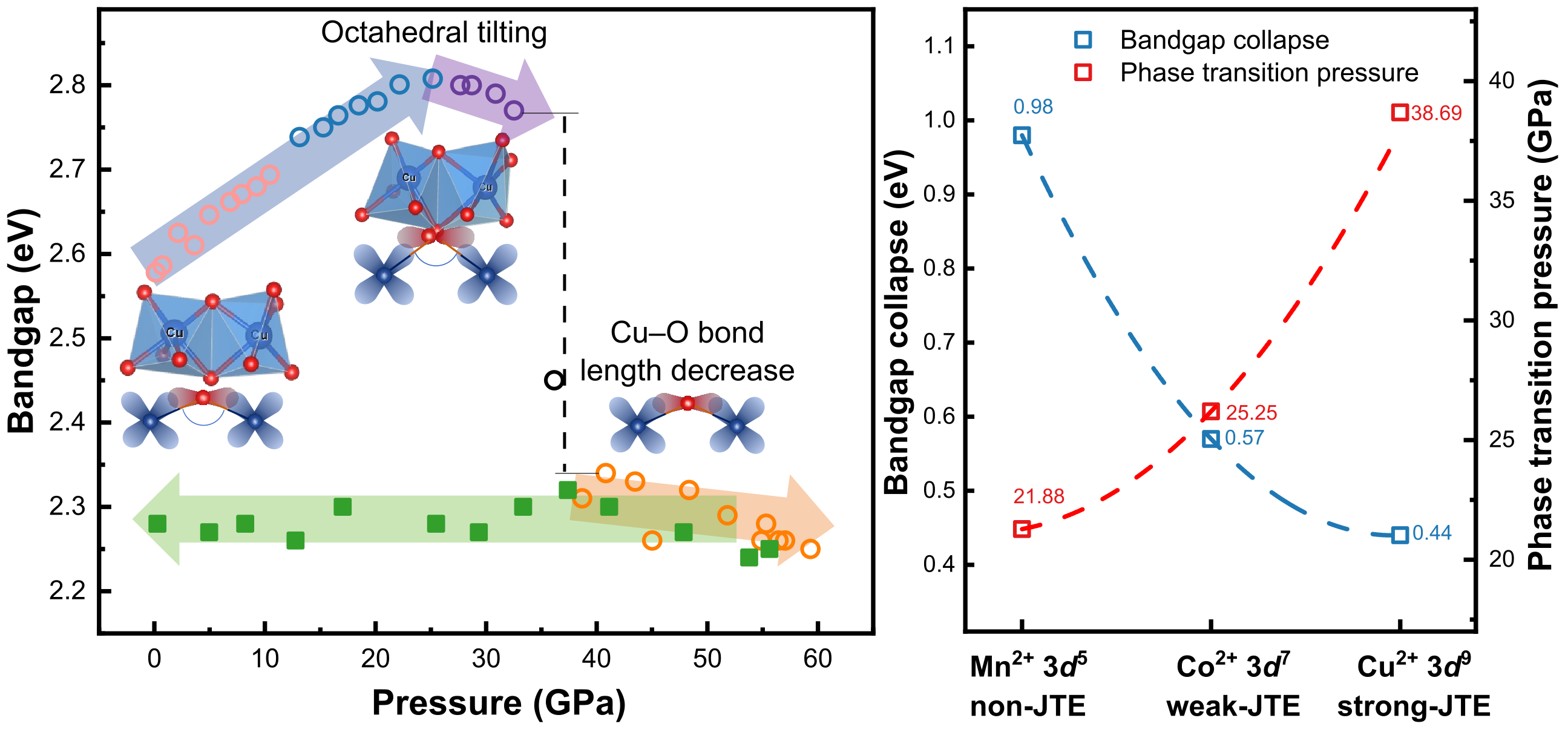
The growing demand for sustainable energy has intensified the search for efficient photovoltaic materials with suitable bandgaps. Multiferroic oxides (M3TeO6) have emerged as promising candidates for solar-energy harvesting due to their structural flexibility and strong electron-lattice coupling. However, a unified physical understanding of their pressure-dependent bandgap evolution-particularly the role of Jahn-Teller effects (JTE) remains elusive. In this work, we investigate the structural and electronic evolution of Cu3TeO6 as a function of pressure using synchrotron-based X-ray diffraction, Raman spectroscopy, and UV-vis absorption techniques. We discovered a complicated bandgap response of Cu3TeO6, characterized by an initial widening followed by a sharp collapse, corresponding to the sequential phase transitions Ia → Ibca → P2/m. The low-bandgap state of Cu3TeO6 (∼2.28 eV) is quenchable to ambient pressure. This bandgap behavior of Cu3TeO6 can be rationalized by the competition between octahedral distortion and bond-length compression. At low pressures, octahedral tilting may reduce effective orbital overlap, widening the bandgap, whereas at high pressures, Cu–O shortening is expected to enhance Cu 3d–O 2p wave-function overlap, triggering the bandgap collapse. By comparing M3TeO6 systems (M = Mn, Co, Cu) with varying Jahn-Teller strengths, we suggest that compression energy is partitioned differently across these materials. In strong-JTE compounds, a significant portion of the applied pressure is consumed in suppressing Jahn-Teller distortions, thereby delaying structural transitions and moderating the rate of bandgap collapse. These findings provide a useful working framework for understanding pressure-dependent bandgap evolution in representative M3TeO6 tellurates and underscore the utility of high pressure as a controllable tool for rational bandgap tuning in multifunctional and correlated oxide materials.




- Address: Fuzhou High & New Technology Industrial Zone, Shangjie, Minhou, Fuzhou, Fujian 350108, China
- Tel: (86)-591-63173769, 63173770
- E-mail: cjsc@fjirsm.ac.cn
CN 35–1112/TQ, ISSN 0254–5861, Online ISSN: 2949-768X Copyright @ 2022 Chinese Journal of Structural Chemistry-www.Chinese Journal of Structural Chemistry.net. All Rights Reserved 闽ICP备2022002645号-1