

Just Accepted
Just Accepted Articles have been posted online after technical editing and typesetting for immediate view. The final edited version with page numbers will appear in the Current Issue soon.
Submit a Manuscript

Synergistic structural and electronic regulation of copper-based metal-covalent organic frameworks for improving bifunctional photocatalysis
Yan Sun, Yafei Qian, Ning An, Jingwei Huang, Houde She, Lei Wang*, Qizhao Wang*
https://doi.org/10.1016/j.cjsc.2026.101079
Photocatalysis; Metal-covalent organic framework; H2O2 photosynthesis; Carbon dioxide reduction
ABSTRACT
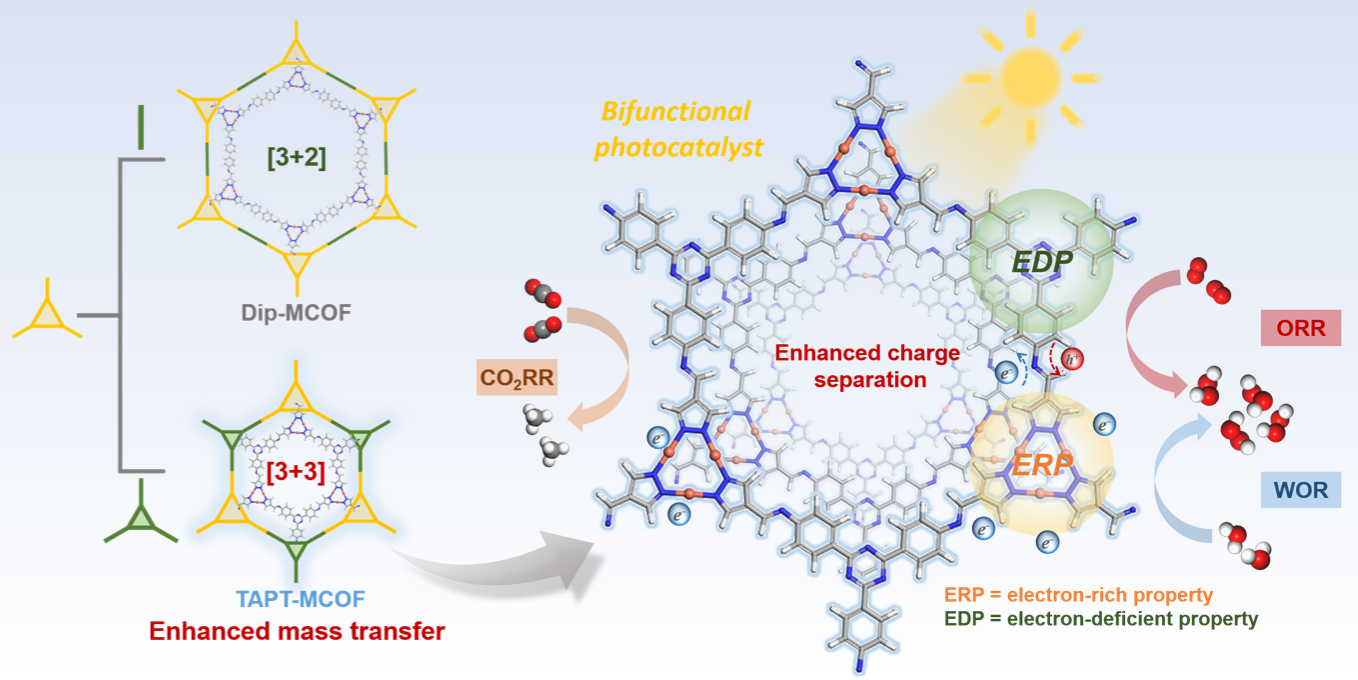
Photocatalytic technology is an effective approach to address energy shortages and environmental problems. However, developing efficient and stable multifunctional photocatalysts remains a challenging task. In this study, two metal-covalent organic frameworks (MCOFs) were synthesized using a trinuclear copper cluster as the electron-rich node: TAPT-MCOF with a [3+3] configuration and Dip-MCOF with a [3+2] configuration. In the absence of sacrificial agent, TAPT-MCOF exhibits improved visible-light-driven photocatalytic performance in both hydrogen peroxide (H2O2) synthesis and carbon dioxide (CO2) reduction. The H2O2 production rate is 261.8 μmol g-1 h-1, about 2.4 times that of Dip-MCOF. The reaction rate for CO2 reduction is also higher than that of Dip-MCOF. The enhanced behavior originates from two synergistic effects: (ⅰ) the specific surface area of TAPT-MCOF in the [3+3] configuration affords favored transport channels for efficient mass migration, including the reactants and products; and (ⅱ) the triazine group with electron-deficient property (EDP) and the trinuclear copper (Cu3Py) cluster with electron-rich property (ERP) in TAPT-MCOF create a highly intensified local asymmetric charge distribution, effectively promoting the photogenerated electron-hole separation. This finding provides guidance for designing efficient bifunctional photocatalysts by leveraging the dual structure regulation of porous frameworks.




- Address: Fuzhou High & New Technology Industrial Zone, Shangjie, Minhou, Fuzhou, Fujian 350108, China
- Tel: (86)-591-63173769, 63173770
- E-mail: cjsc@fjirsm.ac.cn
CN 35–1112/TQ, ISSN 0254–5861, Online ISSN: 2949-768X Copyright @ 2022 Chinese Journal of Structural Chemistry-www.Chinese Journal of Structural Chemistry.net. All Rights Reserved 闽ICP备2022002645号-1