

Just Accepted
Just Accepted Articles have been posted online after technical editing and typesetting for immediate view. The final edited version with page numbers will appear in the Current Issue soon.
Submit a Manuscript

Microenvironment engineering enabling an alternative pathway for the methanol oxidation reaction
Yang Zheng, Juan Ding, Qingcui Liu, Yudai Huang*, Zhiping Lai*
https://doi.org/10.1016/j.cjsc.2026.101084
Nickel hydroxide electrocatalyst; Formate; Microenvironment engineering; Methanol electrooxidation reaction; Energy-saving hydrogen generation
ABSTRACT
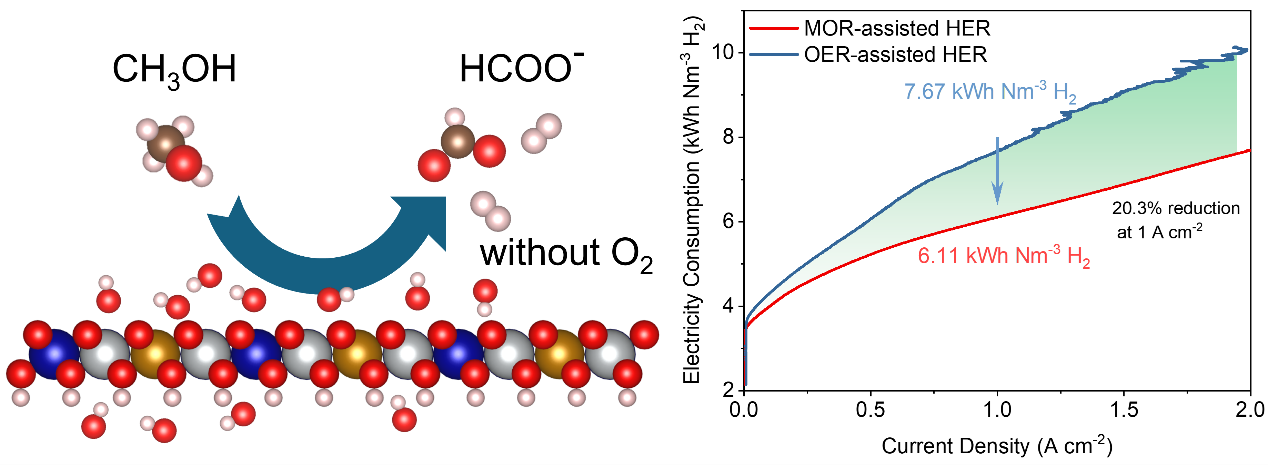
Conventional Ni-based methanol oxidation reaction (MOR) electrocatalysts predominantly operate through a standalone nickel redox cycle, where slow surface reconstruction inherently limits their overall kinetic efficiency. Overcoming this fundamental limitation requires exploring complementary reaction pathways. Herein, we report an alternative MOR pathway unlocked via microenvironment engineering on ultrathin NiFeCr hydroxide (NiFeCr-OH) nanosheets. Cr induced electronic redistribution regulates interfacial OH- adsorption and promotes the formation of an *OH-enriched microenvironment. The *OH-enriched microenvironment enables an unconventional MOR pathway, driven by the interaction between nucleophilic methanol and electrophilic *OH. This parallel pathway synergizes with the Ni redox cycle, effectively bypassing the kinetic limitations of the slow Ni reconstruction process. Benefiting from this synergistic microenvironment and parallel reaction pathway, the NiFeCr-OH catalyst delivers a current density of 100 mA cm-2 at 1.44 V with high formate selectivity and long-term stability. These findings suggest that exploiting unconventional reaction pathways is an effective strategy for enhancing MOR efficiency, providing valuable insights into the design of practical and efficient electrocatalysts.




- Address: Fuzhou High & New Technology Industrial Zone, Shangjie, Minhou, Fuzhou, Fujian 350108, China
- Tel: (86)-591-63173769, 63173770
- E-mail: cjsc@fjirsm.ac.cn
CN 35–1112/TQ, ISSN 0254–5861, Online ISSN: 2949-768X Copyright @ 2022 Chinese Journal of Structural Chemistry-www.Chinese Journal of Structural Chemistry.net. All Rights Reserved 闽ICP备2022002645号-1