

Just Accepted
Just Accepted Articles have been posted online after technical editing and typesetting for immediate view. The final edited version with page numbers will appear in the Current Issue soon.
Submit a Manuscript

Controlled synthesis and photothermal conversion of Ag+-triggered-hetero-/homo-metallic cages including ring-in-ring systems
Ming-Yu Lu, Ming Liu, Ruo-Tong You, Jian-Xin Yang, Shui-Ren Liu, Li-Long Dang*, Lu-Fang Ma
https://doi.org/10.1016/j.cjsc.2026.101100
Coordination-driven self-assembly; Structural regulation; Ring-in-Ring; π-π stacking interaction; Photothermal conversion
ABSTRACT
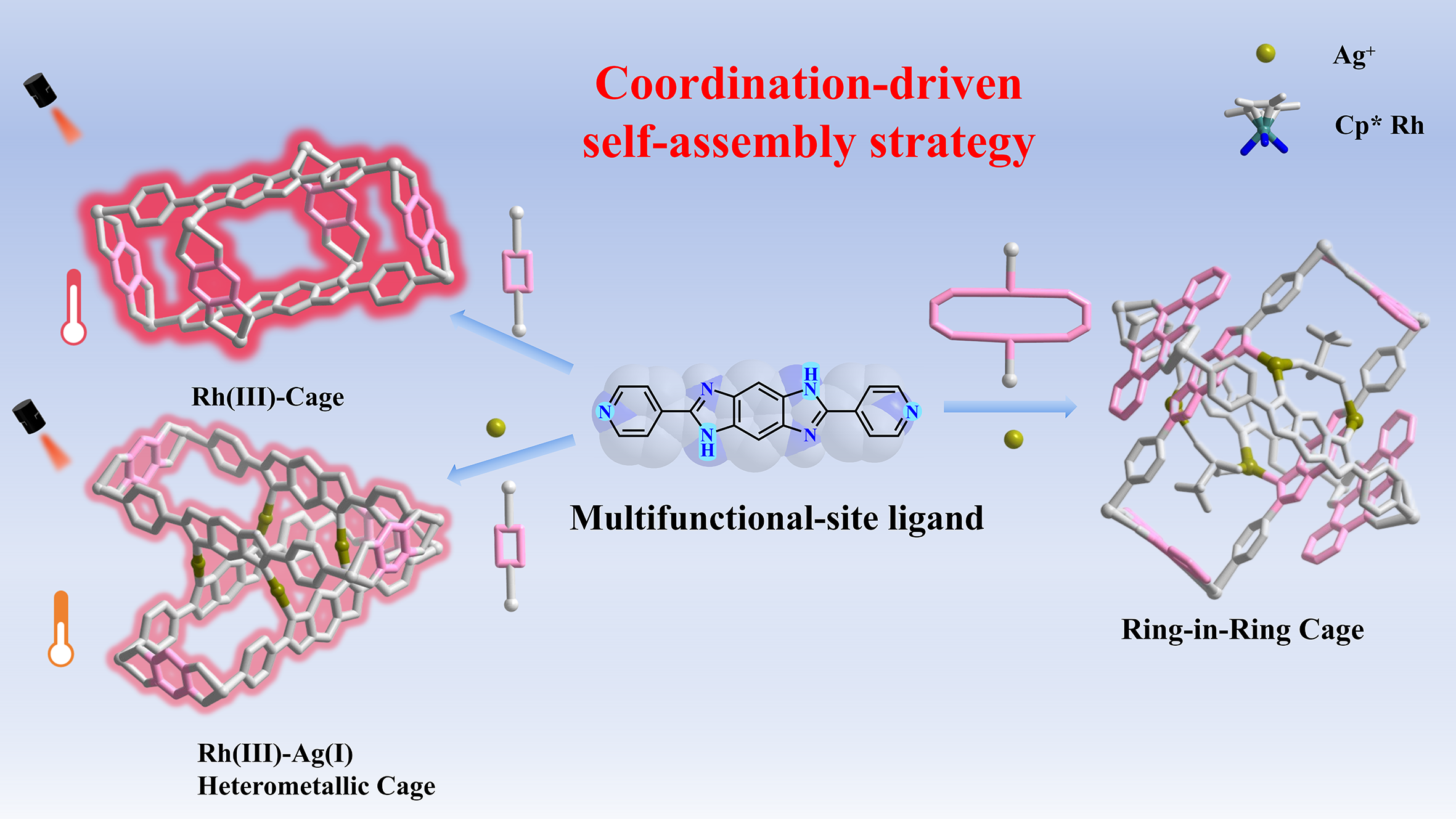
Achieving precise structural regulation of coordination topological assemblies, while simultaneously elucidating the structure–function relationships dictated by distinct architectures, remains a central challenge. Herein, a multifunctional ligand L bearing both pyridyl and imidazolyl moieties is elaborately designed. Self-assembly of this ligand with a series of distinct building blocks yields complex systems with diverse topologies, including homometallic and heterometallic cages structures as well as Ring-in-Ring architectures. Experimental analyses demonstrate that the introduction of Ag+ ions can induce structural transformation, enabling the construction of heterometallic assemblies with unique topological features. Structural analysis of all compounds, which are fully characterized by single-crystal X-ray diffraction (SC-XRD) and nuclear magnetic resonance (NMR), reveals the formation mechanism of each topological architecture. The resulting assemblies exhibit strikingly distinct near-infrared (NIR) photothermal conversion performance, with the optimal sample attaining a favorable photothermal conversion efficiency of 55.0%. This study establishes a critical theoretical architecture for the rational design of innovative topological supramolecular photothermal materials.




- Address: Fuzhou High & New Technology Industrial Zone, Shangjie, Minhou, Fuzhou, Fujian 350108, China
- Tel: (86)-591-63173769, 63173770
- E-mail: cjsc@fjirsm.ac.cn
CN 35–1112/TQ, ISSN 0254–5861, Online ISSN: 2949-768X Copyright @ 2022 Chinese Journal of Structural Chemistry-www.Chinese Journal of Structural Chemistry.net. All Rights Reserved 闽ICP备2022002645号-1