

Just Accepted
Just Accepted Articles have been posted online after technical editing and typesetting for immediate view. The final edited version with page numbers will appear in the Current Issue soon.
Submit a Manuscript

Tetrahedral-octahedral cation chemistry underpinning spinel oxide functionality
Tianqi Ma#, Kean Zhu#, Linai Zhou, Weilin Xu, Jun Wan*
https://doi.org/10.1016/j.cjsc.2026.101115
Spinel oxides; Crystal chemistry; High-entropy spinel; Cation distribution; Tetrahedral–octahedral coordination
ABSTRACT
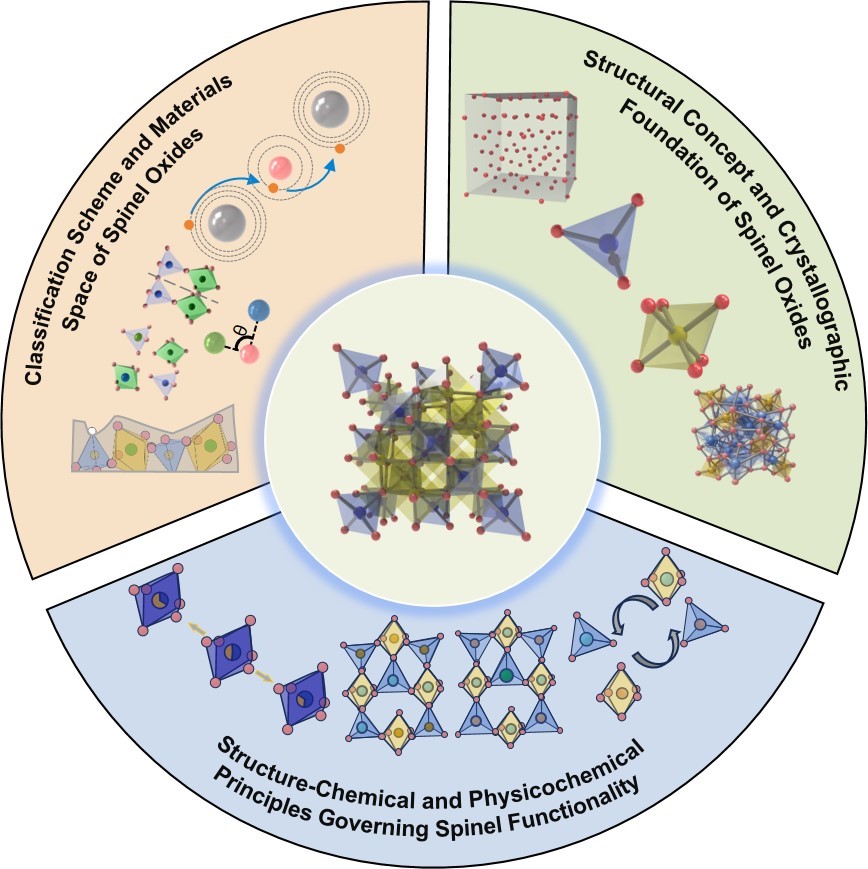
Spinel oxides occupy a distinctive position in advanced materials science because a single AB2O4 lattice can support electrochemical, magnetic, optical, interfacial, and extreme-environment functions that are usually distributed across different oxide families. Yet current research remains fragmented by application domain, which obscures the common crystallographic principles that govern performance and limits the development of transferable design logic. This review addresses that gap by establishing a structure-centered framework for spinel oxides, spanning crystallographic foundations, coordination-site chemistry, inversion behavior, local disorder, structure-derived physicochemical principles, and an expanded materials classification from classical ordered spinels to high-entropy spinels. On this basis, representative advances are analyzed across four major technological landscapes, including energy conversion and storage, information sensing and intelligent response, extreme-environment protection and high-temperature service, and advanced photonic, magnetic, and device-oriented systems. The central contribution lies in treating spinel oxides not as isolated functional materials, but as a crystallographically programmable platform in which cation configuration, defect adaptability, and framework robustness jointly determine multifunctional behavior. This perspective provides a more general structure–function language for spinel chemistry and offers a foundation for future oxide design aimed at integrating activity, durability, environmental resilience, and multifunctional intelligence within a unified materials architecture.




- Address: Fuzhou High & New Technology Industrial Zone, Shangjie, Minhou, Fuzhou, Fujian 350108, China
- Tel: (86)-591-63173769, 63173770
- E-mail: cjsc@fjirsm.ac.cn
CN 35–1112/TQ, ISSN 0254–5861, Online ISSN: 2949-768X Copyright @ 2022 Chinese Journal of Structural Chemistry-www.Chinese Journal of Structural Chemistry.net. All Rights Reserved 闽ICP备2022002645号-1