

Just Accepted
Just Accepted Articles have been posted online after technical editing and typesetting for immediate view. The final edited version with page numbers will appear in the Current Issue soon.
Submit a Manuscript

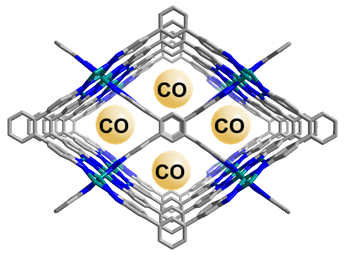
Assembly of tetra-benzotriazolate-based MOFs featuring Boerdijk-Coxeter helices with accessible Cu(I) sites for the selective adsorption of CO
Liang Gu†, Zhangyi Xiong†, He Huang†, Yuanlong Zhong, Zhenning Yang, M. Infas H. Mohideen, Zhiwei Qiao*, Zhijie Chen*
https://doi.org/10.1016/j.cjsc.2026.101132
ABSTRACT
Metal–organic frameworks (MOFs) featuring accessible Cu(I) sites exhibit exceptional properties, garnering significant attention for applications such as the selective adsorption of π-acidic gases. Benzotriazolate ligands represent an ideal platform for constructing such MOFs; however, most reported systems are based on linear, ditopic linkers, limiting the spatial arrangement of Cu(I) sites within the framework and consequently their functionalities. Herein, we report the assembly of tetratopic benzotriazolate ligands with Cu(I) ions into a single-crystalline MOF—Cu-TBT—displaying a rod-packing structure with hqz net and incorporating linearly coordinatively unsaturated Cu(I) sites. Cu-TBT possesses an open pore architecture with Cu(I) sites, showing a significantly enhanced affinity for CO over N2 and H2, as supported by adsorption, spectroscopic and simulation studies. This work suggests that increasing the ligand connectivity is an effective strategy for regulating the spatial distribution of accessible low-valent metal sites, paving the way for unlocking crystalline porous materials for π-acidic gas adsorption.




- Address: Fuzhou High & New Technology Industrial Zone, Shangjie, Minhou, Fuzhou, Fujian 350108, China
- Tel: (86)-591-63173769, 63173770
- E-mail: cjsc@fjirsm.ac.cn
CN 35–1112/TQ, ISSN 0254–5861, Online ISSN: 2949-768X Copyright @ 2022 Chinese Journal of Structural Chemistry-www.Chinese Journal of Structural Chemistry.net. All Rights Reserved 闽ICP备2022002645号-1