

Just Accepted
Just Accepted Articles have been posted online after technical editing and typesetting for immediate view. The final edited version with page numbers will appear in the Current Issue soon.
Submit a Manuscript

High-loading single-atom catalysts for electrochemical energy conversion
Fangqi Yang1*, Zikang Feng1, Jiaqi Wang, Yao Jin, Haoming Yu, Yang Ding*, Tonglin Yang*
https://doi.org/10.1016/j.cjsc.2026.101136
Single-atom catalysts; High-loading; Synthetic methods; Characterization; Electrochemical applications
ABSTRACT
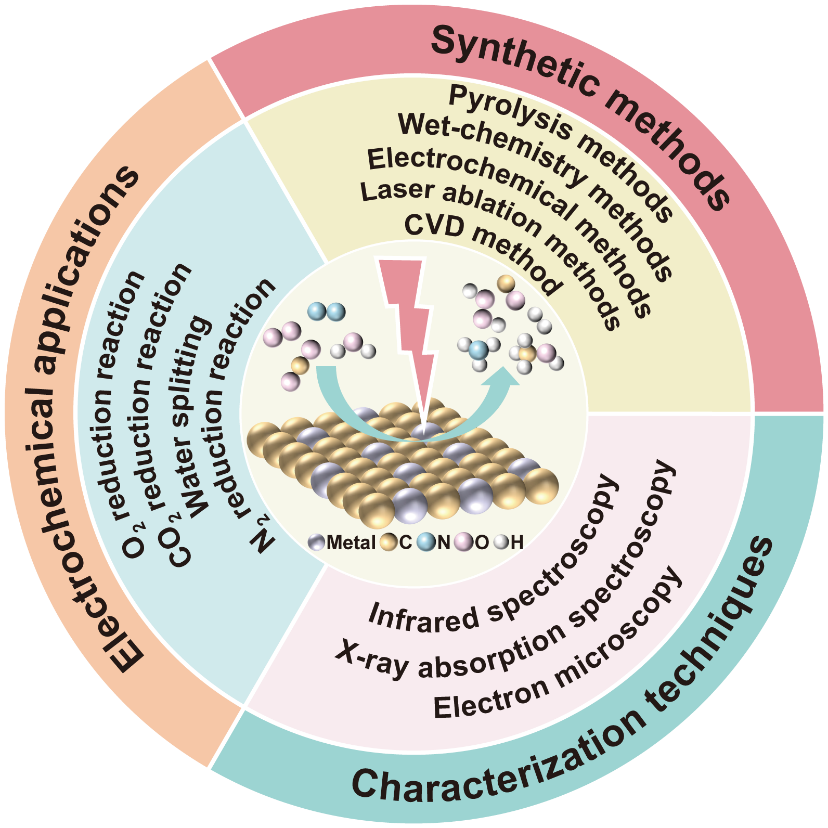
Single-atom catalysts (SACs) have emerged as a frontier in heterogeneous catalysis due to their maximum atom utilization efficiency, tunable electronic structures, and well-defined active sites. However, conventional SACs are typically constrained by low metal loadings (usually below 5 wt%), which limits their overall catalytic output and practical applicability. Developing high-loading SACs with metal contents exceeding 5 wt% has therefore become a critical direction to enhance the density of accessible active sites and boost catalytic performance. In this review, we systematically summarize recent progress in the design, characterization, and electrochemical applications of high-loading SACs. We first discuss various synthetic strategies for achieving SACs with high metal loadings, including wet-chemistry methods, pyrolysis, electrochemical synthesis, laser ablation, and chemical vapor deposition. Subsequently, we highlight advanced characterization techniques, particularly aberration-corrected HAADF-STEM and X-ray absorption spectroscopy (XAS), which are essential for unambiguously identifying isolated metal atoms and elucidating their coordination environments at high densities. We then present representative examples of high-loading SACs applied in key electrochemical energy conversion reactions, including the oxygen reduction reaction (ORR), carbon dioxide reduction reaction (CO2RR), water splitting (HER/OER), and nitrogen reduction reaction (NRR), with an emphasis on the relationship between single-atom density, atomic dispersion, and catalytic performance. Finally, we discuss the current challenges and future perspectives for the rational design and practical implementation of high-loading SACs. This review aims to provide a comprehensive understanding of high-loading SACs and to guide the development of next-generation catalysts for sustainable energy technologies.




- Address: Fuzhou High & New Technology Industrial Zone, Shangjie, Minhou, Fuzhou, Fujian 350108, China
- Tel: (86)-591-63173769, 63173770
- E-mail: cjsc@fjirsm.ac.cn
CN 35–1112/TQ, ISSN 0254–5861, Online ISSN: 2949-768X Copyright @ 2022 Chinese Journal of Structural Chemistry-www.Chinese Journal of Structural Chemistry.net. All Rights Reserved 闽ICP备2022002645号-1