

Just Accepted
Just Accepted Articles have been posted online after technical editing and typesetting for immediate view. The final edited version with page numbers will appear in the Current Issue soon.
Submit a Manuscript

Edge dual-functionalized carbon nitride with donor-π-acceptor architecture for deep photocatalytic oxidative desulfurization of liquid fuels
Yina Nie, Tingting Ma, Wenlin Zhang*, Lin Liu*, Feng Fu*, Jun Wan*
https://doi.org/10.1016/j.cjsc.2026.101148
Photocatalytic oxidation desulfurization; Carbon nitride; Donor-π-acceptor; Charge separation; Edge functionalization
ABSTRACT
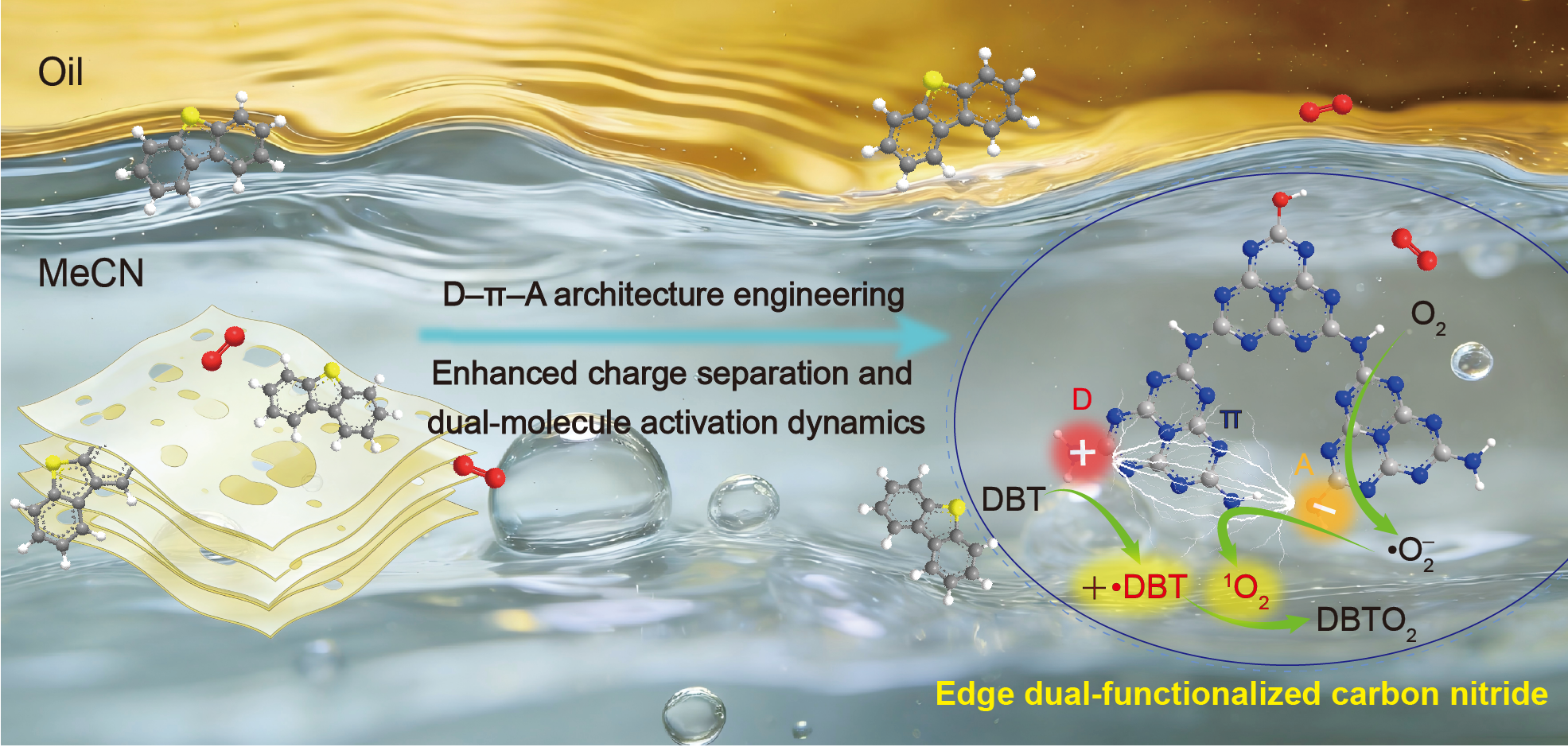
Deep desulfurization of liquid fuels is increasingly critical for the petroleum refining industry amid stringent environmental regulations. However, conventional hydrodesulfurization struggles to achieve deep removal of heterocyclic aromatic sulfur compounds (HASCs), while photocatalytic oxidative desulfurization (PODS) is currently constrained by inefficient charge separation and the inability to synchronously activate O2 and dibenzothiophene (DBT). Herein, an edge dual-functionalized carbon nitride (W5U2CN) is fabricated via a combined water-vapor and ammonia-etching strategy, which introduces edge –NH2 and –OH groups to construct a donor–π–acceptor (D–π–A) architecture. This design yields triple synergistic effects, in which the D–π–A dipole field accelerates photogenerated charge separation, the polar hydrophilic groups improve wettability in acetonitrile and facilitate DBT diffusion and adsorption at the catalyst–solvent interface, and the edge functional groups synergistically activate O2 and DBT. In situ diffuse reflectance Fourier transform infrared spectroscopy and electron paramagnetic resonance evidence confirm enhanced DBT adsorption and identify •O2− and 1O2 as the dominant reactive oxygen species, with O2 converted to 1O2 via a two-step electron-transfer pathway. Consequently, the optimized W5U2CN affords 99.66% desulfurization efficiency with a high reaction rate of 49.83 ppm·g-1·h-1 in simulated fuel, and the sulfur removal efficiency for real diesel feedstock reaches 97.5%. This work demonstrates that surface electronic structure engineering via dual-functional-group modification provides a promising strategy for designing efficient photocatalytic desulfurization catalysts.




- Address: Fuzhou High & New Technology Industrial Zone, Shangjie, Minhou, Fuzhou, Fujian 350108, China
- Tel: (86)-591-63173769, 63173770
- E-mail: cjsc@fjirsm.ac.cn
CN 35–1112/TQ, ISSN 0254–5861, Online ISSN: 2949-768X Copyright @ 2022 Chinese Journal of Structural Chemistry-www.Chinese Journal of Structural Chemistry.net. All Rights Reserved 闽ICP备2022002645号-1