


Iodine Adsorption Studies of Dipalladium-based Supramolecular Cages
LU Hong-Lin, TONG Jin, MA Hong-Weib* and YU Shu-Yan*
Chin. J. Struct. Chem. 2021, 40, 1680-1686 DOI: 10.14102/j.cnki.0254-5861.2011-3271
December 15, 2021
self-assembly, palladium, cages, host-guest, iodine adsorption
ABSTRACT
Four
water-soluble cage-like hosts (1·4NO3-: {[(bpy)2Pd2]2L12}(NO3)4, 2·4NO3-: {[(bpy)2Pd2]2L22}(NO3)4, 3·6NO3-: {[(bpy)2Pd2]3L32}(NO3)6 and 4·6NO3-: {[(bpy)2Pd2]3L42}(NO3)6)
have been successfully self-assembled by coordinating the flexible amide based
polypyrazole ligands (H2L1: N1,N4-di(1H-pyrazol-5-yl)terephthalamide,
H2L2: N1,N4-bis(3-methyl-1H-pyrazol-5-yl)-terephthalamide,
H3L3: N1,N3,N5-tri(1H-pyrazol-5-yl)benzene-1,3,5-tricarboxamide
and H3L4: N1,N3,N5-tris(3-methyl-1H-pyrazol-
5-yl)benzene-1,3,5-tricarboxamide) with dipalladium corners ([(bpy)2Pd2(NO3)2](NO3)2,
where bpy = 2,2΄-bipyridine) in aqueous solution. Their structures were
characterized by 1H NMR, ESI-MS and single-crystal X-ray
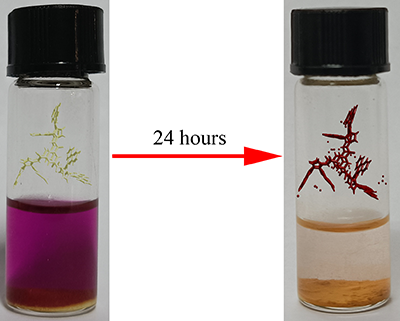
diffraction. Notably, all the four supramolecular assemblies are capable of
adsorbing iodine molecules via halogen bonds and other supramolecular
interactions.




- Address: Fuzhou High & New Technology Industrial Zone, Shangjie, Minhou, Fuzhou, Fujian 350108, China
- Tel: (86)-591-63173769, 63173770
- E-mail: cjsc@fjirsm.ac.cn
CN 35–1112/TQ, ISSN 0254–5861, Online ISSN: 2949-768X Copyright @ 2022 Chinese Journal of Structural Chemistry-www.Chinese Journal of Structural Chemistry.net. All Rights Reserved 闽ICP备2022002645号-1