


Cover Picture
Borosilicates as deep-ultraviolet transparent nonlinear optical crystals: structural motifs, performance limits and future directions
Yangfeifei Ou, Xiao-Liang Zhou, You-Zhao Lan, Jian-Wen Cheng* Submit a Manuscript
Borosilicates as deep-ultraviolet transparent nonlinear optical crystals: structural motifs, performance limits and future directions
Yangfeifei Ou, Xiao-Liang Zhou, You-Zhao Lan, Jian-Wen Cheng* Submit a Manuscript
Borosilicates as deep-ultraviolet transparent nonlinear optical crystals: Structural motifs, performance limits and future directions
Yangfeifei Ou, Xiao-Liang Zhou, You-Zhao Lan, Jian-Wen Cheng*
Chin. J. Struct. Chem., 2025, 44(9), 100708. DOI: 10.1016/j.cjsc.2025.100708
September 1, 2025
Borosilicate; Borate; Nonlinear optical; Deep-ultraviolet
ABSTRACT
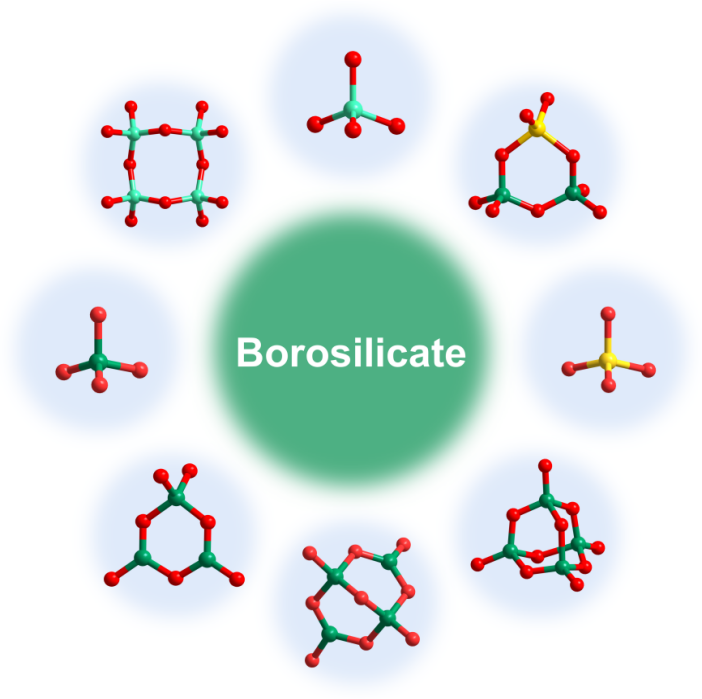
Short-wavelength nonlinear optical (NLO) crystals can convert a specific wavelength of light to ultraviolet (UV) and deep-UV region. To date, most of the commercialized UV and deep-UV NLO materials are borate crystals. Borosilicates combine the merits of borates and silicates, they show some unique advantages of rich structural types, moderate second harmonic generation (SHG) response, and high UV transmittance. This paper summarizes the known NLO borosilicates, according to the linkage modes of B-O and Si-O units, these borosilicates can be grouped into two types: (1) borosilicates with B-O-Si covalent bond, and (2) borosilicates with isolated B–O and Si–O units. We discuss the structural features, SHG intensities, and UV cutoff edges of these borosilicates. Future perspectives in this field are given in the final.




- Address: Fuzhou High & New Technology Industrial Zone, Shangjie, Minhou, Fuzhou, Fujian 350108, China
- Tel: (86)-591-63173769, 63173770
- E-mail: cjsc@fjirsm.ac.cn
CN 35–1112/TQ, ISSN 0254–5861, Online ISSN: 2949-768X Copyright @ 2022 Chinese Journal of Structural Chemistry-www.Chinese Journal of Structural Chemistry.net. All Rights Reserved 闽ICP备2022002645号-1