


MOF derived Co–Mo2C heterojunctions with interfacial electronic modulation for oxygen reduction reaction and zinc-air batteries
Desheng Li#, Qin Li#, Peng Xu, Xingyu Guo, Heng Wu, Rui Liu*, Fei Tan* Submit a Manuscript
Lin Geng, Wei-Hui Fang*
Chin. J. Struct. Chem., 2026, 45(2), 100746. DOI: 10.1016/j.cjsc.2025.100746
February 1, 2026
ABSTRACT
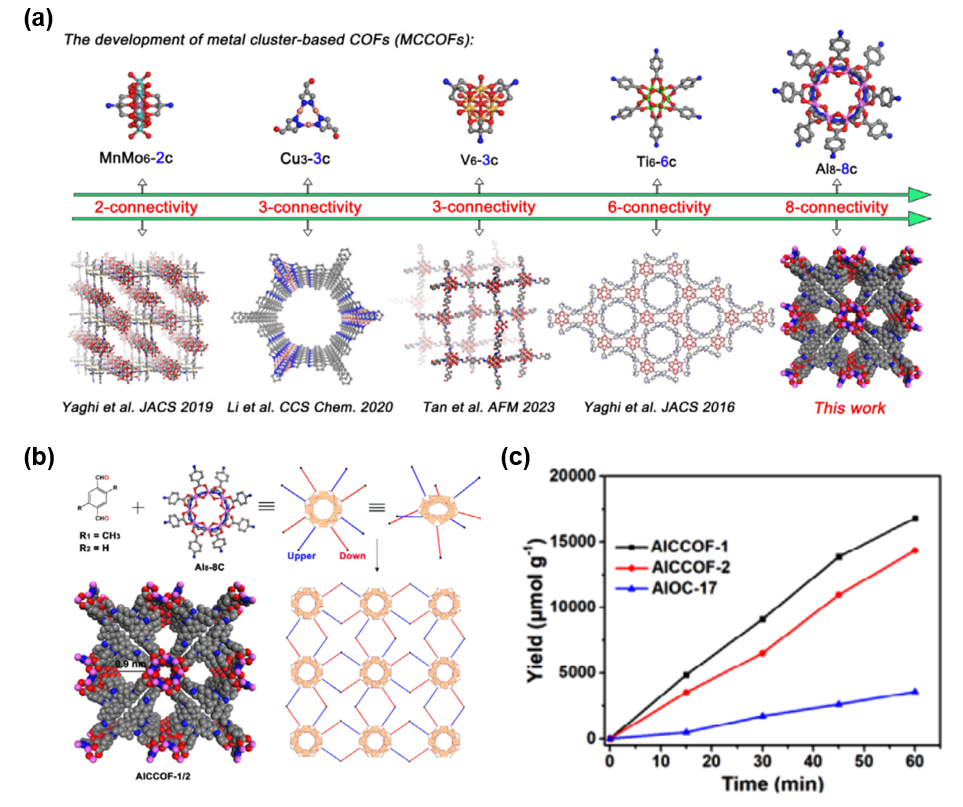
In summary, this work validates the potential of aluminum molecular rings
as building blocks for high-connectivity COFs and expands their utility into
photocatalysis. This study represents the first breakthrough in integrating
aluminum molecular rings into covalent networks. This advancement paves a new
way for novel multidimensional network designs based on aluminum molecular
rings. It is reasonable to expect such ring units to enable access to richer
network structures and topologies, offering new structural paradigms for
high-connectivity functional frameworks. The pre-organized aluminum molecular
rings exhibit notable advantages, including low cost, high stability, and
structural tailorability, providing a robust foundation for advancing MCCOF
applications. Future research could further propel this field by employing
precise functionalization strategies to tailor aluminum molecular rings with
specific properties. Potential directions include, but are not limited to, the
following aspects: 1) Precise control over the ring size. Introducing
macrocyclic structures can significantly enhance the porosity of MCCOFs and
facilitate the construction of hierarchical pore systems, showing promising
potential for applications in gas adsorption and molecular sieving. 2) Rational
design the pore microenvironments. Incorporation of specific heteroatoms (O, F
or S) could not only impart functional properties such as proton conduction and
sensing but also enable the modulation of physicochemical behaviors via
encapsulation of functional guest species. 3) Functionalization of the surface
chemistry. By selecting diverse functional ligands and controlling their
spatial arrangement, more versatile functionalities of MCCOF materials would be
unlock. For instance, the introduction of chiral or photoactive ligands may
expand applications in chiral recognition, information storage, catalysis and
optoelectronic properties.




- Address: Fuzhou High & New Technology Industrial Zone, Shangjie, Minhou, Fuzhou, Fujian 350108, China
- Tel: (86)-591-63173769, 63173770
- E-mail: cjsc@fjirsm.ac.cn