


Cover Picture
Chiral europium-organotin oxo-clusters with dual-emission circularly polarized luminescence
Gui-Xin Yan, Er-Xia Chen, Jin-Xia Yang, Jian Zhang*, Qipu Lin * Submit a Manuscript
Chiral europium-organotin oxo-clusters with dual-emission circularly polarized luminescence
Gui-Xin Yan, Er-Xia Chen, Jin-Xia Yang, Jian Zhang*, Qipu Lin * Submit a Manuscript
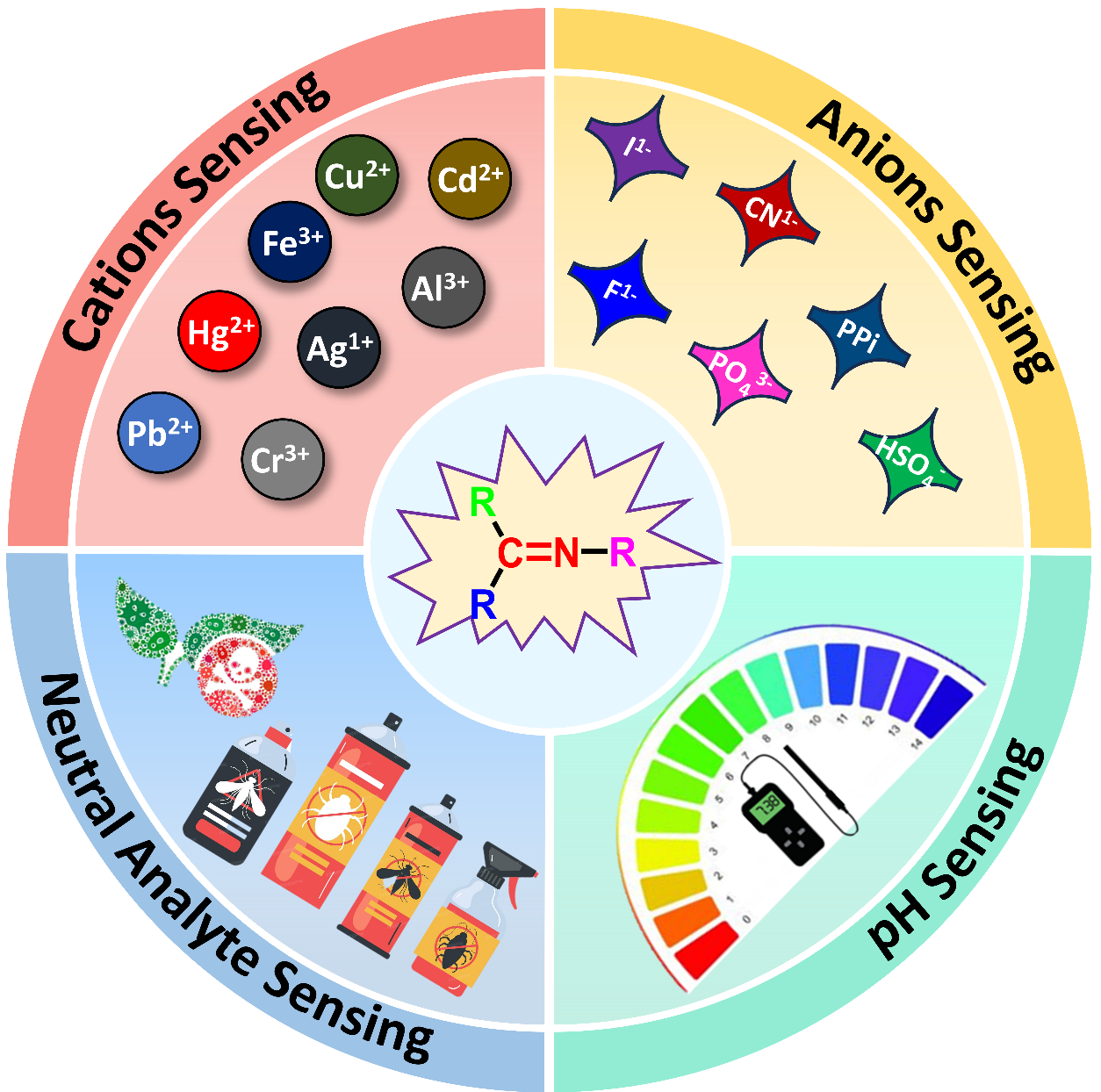
Chromogenic and fluorogenic Schiff base sensors
Fozia Nazir, Syeda Sundas Musawar, Ashfaq Ahmad Khan, Bilal Akram, Farid Ahmed*
Chin. J. Struct. Chem., 2025, 44(12), 100751. DOI: 10.1016/j.cjsc.2025.100751
December 1, 2025
Environmental monitoring; Schiff base; Fluorescent sensor; Metal cations; Anions and neutral species
ABSTRACT
Since their discovery by Hugo Schiff in 1864, Schiff bases and their metal complexes have gained recognition for their catalytic and biological properties. These compounds exhibit diverse functionalities, serving as catalysts in synthetic processes and displaying notable biological activities such as antifungal, antibacterial, anti-malarial, and antiviral effects. In various applications, Schiff bases serve as versatile tools, particularly in sensing applications. Through coordination with various metal ions, they form stable complexes. They are utilized as fluorescent turn-on/turn-off sensors for detecting a wide range of analytes. The coordination ability makes them valuable as chemosensor for detecting environmentally and biologically important analytes. This review provides a thorough overview of Schiff base chemosensors designed for the detection of environmental and biological significance including metal cations, anions, and neutral analytes. It is structured into four focused sections. The first section addresses the use of Schiff base chemosensor for the selective detection of various metal cations, including Ca2+, Al3+, Cr3+, Mn2+, Fe3+, Ni2+, Cu2+, Zn2+, Cd2+, Hg2+, and Pb2+. The second section examines the application of fluorescent Schiff base sensors in detecting diverse anions such as F-, CN-, I-, and HSO4-. The third section investigates the use of Schiff base fluorescent probes for accurate pH detection and determination. The fourth section explores the utilization of Schiff base sensors for detecting environmentally and biologically important neutral analytes, including insecticides, pesticides, and others. Additionally, the Schiff base chemosensors for metal cations and anions section concludes with a table summarizing the reviewed fluorescent Schiff base sensors for enhanced clarity.




- Address: Fuzhou High & New Technology Industrial Zone, Shangjie, Minhou, Fuzhou, Fujian 350108, China
- Tel: (86)-591-63173769, 63173770
- E-mail: cjsc@fjirsm.ac.cn
CN 35–1112/TQ, ISSN 0254–5861, Online ISSN: 2949-768X Copyright @ 2022 Chinese Journal of Structural Chemistry-www.Chinese Journal of Structural Chemistry.net. All Rights Reserved 闽ICP备2022002645号-1