


Cover Picture
Chiral europium-organotin oxo-clusters with dual-emission circularly polarized luminescence
Gui-Xin Yan, Er-Xia Chen, Jin-Xia Yang, Jian Zhang*, Qipu Lin * Submit a Manuscript
Chiral europium-organotin oxo-clusters with dual-emission circularly polarized luminescence
Gui-Xin Yan, Er-Xia Chen, Jin-Xia Yang, Jian Zhang*, Qipu Lin * Submit a Manuscript
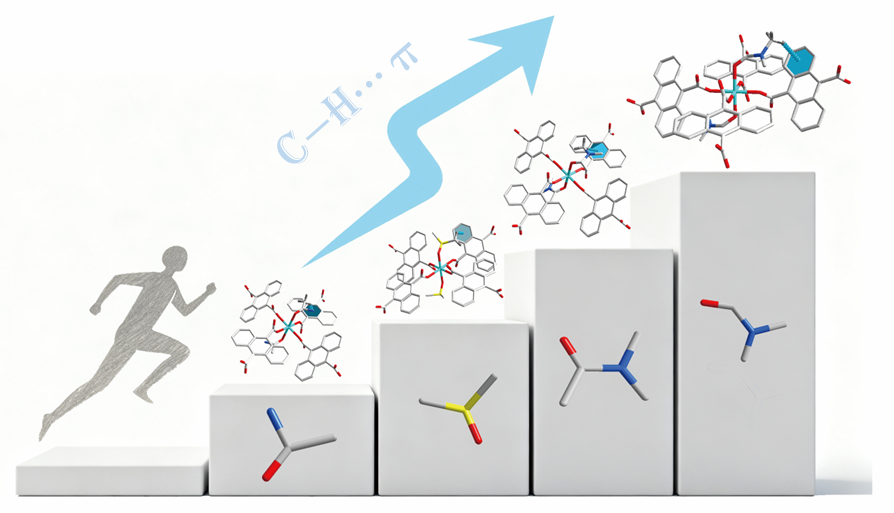
Solvent-coordination directed control of electron transfer dynamics in photoactive complexes
Yan-Rui Zhao, Jin Zhang, Shi-Kun Yan, Guang-Zhi Zhou, Ya-Hui Wang, Qi-Yue Xin, Ji-Xiang Hu*
Chin. J. Struct. Chem., 2025, 44(12), 100753. DOI: 10.1016/j.cjsc.2025.100753
Photochromic materials; Metal-organic complexes; Solvent molecules; Electron transfer
ABSTRACT
Photochromic materials attract significant attention for their applications in anticounterfeiting devices, optical switches and molecular sensors. However, the influence of solvent molecules, particularly coordinated solvents, on electron transfer (ET) photochromic systems remains poorly understood. In this study, we synthesized a series of isostructural metal-organic complexes (MOCs), [Mn(ADC)(L)]n (ADC = 9,10-anthracenedicarboxylic acid, L = DMF for 1, DMA for 2, MEA for 3, and DMSO for 4) to investigate the solvent-chromic behavior. All these MOCs exhibit typical radical-induced chromism upon illumination with a xenon lamp at room temperature. It is worth noting that coordination solvent molecules significantly modulate the photochromic response rate. Among the compounds studied, compound 1 exhibits the fastest response, while compound 3 shows the slowest. This variation in rate correlates with differences in the optimal electron transfer (ET) path length within their structures. Specifically, solvent molecules regulate the C−H···π interaction distance through their steric hindrance and electronic properties. Shorter C−H···π paths facilitate more efficient electron transfer upon photoexcitation, thus leading to faster photochromic response rates. Furthermore, illumination actuates magnetic couplings between photogenerated radicals and Mn2+ centers, resulting in a significant increase in room-temperature magnetization, demonstrating a photomagnetic response. This study demonstrates that coordinating solvent selection effectively controls photoinduced ET behavior, providing new insights for designing advanced photoactive materials.




- Address: Fuzhou High & New Technology Industrial Zone, Shangjie, Minhou, Fuzhou, Fujian 350108, China
- Tel: (86)-591-63173769, 63173770
- E-mail: cjsc@fjirsm.ac.cn
CN 35–1112/TQ, ISSN 0254–5861, Online ISSN: 2949-768X Copyright @ 2022 Chinese Journal of Structural Chemistry-www.Chinese Journal of Structural Chemistry.net. All Rights Reserved 闽ICP备2022002645号-1