


Cover Picture
Chiral europium-organotin oxo-clusters with dual-emission circularly polarized luminescence
Gui-Xin Yan, Er-Xia Chen, Jin-Xia Yang, Jian Zhang*, Qipu Lin * Submit a Manuscript
Chiral europium-organotin oxo-clusters with dual-emission circularly polarized luminescence
Gui-Xin Yan, Er-Xia Chen, Jin-Xia Yang, Jian Zhang*, Qipu Lin * Submit a Manuscript
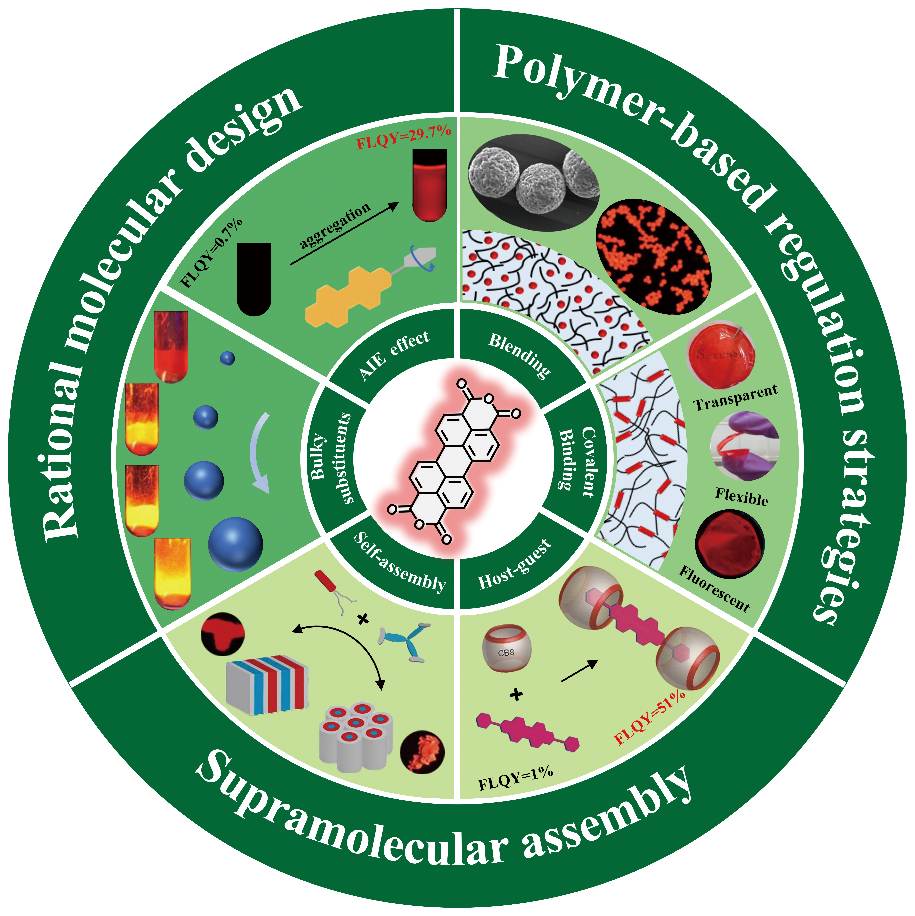
Fluorescence enhancement of perylene diimide: Design strategy and application
Ya-Ru Qu†, Kai-Li Tian†, Han-Jun Huang, Jia-Jun Tu, Ai-Hao Chen, Hai-Jun Sun, Maxim V. Bermeshev, Shao-Jie Wang*, Wen-Bin Li*, Xiang-Kui Ren*
Chin. J. Struct. Chem., 2025, 44(12), 100756. DOI: 10.1016/j.cjsc.2025.100756
December 1, 2025
Perylene diimide; High fluorescence; Aggregation-caused quenching; Molecular design; Polymer regulation; Supramolecular assembly
ABSTRACT
Perylene diimide (PDI) derivatives have emerged as a class of important organic fluorescent materials owing to their high extinction coefficient, excellent thermal and photostability, and versatile structural tunability. However, due to its intrinsic rigid planar structure, π-π stacking is easy to occur, resulting in aggregation-caused quenching (ACQ). In recent years, extensive efforts have been devoted to overcome this challenge and enhance the fluorescence performance of PDIs. This review systematically summarizes representative strategies from three major perspectives: (ⅰ) Rational molecular design, including the introduction of bulky aromatic substituents, dendritic or POSS units to provide steric hindrance, as well as the activation of aggregation-induced emission (AIE) (ⅱ) Polymer-based regulation strategies, including physical blending with polymer hosts and covalent integration into polymer backbones, which provide spatial isolation and structural robustness; and (ⅲ) Supramolecular assembly, where host-guest inclusion and self-assembly pathways precisely tune intermolecular packing and excitonic coupling. These strategies have enabled significant improvements in fluorescence quantum yield across solution, aggregate, and solid states. Furthermore, highly emissive PDI derivatives have demonstrated broad applicability in biomedicine, sensing and anti-counterfeiting, and optoelectronic devices such as OLEDs. This review highlights the fundamental design principles, performance optimization strategies, and emerging application frontiers of PDI-based luminescent materials, providing guidance for their further development toward multifunctional and sustainable optoelectronic technologies.




- Address: Fuzhou High & New Technology Industrial Zone, Shangjie, Minhou, Fuzhou, Fujian 350108, China
- Tel: (86)-591-63173769, 63173770
- E-mail: cjsc@fjirsm.ac.cn
CN 35–1112/TQ, ISSN 0254–5861, Online ISSN: 2949-768X Copyright @ 2022 Chinese Journal of Structural Chemistry-www.Chinese Journal of Structural Chemistry.net. All Rights Reserved 闽ICP备2022002645号-1