


Cover Picture
Nuclear magnetic resonance-guided Monte Carlo/molecular dynamics structure inference for amorphous solids
Kangren Kong, Zaiqiang Ma, Yu Yin, Zhaoming Liu, Ruikang Tang* Submit a Manuscript
Nuclear magnetic resonance-guided Monte Carlo/molecular dynamics structure inference for amorphous solids
Kangren Kong, Zaiqiang Ma, Yu Yin, Zhaoming Liu, Ruikang Tang* Submit a Manuscript
Nuclear magnetic resonance-guided Monte Carlo/molecular dynamics structure inference for amorphous solids
Kangren Kong1, Zaiqiang Ma1, Yu Yin, Zhaoming Liu, Ruikang Tang*
Chin. J. Struct. Chem., 2026, 45(3), 100773. DOI: 10.1016/j.cjsc.2025.100773
March 1, 2026
REDOR; Amorphous material; Molecular dynamics; Calcium carbonate; Calcium phosphate
ABSTRACT
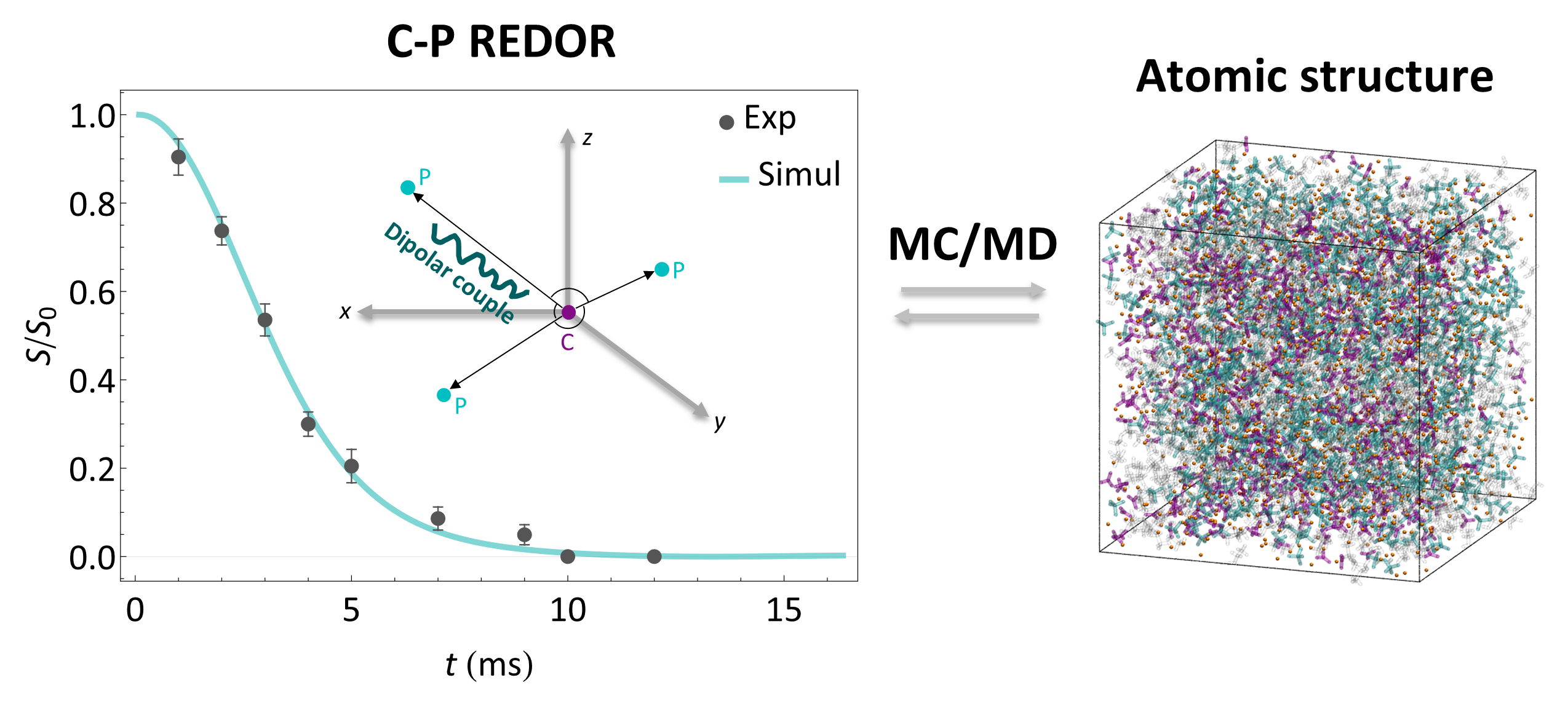
Amorphous solids, which do not possess the long-range order, hold great promise in mechanical, optical, and chemical properties, etc., and have also been revealed as critical biomineralization precursors. However, fundamental questions about their three-dimensional (3D) atomic structure remain challenging due to the long-range disorder. Conventional protocols probe such molecular structures through scattering or real-space imaging. The former provides ensemble-averaged data that masks local structural deviations, while the latter is hampered by the electron-beam sensitivity of materials. Nevertheless, based on distance-sensitive heteronuclear coupling, rotational echo double resonance (REDOR), a specialized solid-state nuclear magnetic resonance (NMR) measurement, is efficient in detecting local deviations and usually nondestructive. Here, using amorphous calcium carbonate/phosphate Ca(CO3)x(PO4)2(1-x)/3 (0 < x <1, CaCPs) solids synthesized by ion cross-linking as an example, we develop a nondestructive method to reveal local deviations of amorphous ionic solids by combining REDOR, Monte Carlo (MC), and molecular dynamic (MD) simulation. Briefly, MC simulations generated atomic structures with heterogeneous medium-range spatial apportionment of ions, and MD simulations relaxed the initial configuration to rationalize short-range order. Then, theoretical REDOR decay curves of MC/MD-generated structures were compared with experimental values to check the medium-range order. We revealed that there was heterogeneous medium-range spatial apportionment of anions in CaCPs. Because solid-state NMR applies to virtually any spin-bearing material, this methodology provides an alternative route to resolve the atomic structure of amorphous solids.




- Address: Fuzhou High & New Technology Industrial Zone, Shangjie, Minhou, Fuzhou, Fujian 350108, China
- Tel: (86)-591-63173769, 63173770
- E-mail: cjsc@fjirsm.ac.cn
CN 35–1112/TQ, ISSN 0254–5861, Online ISSN: 2949-768X Copyright @ 2022 Chinese Journal of Structural Chemistry-www.Chinese Journal of Structural Chemistry.net. All Rights Reserved 闽ICP备2022002645号-1