


Cover Picture
Nuclear magnetic resonance-guided Monte Carlo/molecular dynamics structure inference for amorphous solids
Kangren Kong, Zaiqiang Ma, Yu Yin, Zhaoming Liu, Ruikang Tang* Submit a Manuscript
Nuclear magnetic resonance-guided Monte Carlo/molecular dynamics structure inference for amorphous solids
Kangren Kong, Zaiqiang Ma, Yu Yin, Zhaoming Liu, Ruikang Tang* Submit a Manuscript
Metal-organic frameworks in perovskite solar cells: Harnessing structural diversity for enhanced photovoltaic performance
Yuhao Xiong, Jian Zhang*, Yue Sun, Boyuan Hu, Wei Wang, Yuanyuan Yin, Debin Xia, Kaifeng Lin, Yulin Yang*, Evgeny Tretyakov
Chin. J. Struct. Chem., 2026, 45(3), 100842. DOI: 10.1016/j.cjsc.2025.100842
March 1, 2026
Metal-organic frameworks; Perovskite solar cells; Crystallization regulation; Defect passivation; Interface
ABSTRACT
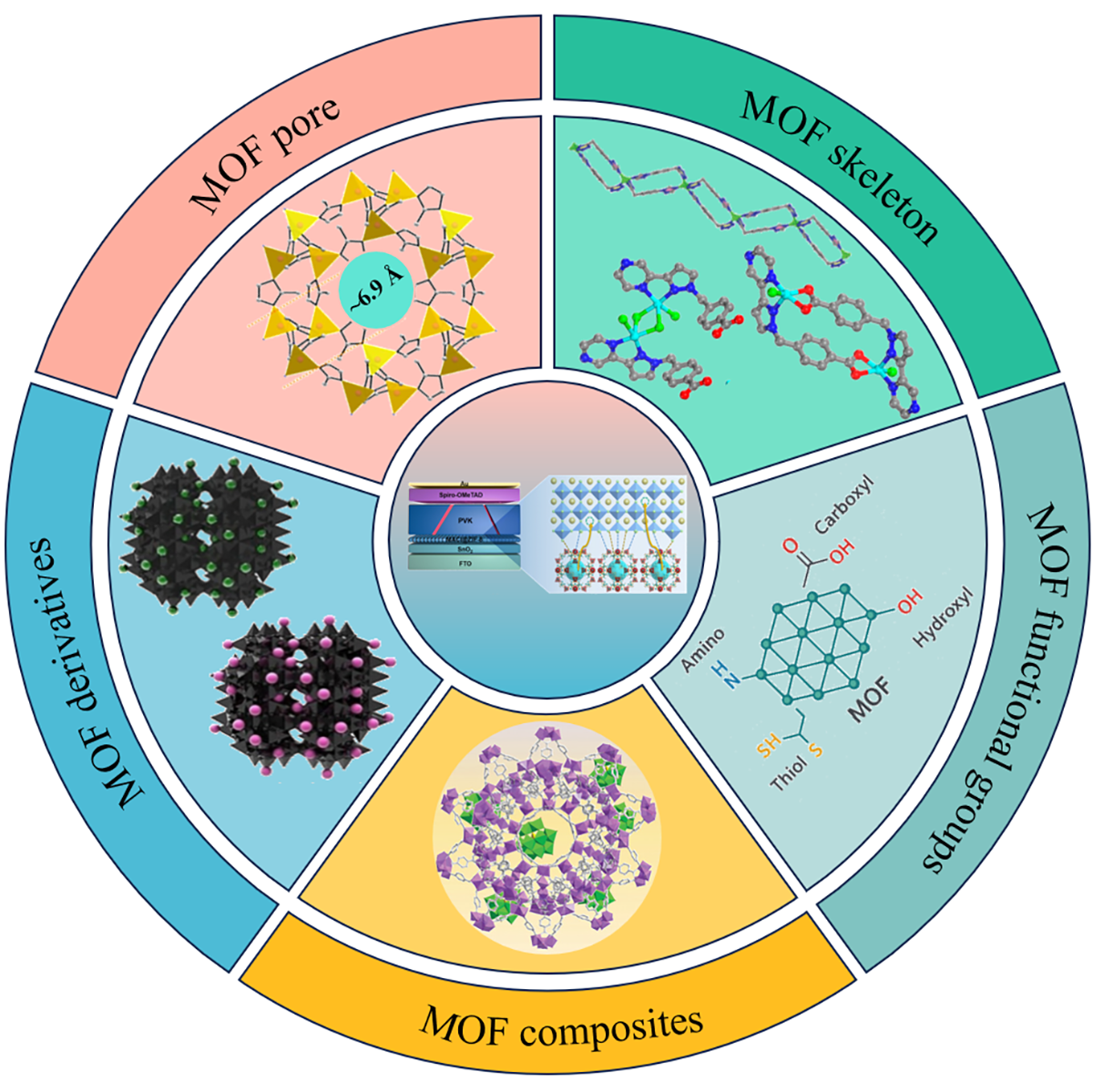
In recent years, metal-organic frameworks (MOFs) have emerged as promising materials in modifying perovskite solar cells (PSCs) due to their unique porous structures, exceptional specific surface area, tunable organic–inorganic coordination environments, and abundant modification sites. These features endowed MOFs with the ability to regulate the crystallization rate of perovskite films, promote uniform crystal growth, and passivate both surface and grain boundary defects. This review systematically categorizes the applications of MOFs in PSCs based on MOF types and their corresponding functional mechanisms, while exploring the selection criteria for MOFs with different structures from five key dimensions: pores, framework structures, functional groups, MOF composites, and MOF derivatives. Focusing on the structural design of MOFs, this review further aims to forecast the development trends of MOFs at the MOF/PSCs interface and provide guidance for the rational design and selection of MOFs for propelling next-generation photovoltaic technologies.




- Address: Fuzhou High & New Technology Industrial Zone, Shangjie, Minhou, Fuzhou, Fujian 350108, China
- Tel: (86)-591-63173769, 63173770
- E-mail: cjsc@fjirsm.ac.cn
CN 35–1112/TQ, ISSN 0254–5861, Online ISSN: 2949-768X Copyright @ 2022 Chinese Journal of Structural Chemistry-www.Chinese Journal of Structural Chemistry.net. All Rights Reserved 闽ICP备2022002645号-1