


Cover Picture
A stable Zr-MOF with trap-and-flow channels for efficient natural gas purification
Zhenyu Ji, Yucheng Xiao, Yunzhe Zhou, Ting Zhao, Lingna Yang, Cheng Chen, Mingyan Wu*, and Maochun Hong Submit a Manuscript
A stable Zr-MOF with trap-and-flow channels for efficient natural gas purification
Zhenyu Ji, Yucheng Xiao, Yunzhe Zhou, Ting Zhao, Lingna Yang, Cheng Chen, Mingyan Wu*, and Maochun Hong Submit a Manuscript
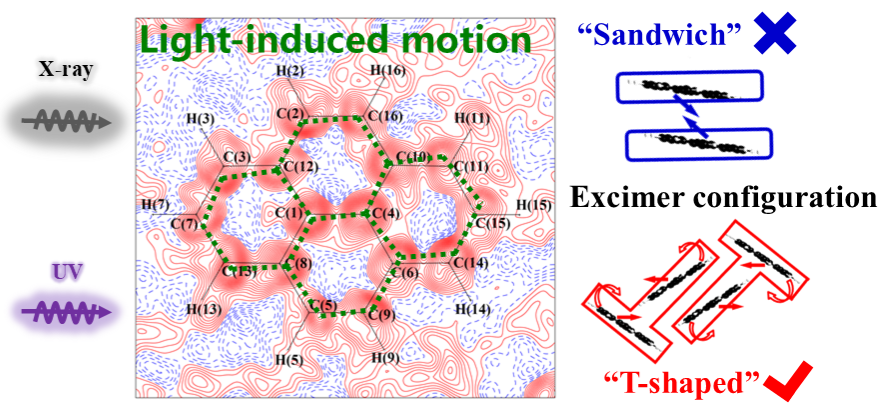
Unconventional configuration of excimer in luminescent aggregates uncovered by in situ photo-difference electron density
Long-Qi Yang, Xiao-Ming Jiang*, Fa-Kun Zheng, Guo-Cong Guo*
Chin. J. Struct. Chem., 2026, 45(4), 100846. DOI: 10.1016/j.cjsc.2025.100846
April 1, 2026
Luminescent aggregates; Excimer; In-situ electron density; Noncovalent interactions; Light-induced structural evolution
ABSTRACT
Excimers host an important role in nature and modern industrial applications; however, a precise understanding regarding their configuration remains elusive owing to the difficulty in observing their formation in situ. Here we present an experimental scheme enabling in-situ visualization of structural evolution of molecules through photo-difference electron density. Application to pyrene crystals revealed an unanticipated excimer formation pathway. By observing the photo-induced molecular shift and rotation, we discovered the unconventional T-shaped configuration of pyrene excimers, which consists of more closely adjacent nonparallel molecules tending towards a perpendicular orientation, rather than the conventional sandwich configuration formed by adjacent parallel molecules. The results help demystify the molecular orientation and configuration associated with excimer discovered decades ago, and shed light on revealing fundamental mechanism of excimers in the fields of biomolecule detection, photovoltaics, and organic electronics.




- Address: Fuzhou High & New Technology Industrial Zone, Shangjie, Minhou, Fuzhou, Fujian 350108, China
- Tel: (86)-591-63173769, 63173770
- E-mail: cjsc@fjirsm.ac.cn
CN 35–1112/TQ, ISSN 0254–5861, Online ISSN: 2949-768X Copyright @ 2022 Chinese Journal of Structural Chemistry-www.Chinese Journal of Structural Chemistry.net. All Rights Reserved 闽ICP备2022002645号-1