


Cover Picture
A stable Zr-MOF with trap-and-flow channels for efficient natural gas purification
Zhenyu Ji, Yucheng Xiao, Yunzhe Zhou, Ting Zhao, Lingna Yang, Cheng Chen, Mingyan Wu*, and Maochun Hong Submit a Manuscript
A stable Zr-MOF with trap-and-flow channels for efficient natural gas purification
Zhenyu Ji, Yucheng Xiao, Yunzhe Zhou, Ting Zhao, Lingna Yang, Cheng Chen, Mingyan Wu*, and Maochun Hong Submit a Manuscript
Sub-nanoscale oxygen-defect-rich MoO3-x: A versatile platform for label-free ultrasensitive SERS biodetection
Xiaoyu Song1, Xinghua Liu1, Lei Xu1, Aochi Liu, Xiangyu Meng, Yuening Wang, Mingjian Zhang, Guangcheng Xi*, Jie Lin*, Xiaotian Wang*, Gengchen Xie*
Chin. J. Struct. Chem., 2026, 45(4), 100848. DOI: 10.1016/j.cjsc.2025.100848
April 1, 2026
MoO3-x Sub-NWs; Oxygen vacancy engineering; SERS; Environmental monitoring & cancer subtyping
ABSTRACT
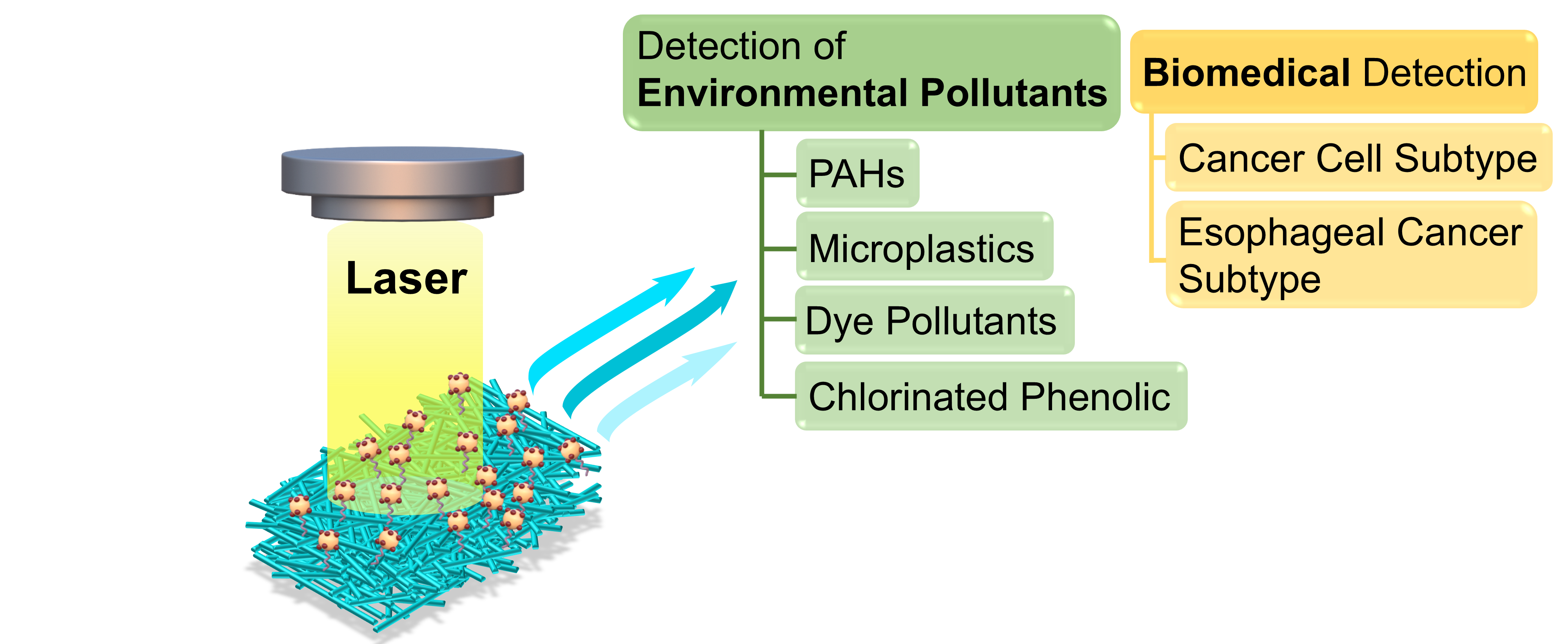
Although surface-enhanced Raman scattering (SERS) technology has been widely applied in fields such as environmental pollutant monitoring and early cancer diagnosis, the design of universal substrates to enable high-sensitivity detection across multiple scenarios remains a pressing problem to be solved. In this study, an innovative defect engineering strategy was employed to successfully develop a SERS substrate based on molybdenum oxide sub-nanowires (MoO3-x Sub-NWs) with a high oxygen vacancy (Vo) concentration. This substrate uniquely combines the gradient defect states induced by Vo and the quantum confinement effect generated by the one-dimensional sub-nanostructure, thereby achieving the synergy of chemical enhancement and electromagnetic enhancement. Experimental results demonstrate that the substrate exhibits an enhancement factor as high as 7.8×10⁷ for rhodamine 6G, achieves a LOD of 10-11 M for dyes such as methyl orange, and enables effective detection of various environmental pollutants including polychlorinated phenols, polycyclic aromatic hydrocarbons, and polystyrene microspheres. In terms of biomedical applications, based on the PCA-LDA model, the method achieves a three-category classification accuracy of 92.22% for hepatocellular carcinoma cells (HepG2), esophageal cancer cells (TE-1), and white blood cells (WBC), a discrimination accuracy of 90% for esophageal cancer subtypes (TE-1 and KYSE), and an ROC curve AUC value of 0.97. This study provides a new paradigm for the development of high-performance universal SERS substrates and possesses significant application value in the fields of environmental monitoring and non-invasive tumor diagnosis.




- Address: Fuzhou High & New Technology Industrial Zone, Shangjie, Minhou, Fuzhou, Fujian 350108, China
- Tel: (86)-591-63173769, 63173770
- E-mail: cjsc@fjirsm.ac.cn
CN 35–1112/TQ, ISSN 0254–5861, Online ISSN: 2949-768X Copyright @ 2022 Chinese Journal of Structural Chemistry-www.Chinese Journal of Structural Chemistry.net. All Rights Reserved 闽ICP备2022002645号-1