


Cover Picture
A stable Zr-MOF with trap-and-flow channels for efficient natural gas purification
Zhenyu Ji, Yucheng Xiao, Yunzhe Zhou, Ting Zhao, Lingna Yang, Cheng Chen, Mingyan Wu*, and Maochun Hong Submit a Manuscript
A stable Zr-MOF with trap-and-flow channels for efficient natural gas purification
Zhenyu Ji, Yucheng Xiao, Yunzhe Zhou, Ting Zhao, Lingna Yang, Cheng Chen, Mingyan Wu*, and Maochun Hong Submit a Manuscript
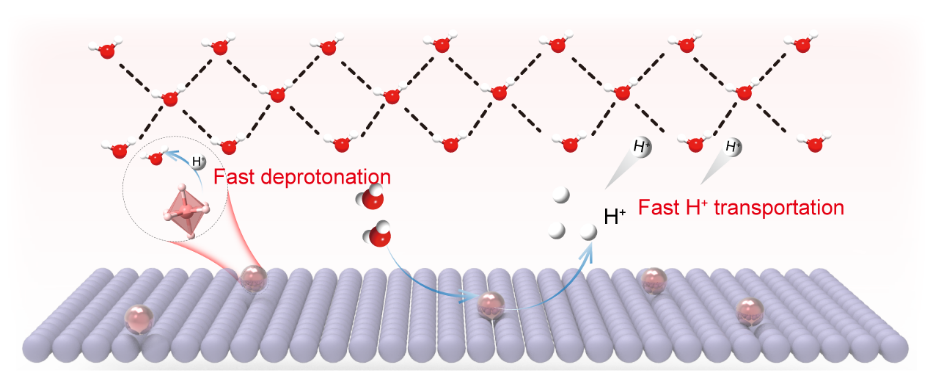
Oxophilic support mediated interfacial water reconstruction on RuO2 for high-efficiency proton exchange membrane electrolysis
Juan Zhu1, Jingxiang Xia1, Wei Luo*
Chin. J. Struct. Chem., 2026, 45(4), 100857. DOI: 10.1016/j.cjsc.2025.100857
April 1, 2026
Acidic oxygen evolution reaction; Interfacial H2O; Hydrogen-bond network; Proton exchange membrane water electrolyzer
ABSTRACT
The development of highly efficient and stable RuO2-based electrocatalysts as promising alternatives to IrO2 for acidic oxygen evolution reaction (OER) is crucial for the practical application of proton exchange membrane water electrolyzers (PEMWEs). Although considerable efforts have been devoted to breaking the scaling relationship of adsorbate evolution mechanism (AEM) pathway through modulating the electronic structure of catalysts and the binding energies of reaction intermediate species, limited attention has been paid to the role of interfacial water structure at the interface between catalyst and electrolyte. Here, we anchored RuO2 onto oxophilic MoO3 nanosheet, and realized an optimized connectivity of hydrogen-bond network in the electric double layer (EDL). Through advanced in-situ spectroscopies, we demonstrate that the reconstructed interfacial water molecules can accelerate the dissociation and the follow-up proton transport across the interface, promoting a high-proton-flux interface that ensures simultaneous enhancement of both activity and stability. Consequently, the obtained RuO2/MoO3 heterojunction exhibits remarkable activity and stability in acidic OER (with an overpotential of 235 mV at a current density of 100 mA cm-2 and excellent long-term durability of 420 h at 10 mA cm-2). When evaluated in a PEMWE device, it requires only 1.63 V to achieve a current density of 1.0 A cm-2 and shows no significant voltage degradation over 500 hours of continuous operation at a current density of 100 mA cm-2.




- Address: Fuzhou High & New Technology Industrial Zone, Shangjie, Minhou, Fuzhou, Fujian 350108, China
- Tel: (86)-591-63173769, 63173770
- E-mail: cjsc@fjirsm.ac.cn
CN 35–1112/TQ, ISSN 0254–5861, Online ISSN: 2949-768X Copyright @ 2022 Chinese Journal of Structural Chemistry-www.Chinese Journal of Structural Chemistry.net. All Rights Reserved 闽ICP备2022002645号-1