


Cover Picture
Ligand functionalization boosts circularly polarized luminescence in chiral MOFs
Zhi-Wen Wang, Xiuzhen Wang, Yi-An Chen, Hong-Rui Zheng, Yu-Peng Han, Fei Wang*, Shumei Chen*, Shangda Li*, Jian Zhang Submit a Manuscript
Ligand functionalization boosts circularly polarized luminescence in chiral MOFs
Zhi-Wen Wang, Xiuzhen Wang, Yi-An Chen, Hong-Rui Zheng, Yu-Peng Han, Fei Wang*, Shumei Chen*, Shangda Li*, Jian Zhang Submit a Manuscript
Direct synthesis of highly porous Cr-MOFs with hexatopic car-boxylate ligands for water adsorption
Chaozhuang Xue, Yingying Zhang, Konggang Qu, Shuwen Gong, Huajun Yang*
Chin. J. Struct. Chem., 2026, 45(6), 100890. DOI: 10.1016/j.cjsc.2026.100890
June 1, 2026
Chromium(III) MOFs; Rigid-acs based pacs; Highly porous; Stable MOFs; Water adsorption
ABSTRACT
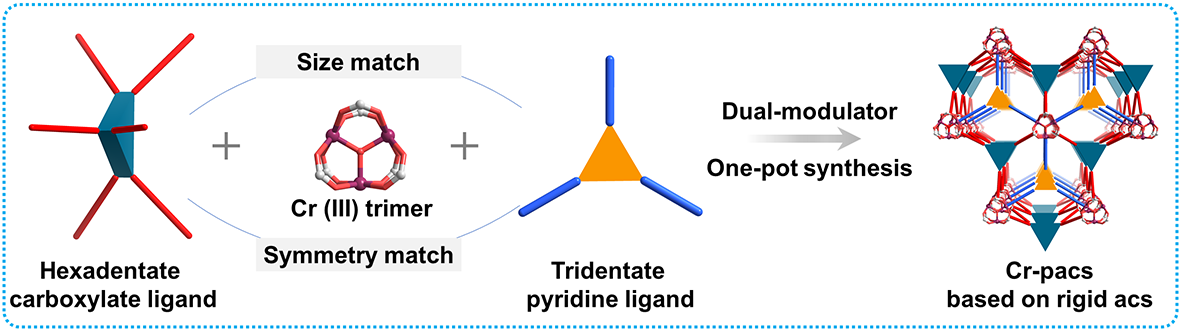
The construction of highly porous metal-organic frameworks (MOFs) is desirable, yet it faces significant challenges including synthetic difficulties and compromised structural stability. Herein we report three new Cr-MOFs, Cr-L1-P1, Cr-L2-P1 and Cr-L3-P2, obtained by facile one-pot synthesis. These materials exhibit partitioned acs (pacs) architecture that combines exceptional porosity with remarkable structural stability, which is achieved by the incorporation of large hexatopic carboxylate ligands and the formation of coordinatively-saturated-chromium(III)-based trimeric secondary building units (SBUs). Experimental results suggest their high thermal stability alongside exceptional chemical stability (> 400oC, acid resistance to 12 M HCl, base resistance to 0.1 M NaOH), placing them among the most stable MOFs. Water vapor adsorption isotherms reveal exceptional saturation uptakes of 0.77, 0.78, and 1.08 gH2O/gsorbent for Cr-L1-P1, Cr-L2-P1, and Cr-L3-P2, respectively. Notably, no obvious performance degradation was observed after 15 cycling measurements. Cr-L2-P1 exhibits suitable adsorption and desorption inflection points within recommended humidity range (45-65%), high working capacities/efficiencies (WCads = 70 wt%, WCdes = 65 wt%, ηads = 90%, ηdes = 83%) and effective working capacities/efficiencies (WCeff = 64 wt%, ηeff = 82%), making it a promising candidate for indoor humidity control.




- Address: Fuzhou High & New Technology Industrial Zone, Shangjie, Minhou, Fuzhou, Fujian 350108, China
- Tel: (86)-591-63173769, 63173770
- E-mail: cjsc@fjirsm.ac.cn
CN 35–1112/TQ, ISSN 0254–5861, Online ISSN: 2949-768X Copyright @ 2022 Chinese Journal of Structural Chemistry-www.Chinese Journal of Structural Chemistry.net. All Rights Reserved 闽ICP备2022002645号-1