

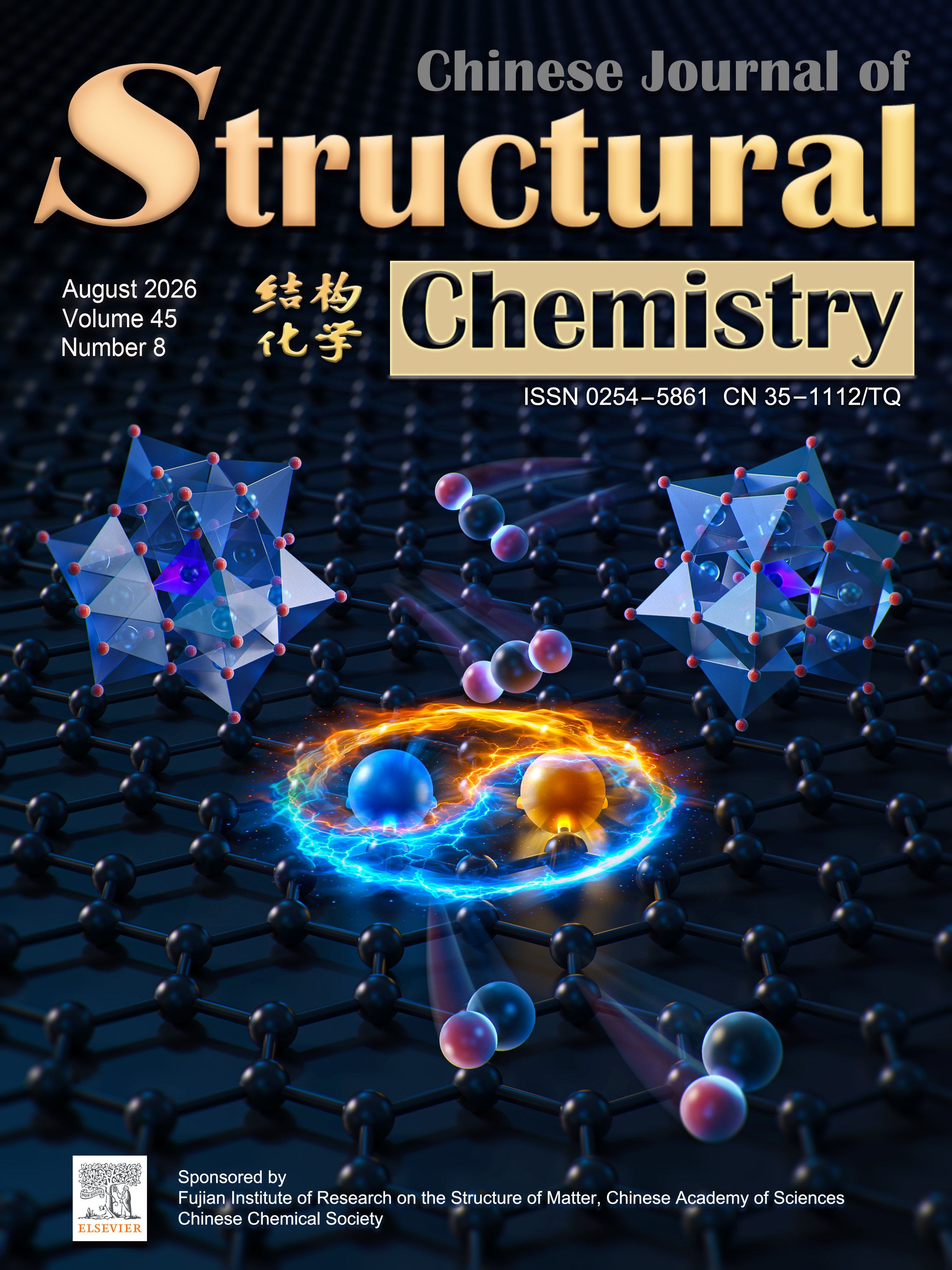
Cover Picture
Boosting efficient electrocatalytic CO2 reduction by two-dimensional polyoxometalate@metal-organic framework composites with asymmetric sites
Teng-Fei Yao, Guo-Ping Yang*, Yao-Yu Wang Submit a Manuscript
Boosting efficient electrocatalytic CO2 reduction by two-dimensional polyoxometalate@metal-organic framework composites with asymmetric sites
Teng-Fei Yao, Guo-Ping Yang*, Yao-Yu Wang Submit a Manuscript
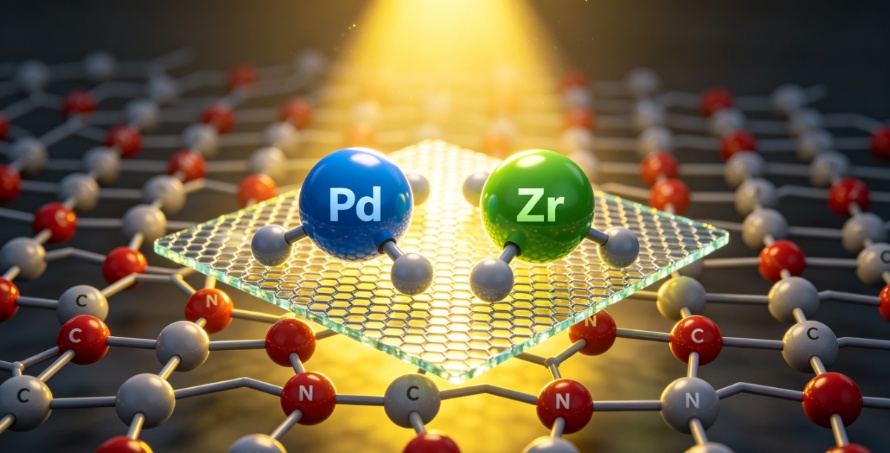
Mixing enthalpy-induced monodispersed Pb-Zr dual-atomic catalysts for efficient photocatalytic hydrogen peroxide production
Wei Zhang#, Dan Liu#, Haishan Zhu#, Longzhou Jin, Shijie Li*, Fang Yang, Yihong Zhang*, Chunqiang Zhuang*
Chin. J. Struct. Chem., 2026, 45(8), 100940. DOI: 10.1016/j.cjsc.2026.100940
August 1, 2026
H2O2 production; Dual atom; Mixing enthalpy; Oxygen reduction reaction
ABSTRACT
Efficient separation and utilization of photogenerated carriers remain central challenges in photocatalysis. Dual-atom systems offer unique opportunities to regulate carrier dynamics through synergistic interactions, yet their rational designs are still lacking. Here, we propose a design strategy for dual-atom photocatalysts based on mixing enthalpy. Guided by this concept, a PbZr dual-atom system was successfully obtained on a carbon nitride support (C3N4). It exhibits outstanding performance in photocatalytic hydrogen peroxide (H2O2), delivering a yield of 69 mmol/g, which is 2.7 times higher than that of pristine C3N4 and surpasses the corresponding single-atom photocatalysts Pb-C3N4 (37.1 mmol/g) and Zr-C3N4 (41.1 mmol/g). Carrier dynamics reveals that synergistic interactions between dual atoms promotes efficient charge separation and transport. Mechanistic investigations demonstrate that H2O2 generation over PbZr-C3N4 proceeds predominantly via an oxygen reduction–driven two-electron pathway. This work establishes a mixing-enthalpy-guided principle for the rational design of efficient dual-atom photocatalysts for oxygen reduction reactions.




- Address: Fuzhou High & New Technology Industrial Zone, Shangjie, Minhou, Fuzhou, Fujian 350108, China
- Tel: (86)-591-63173769, 63173770
- E-mail: cjsc@fjirsm.ac.cn
CN 35–1112/TQ, ISSN 0254–5861, Online ISSN: 2949-768X Copyright @ 2022 Chinese Journal of Structural Chemistry-www.Chinese Journal of Structural Chemistry.net. All Rights Reserved 闽ICP备2022002645号-1