

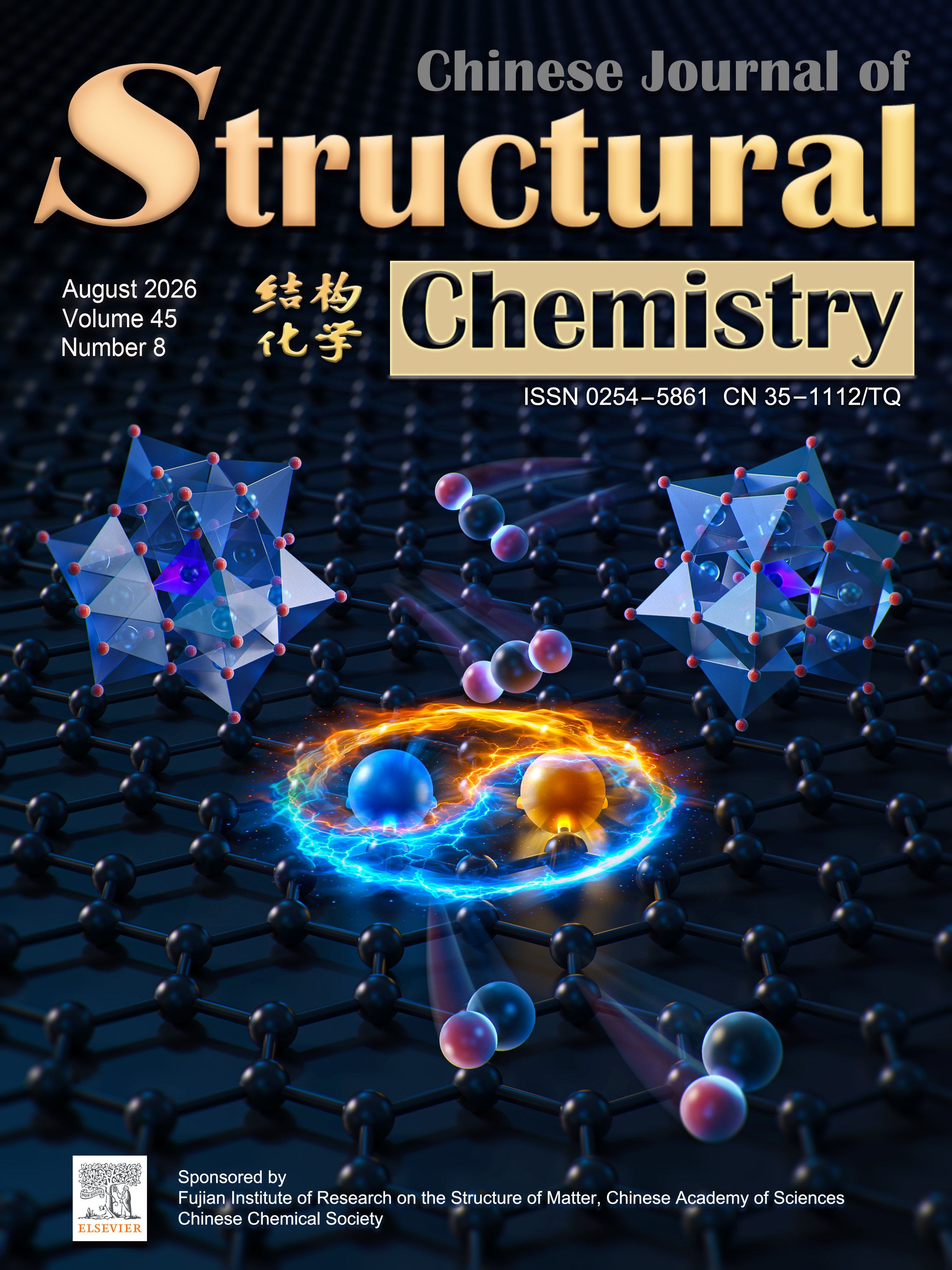
Cover Picture
Boosting efficient electrocatalytic CO2 reduction by two-dimensional polyoxometalate@metal-organic framework composites with asymmetric sites
Teng-Fei Yao, Guo-Ping Yang*, Yao-Yu Wang Submit a Manuscript
Boosting efficient electrocatalytic CO2 reduction by two-dimensional polyoxometalate@metal-organic framework composites with asymmetric sites
Teng-Fei Yao, Guo-Ping Yang*, Yao-Yu Wang Submit a Manuscript
Ultramicroporous metal-incorporated HOF with tailored pore confinement for high-efficiency C2H2/CO2 sieving separation
Yingzhi He, Guangzu Xiong, Wenlei Yang, Yunjia Jiang, Jianbo Hu, Lingyao Wang*, Chaoqun Bian*, Yuanbin Zhang*
Chin. J. Struct. Chem., 2026, 45(8), 100942. DOI: 10.1016/j.cjsc.2026.100942
August 1, 2026
Ultramicroporous material; Hydrogen-bonded organic framework (HOF); C2H2/CO2 separation; Sieving; Gas adsorption
ABSTRACT
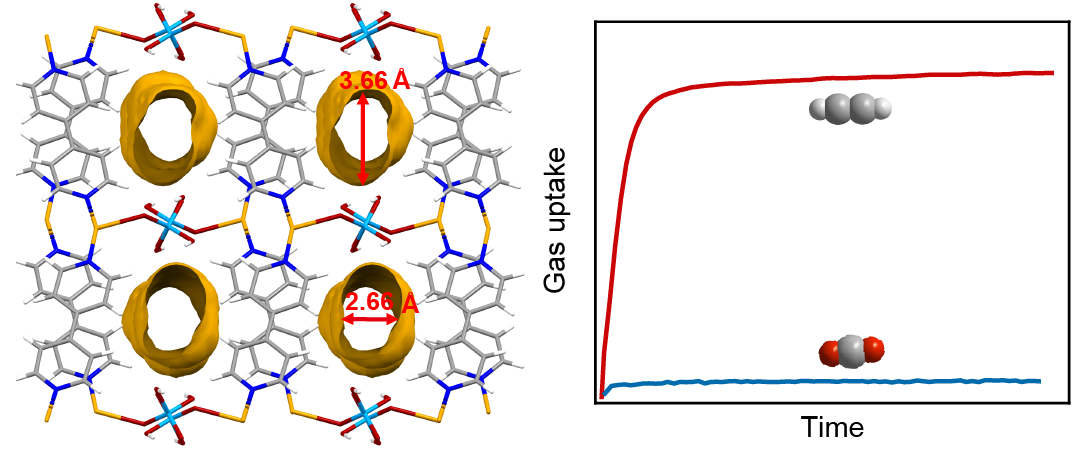
The separation of acetylene (C2H2) from carbon dioxide (CO2) is of great importance in industrial chemical processes but remains challenging due to their similar physical properties. Hydrogen-bonded organic frameworks (HOFs) have emerged as promising adsorbents, yet balancing their structural stability with separation performance requires further optimization. Herein, we report two ionic metal-hybrid HOFs (ZNU-29 and ZNU-30) constructed via ligand modulation and metallization strategies. ZNU-30 features one-dimensional ultramicroporous channels (2.66 × 3.66 Å2) lined with H2PO4- groups and electron-rich pyridine rings, creating a confined pore environment that combines molecular sieving and electrostatic interactions. At 298 K, ZNU-30 exhibits high C2H2 uptake (63.7 cm3/g) and significantly suppressed CO2 adsorption (5.6 cm3/g), leading to an exceptional ideal adsorbed solution theory (IAST) selectivity of 121 for an equimolar C2H2/CO2 mixture. Dynamic breakthrough experiments confirm its excellent practical separation capability. Density functional theory calculations reveal that the superior performance originates from stronger binding affinity and lower diffusion barriers for C2H2 compared to CO2, enabled by the precisely tailored pore geometry and electronegative pore environment. This work offers an effective strategy for designing stable and highly selective metal-hybrid HOFs for challenging gas separations.




- Address: Fuzhou High & New Technology Industrial Zone, Shangjie, Minhou, Fuzhou, Fujian 350108, China
- Tel: (86)-591-63173769, 63173770
- E-mail: cjsc@fjirsm.ac.cn
CN 35–1112/TQ, ISSN 0254–5861, Online ISSN: 2949-768X Copyright @ 2022 Chinese Journal of Structural Chemistry-www.Chinese Journal of Structural Chemistry.net. All Rights Reserved 闽ICP备2022002645号-1