

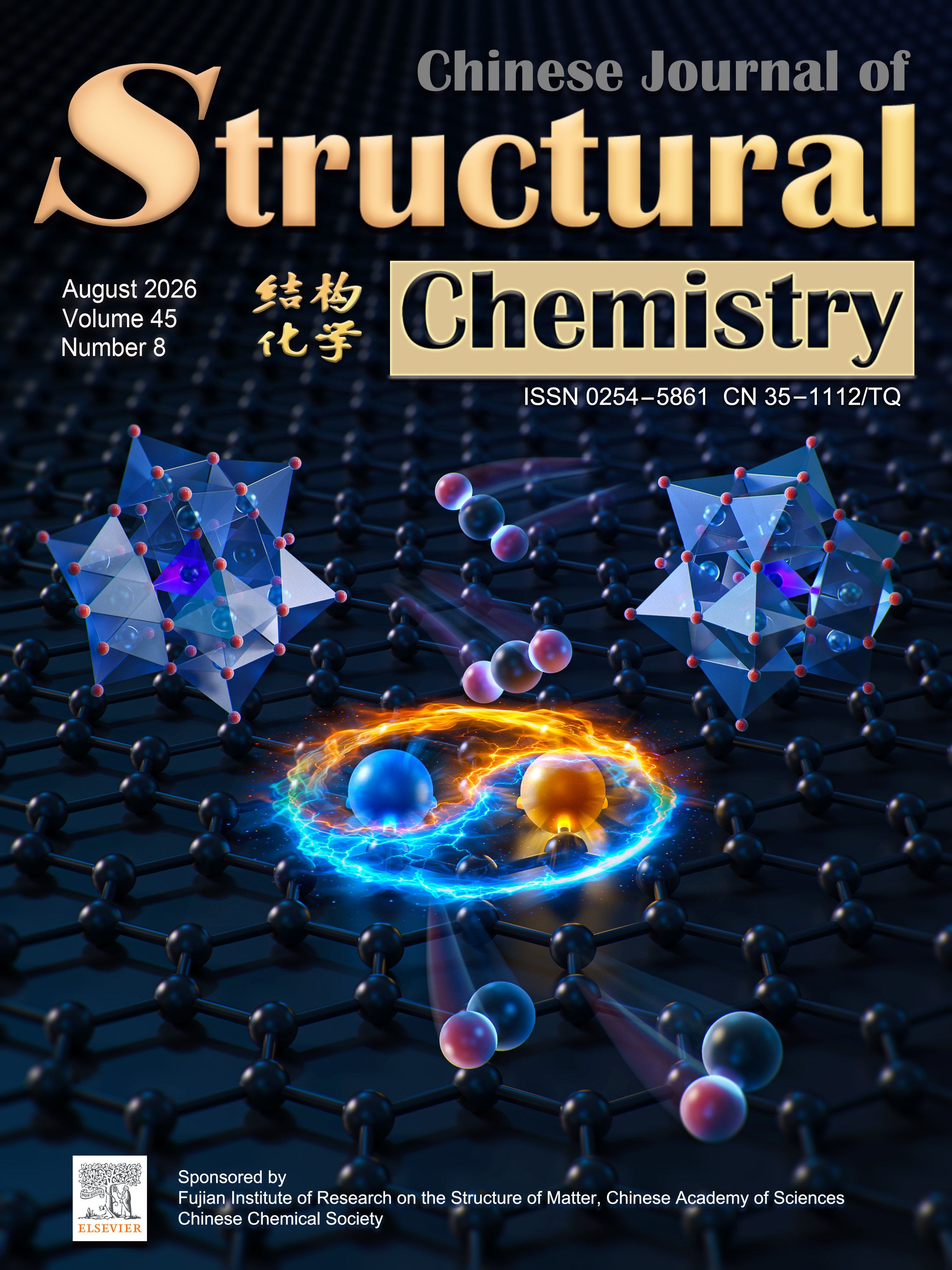
Boosting efficient electrocatalytic CO2 reduction by two-dimensional polyoxometalate@metal-organic framework composites with asymmetric sites
Teng-Fei Yao, Guo-Ping Yang*, Yao-Yu Wang Submit a Manuscript
Yingjie Li, Hailong Hu, Aoqi Wang, Jingru Huang, Shiqi Fu, Zongyin Gao, Shuo Tao, Yalin Zhang*, Qingde Zhang*, Haitao Wang, Xianqiang Huang*
Chin. J. Struct. Chem., 2026, 45(8), 100946. DOI: 10.1016/j.cjsc.2026.100946
August 1, 2026
Polyoxometalates; Bifunctional catalysis; Olefin epoxidation; CO2 fixation
ABSTRACT
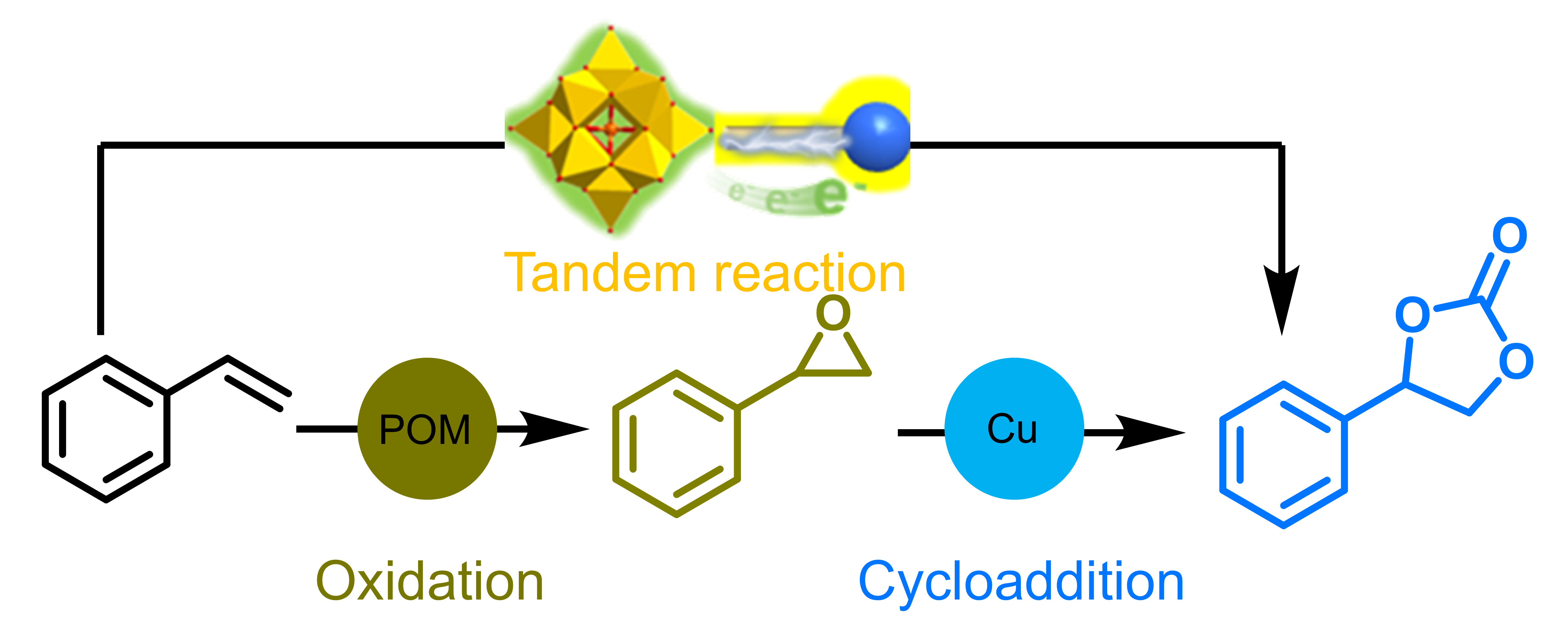
Olefin epoxidation and CO2 cycloaddition are important catalytic reactions for the preparation of cyclic carbonates, valuable intermediates in the chemical industry. The development of a single heterogeneous catalyst capable of efficiently catalyzing both transformations, however, remains a considerable challenge. Herein, two polyoxotungstate-based copper-organic frameworks, [Cu(1-eIM)4]3(VW5O19)2·2(1-eIM) (PCF-1) and [Cu(1-iPIM)4]3[VW12O40]·(OH)3 (PCF-2), have been synthesized and structurally characterized. These compounds possess multidimensional frameworks with excellent solvent and pH stability, and are covalently assembled through Cu-O-W linkages between polyoxotungstate clusters and imidazole-copper units. Density functional theory calculations reveal that the polyoxometalate acidic sites are more favorable for styrene adsorption, whereas the Cu sites preferentially interact with CO2. In catalytic tests, PCF-2 exhibits superior performance in both reactions, giving yields of 88% for olefin epoxidation and 99% for CO2 cycloaddition, together with excellent recycling stability. This study provides an effective strategy for constructing polyoxometalate-based heterogeneous molecular junction catalysts for tandem organic transformations.




- Address: Fuzhou High & New Technology Industrial Zone, Shangjie, Minhou, Fuzhou, Fujian 350108, China
- Tel: (86)-591-63173769, 63173770
- E-mail: cjsc@fjirsm.ac.cn