

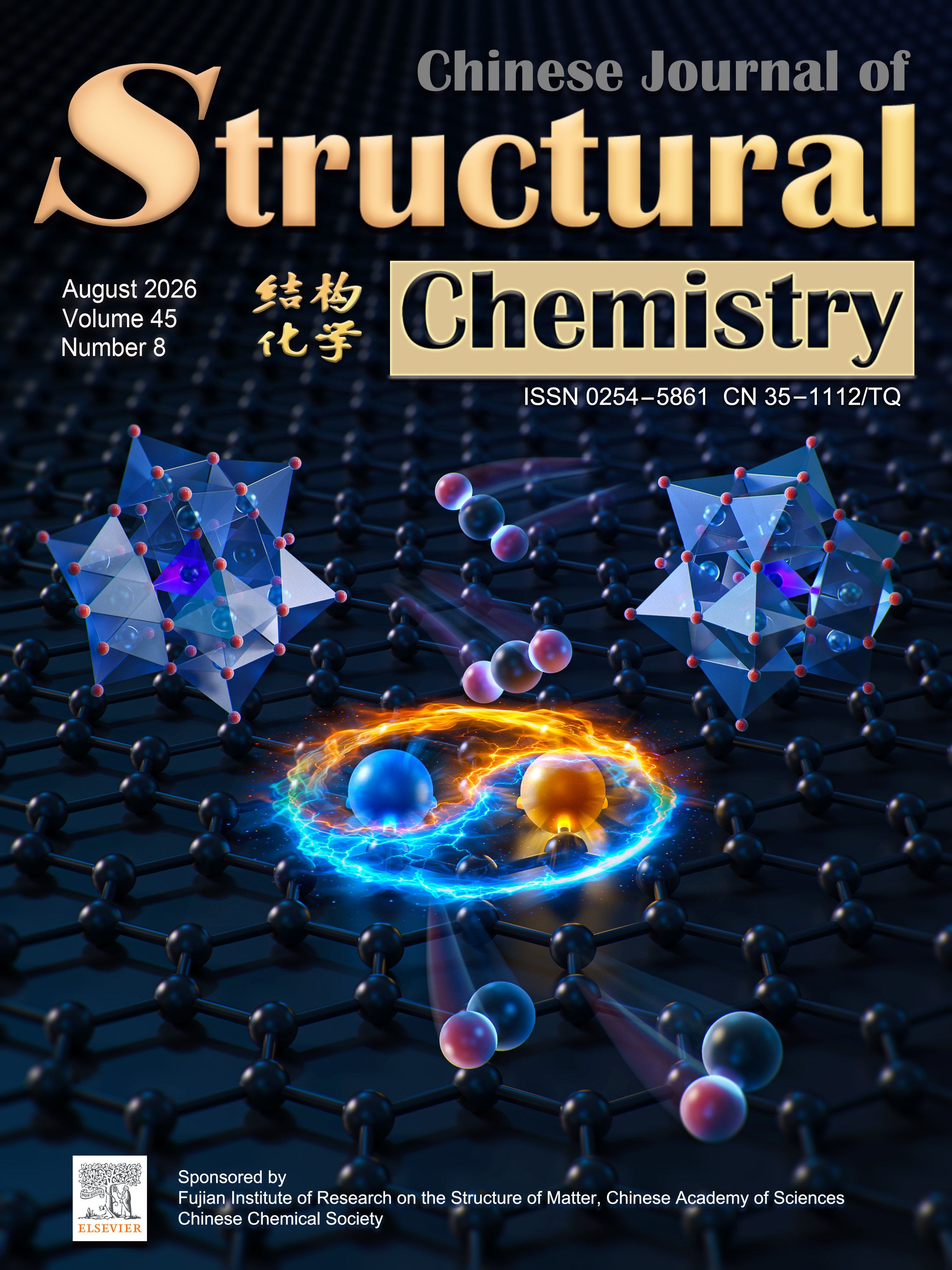
Cover Picture
Boosting efficient electrocatalytic CO2 reduction by two-dimensional polyoxometalate@metal-organic framework composites with asymmetric sites
Teng-Fei Yao, Guo-Ping Yang*, Yao-Yu Wang Submit a Manuscript
Boosting efficient electrocatalytic CO2 reduction by two-dimensional polyoxometalate@metal-organic framework composites with asymmetric sites
Teng-Fei Yao, Guo-Ping Yang*, Yao-Yu Wang Submit a Manuscript
Metal-incorporated polymeric resists with tunable lithographic performance via complex-specific design
Xi Liang, Mei-Hua Xiong, Er-Xia Chen, Lu-Yao Hao, Jin-Xia Yang*, Jian Zhang*, Qipu Lin*
Chin. J. Struct. Chem., 2026, 45(8), 100947. DOI: 10.1016/j.cjsc.2026.100947
August 1, 2026
Non-chemically amplified resists; electron-beam lithography; organometal-incorporated polymers; EUV lithography; negative-tone photoresists
ABSTRACT
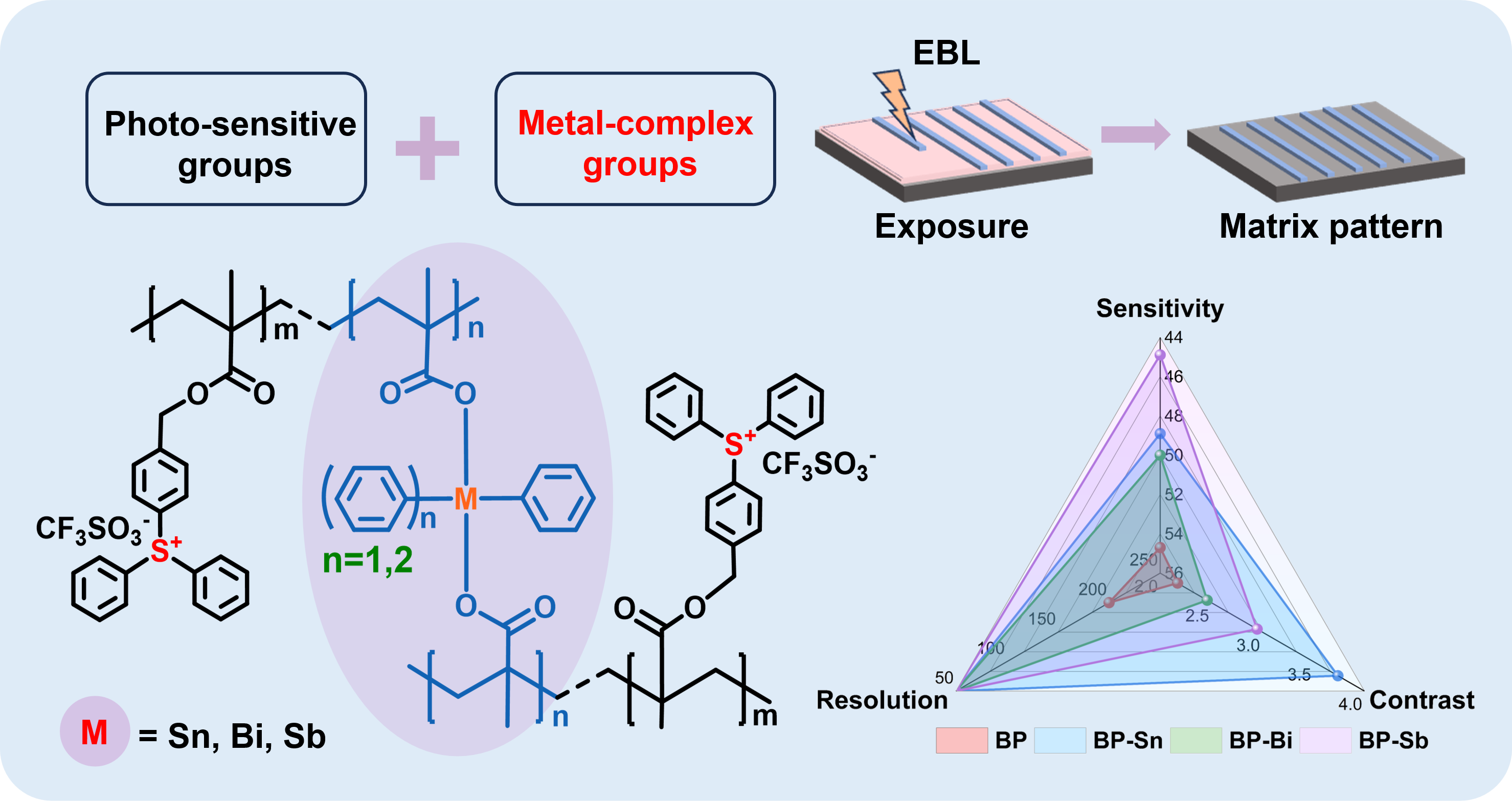
The continued scaling of extreme ultraviolet (EUV) lithography demands photoresists whose key parameters—resolution, sensitivity, and contrast—can be independently tailored to meet the specific requirements of advanced nanofabrication. Herein, we introduce a series of non-chemically amplified negative-tone photoresists based on metal-incorporated polymers, denoted as BP-M (M = Sn, Sb, Bi). The resists are constructed by covalently embedding heavy-metal complexes into a sulfonium-functionalized polymer backbone. Even at low metal loadings, the high EUV absorption and distinct photoreactivity of the metal centers enable efficient patterning without chemical amplification. Despite comparable EUV absorption coefficients, each metal imparts a unique lithographic signature: BP-Sb exhibits the highest sensitivity, BP-Bi achieves the finest resolution, and BP-Sn delivers the sharpest contrast. Lithographic performance can thus be predictably modulated through simple metal substitution. Mechanistic studies uncover a dual-action pathway wherein cleavage of metal–carbon bonds generates cross-linking radicals, while decomposition of sulfonium moieties induces polarity reversal—synergistically driving a pronounced solubility switch. This "complex–polymer synergistic design" establishes a rational platform for resist engineering, positioning antimony and bismuth as sustainable alternatives to conventional tin-based systems.




- Address: Fuzhou High & New Technology Industrial Zone, Shangjie, Minhou, Fuzhou, Fujian 350108, China
- Tel: (86)-591-63173769, 63173770
- E-mail: cjsc@fjirsm.ac.cn
CN 35–1112/TQ, ISSN 0254–5861, Online ISSN: 2949-768X Copyright @ 2022 Chinese Journal of Structural Chemistry-www.Chinese Journal of Structural Chemistry.net. All Rights Reserved 闽ICP备2022002645号-1