

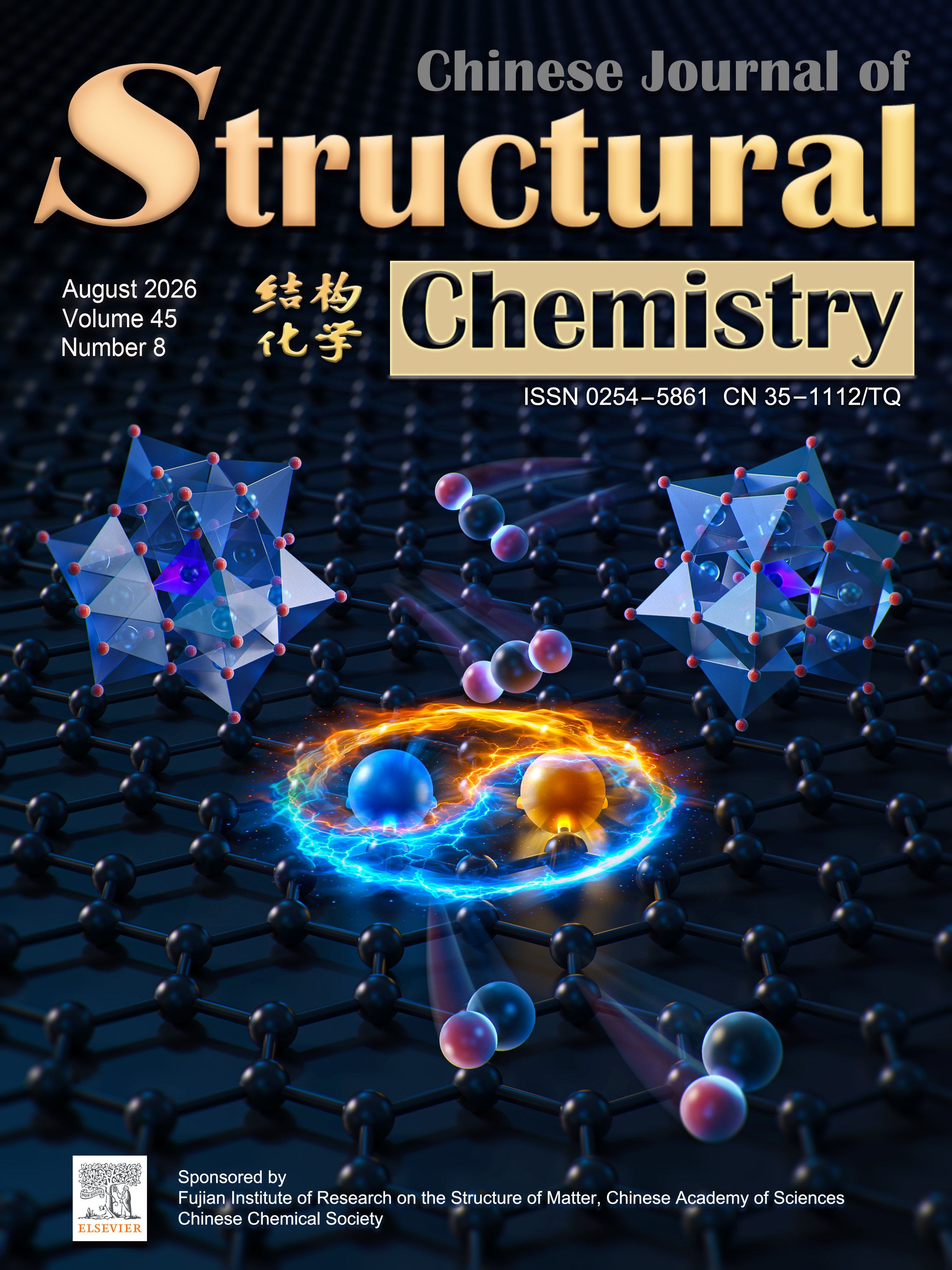
Cover Picture
Boosting efficient electrocatalytic CO2 reduction by two-dimensional polyoxometalate@metal-organic framework composites with asymmetric sites
Teng-Fei Yao, Guo-Ping Yang*, Yao-Yu Wang Submit a Manuscript
Boosting efficient electrocatalytic CO2 reduction by two-dimensional polyoxometalate@metal-organic framework composites with asymmetric sites
Teng-Fei Yao, Guo-Ping Yang*, Yao-Yu Wang Submit a Manuscript
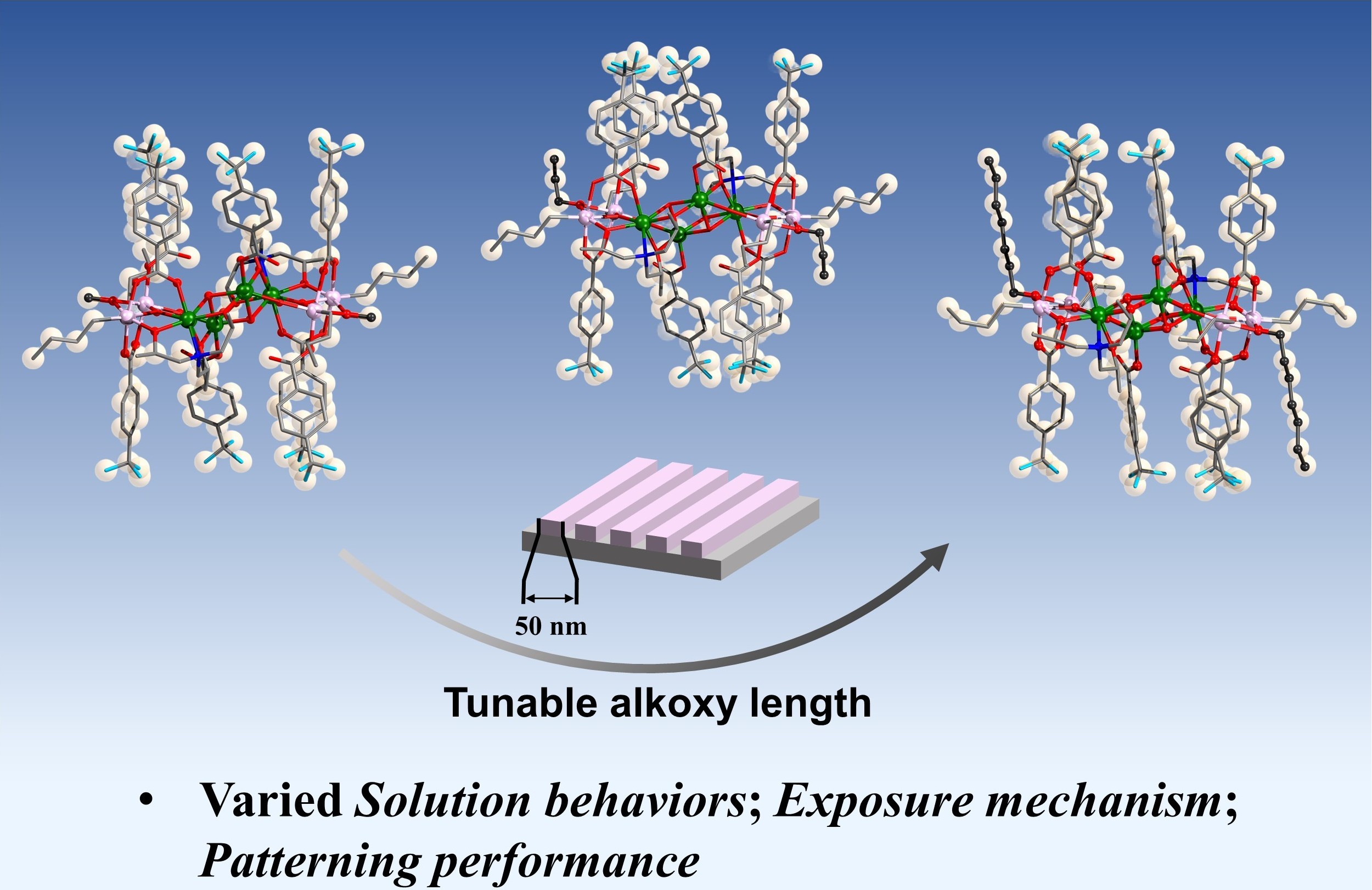
Alkoxy chain-length engineering in heterometallic In-Sn-oxo clusters for nanolithography
Zhaoke Jin, Weizhou Chen, Yifan Hou, Yuting Ye, Xiuzhen Wang, Xiaofeng Yi*, Jian Zhang*
Chin. J. Struct. Chem., 2026, 45(8), 100949. DOI: 10.1016/j.cjsc.2026.100949
August 1, 2026
In-Sn-oxo-clusters; Atomically precise structures; Tunable alkoxy chain-length; Solution processability; Nanolithography
ABSTRACT
The limited solubility and solution processability of metal-oxo clusters often hinder their practical application. To address this, we employed a ligand engineering strategy to synthesize a family of In4Sn4-oxo clusters (InOC-31 to InOC-37) sharing an identical core but functionalized with alkoxy ligands of progressively increasing chain lengths (C1–C7). The influence of alkoxy chain length and conformation on solubility, solution processability, patterning mechanism, and lithographic performance is thoroughly investigated. Solubility in 4-heptanone increases monotonically from 14.7 mg/mL (C1, InOC-31) to 31.4 mg/mL (C7, InOC-37). The resulting clusters exhibit excellent stability and tunable solubility, enabling high-quality thin-film fabrication via spin-coating. Four representative clusters (InOC-31 to InOC-34) each achieved fine patterning at 50 nm linewidth, with the propoxy-functionalized InOC-33 exhibiting optimal performance, including high sensitivity and better line edge roughness. Combined experimental and theoretical analyses reveal that the exposure mechanism involves Sn–butylene/phenyl–Sn crosslinking, multipath cleavage of carboxylate ligands, and competing decomposition routes of the alkoxy ligands. Notably, we propose a novel mechanism wherein alkoxy chain length dictates the decomposition route—proceeding either via direct dissociation or through β-H elimination to form alkenes—which critically governs the observed variations in lithographic performance. This newly elucidated lithographic mechanism provides valuable insights for the design of next-generation metal-based photoresist materials.




- Address: Fuzhou High & New Technology Industrial Zone, Shangjie, Minhou, Fuzhou, Fujian 350108, China
- Tel: (86)-591-63173769, 63173770
- E-mail: cjsc@fjirsm.ac.cn
CN 35–1112/TQ, ISSN 0254–5861, Online ISSN: 2949-768X Copyright @ 2022 Chinese Journal of Structural Chemistry-www.Chinese Journal of Structural Chemistry.net. All Rights Reserved 闽ICP备2022002645号-1