

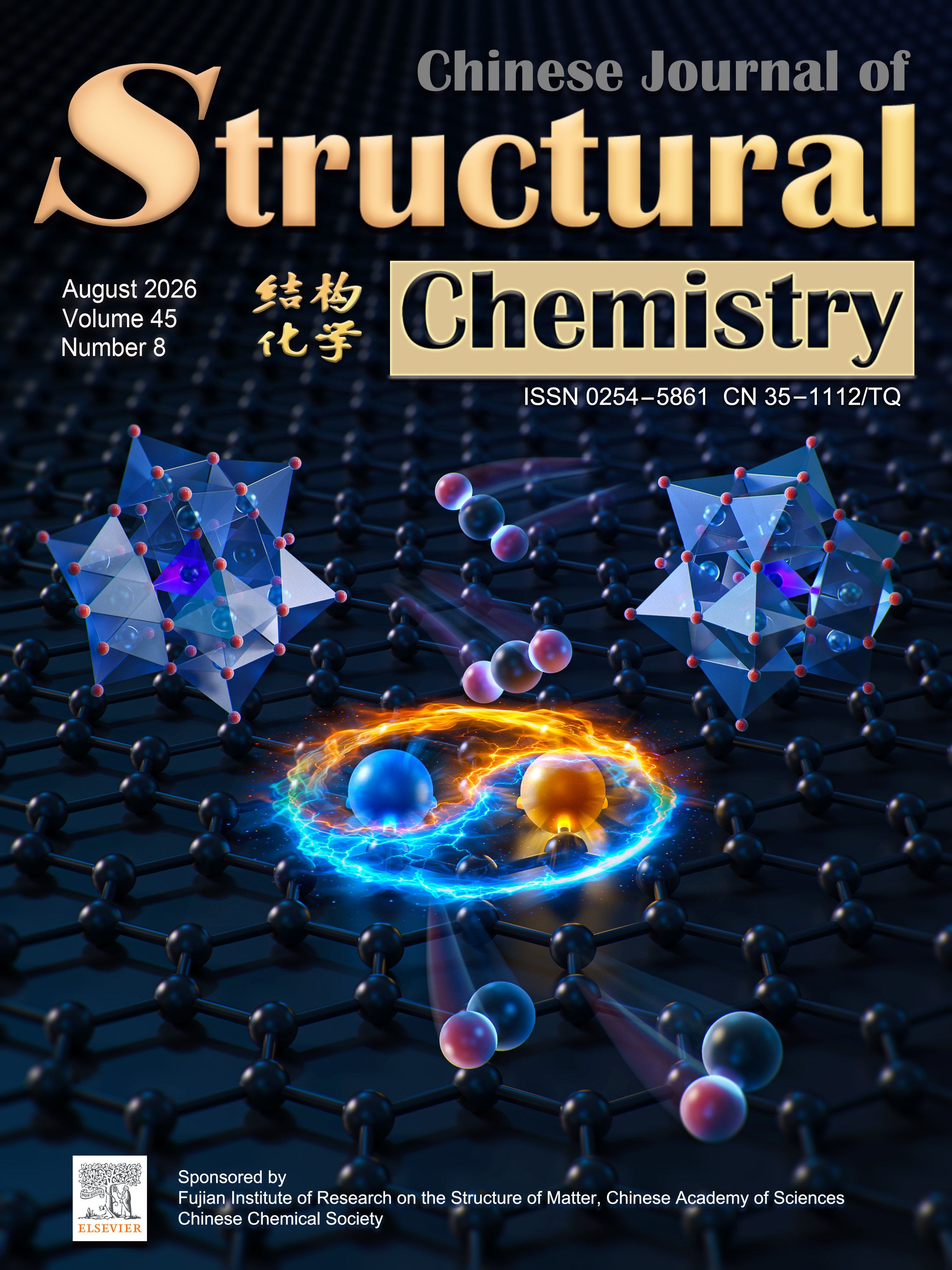
Cover Picture
Boosting efficient electrocatalytic CO2 reduction by two-dimensional polyoxometalate@metal-organic framework composites with asymmetric sites
Teng-Fei Yao, Guo-Ping Yang*, Yao-Yu Wang Submit a Manuscript
Boosting efficient electrocatalytic CO2 reduction by two-dimensional polyoxometalate@metal-organic framework composites with asymmetric sites
Teng-Fei Yao, Guo-Ping Yang*, Yao-Yu Wang Submit a Manuscript
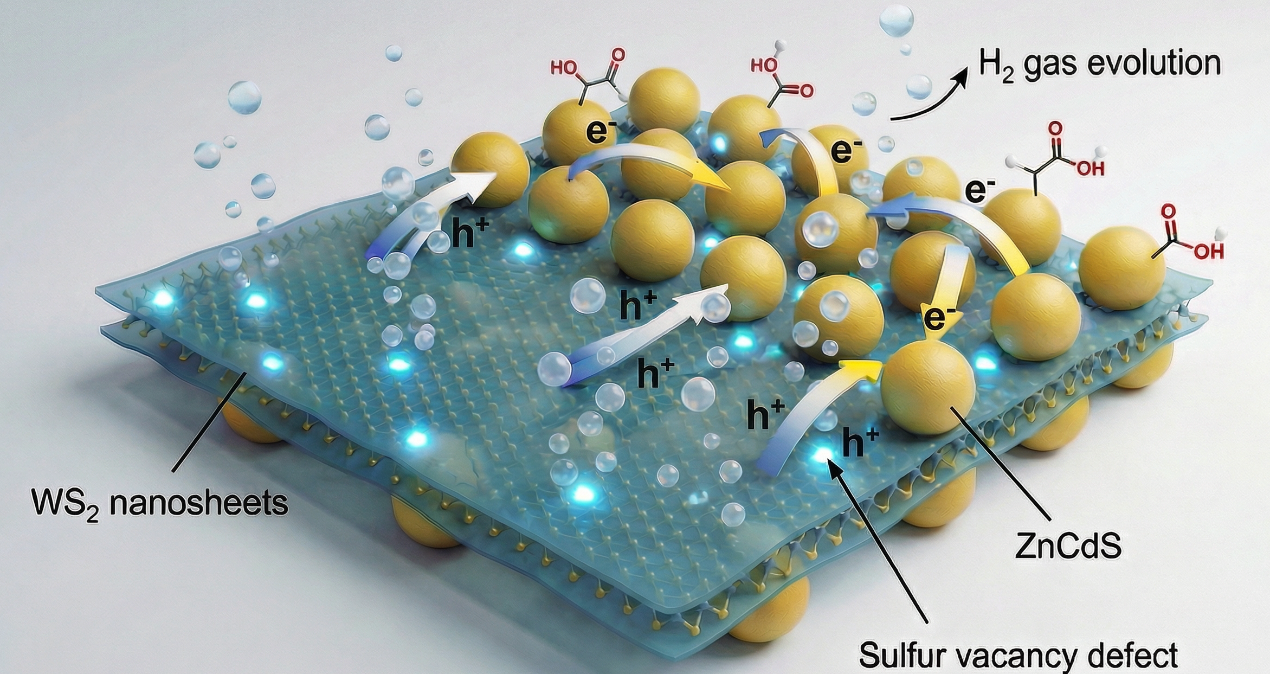
Defect-enhanced charge separation in ZnCdS/WS2 S-scheme heterojunctions: Engineering sulfur vacancies to facilitate photocatalytic H2 production
Tuo Guo, Guojing Hu, Jiaxin Liu, Li Chen, Guangmin Ren*, Qingjie Guo*
Chin. J. Struct. Chem., 2026, 45(8), 100960. DOI: 10.1016/j.cjsc.2026.100960
August 1, 2026
Vs-WS2; ZnCdS; S vacancy; Photocatalytic hydrogen evolution; S-scheme heterojunction
ABSTRACT
The rational construction of active sites on the inner surface of heterojunction can enhance the photocatalyst carrier separation efficiency and photocatalytic activity. Herein, the sulfur-deficient-rich WS2 (Vs-WS2) was selected and complexed with ZnCdS to construct a step-scheme (S-scheme) heterojunction (ZCSW-Vs) with good photocatalytic hydrogen evolution reaction (HER) activity. The optimized photocatalyst ZCSW-Vs exhibited excellent H2 evolution rate of 84.63 mmol g-1 h-1, which was about 14-fold enhanced compared with that of ZCSW. The excellent photocatalytic activity was attributed to S vacancies optimizing the adsorption of hydrogen during the reaction process, according to characterization and density functional theory (DFT) calculations. In addition, the internal electric field of the ZCSW-Vs heterojunction significantly promoted carrier-directed migration. This work provides the insights into the design of efficient photocatalytic materials and the explanation of the reaction mechanism through the synergistic effect of vacancies and S-scheme heterojunctions.




- Address: Fuzhou High & New Technology Industrial Zone, Shangjie, Minhou, Fuzhou, Fujian 350108, China
- Tel: (86)-591-63173769, 63173770
- E-mail: cjsc@fjirsm.ac.cn
CN 35–1112/TQ, ISSN 0254–5861, Online ISSN: 2949-768X Copyright @ 2022 Chinese Journal of Structural Chemistry-www.Chinese Journal of Structural Chemistry.net. All Rights Reserved 闽ICP备2022002645号-1