


Cover Picture
Poly (triazine imide) single crystals with chlorine-terminated facets enable chlorine-tolerant photocatalytic seawater splitting
Wei Xu, Xiaosheng Dang, Qian Wang, Yidong Hou*, Masakazu Anpo, Guigang Zhang* Submit a Manuscript
Poly (triazine imide) single crystals with chlorine-terminated facets enable chlorine-tolerant photocatalytic seawater splitting
Wei Xu, Xiaosheng Dang, Qian Wang, Yidong Hou*, Masakazu Anpo, Guigang Zhang* Submit a Manuscript
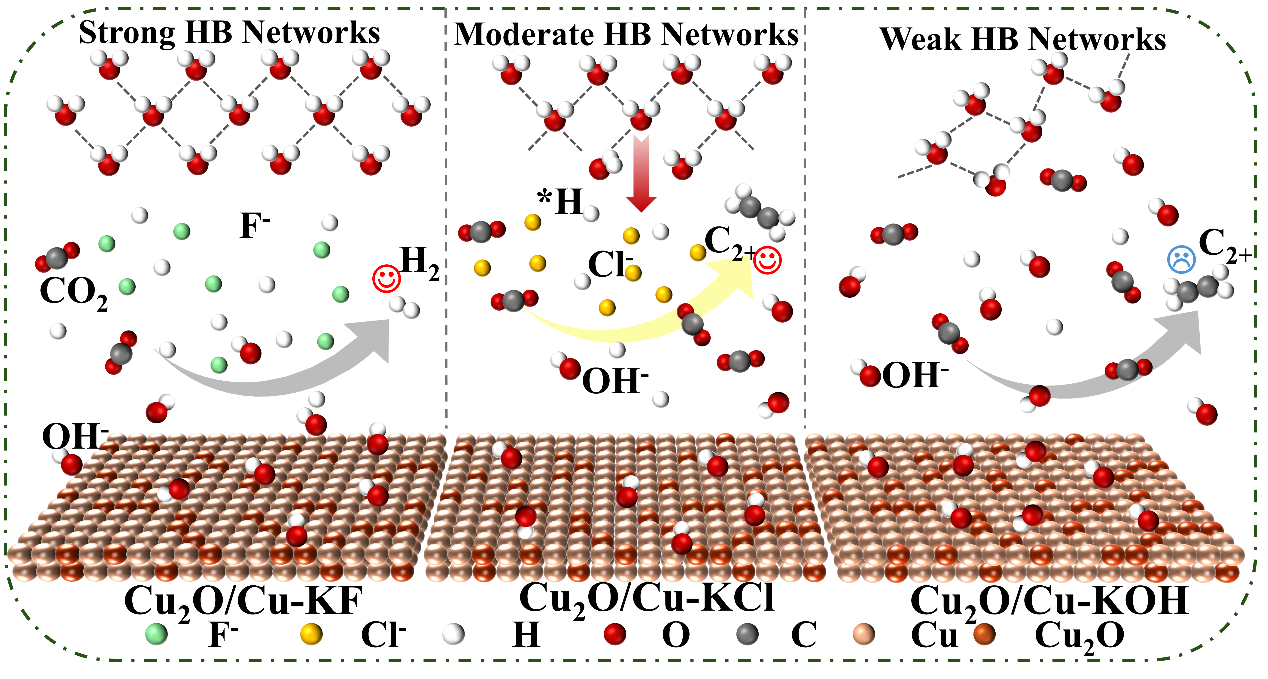
Anions-mediated interfacial-water regulation boosts C2+ selectivity for CO2 electroreduction over Cu-based catalysts
Tingting Gong, Zhen Liu, Wen Jin, Jiamei Li, Min Wang*, Luhua Jiang*
Chin. J. Struct. Chem., 2026, 45(9), 100967. DOI: 10.1016/j.cjsc.2026.100967
September 1, 2026
CO2 electrochemical reduction; Cu-based catalysts; Interfacial water; Anions; In-situ ATR-SEIRAS
ABSTRACT
The electrochemical CO2 reduction reaction (CO2RR) offers a promising strategy to produce high-value-added C2+ products. Cu-based catalysts enable C-C coupling but suffer from low C2+ selectivity. Although electronic/structural engineering and cation effects have been widely studied, the role of anions in tuning interfacial water structure and CO2RR pathways remains insufficiently understood. Herein, a series of low-concentration anions were introduced into 1 M KOH to regulate the interfacial water environment over reconstructed CuO. By combining in-situ attenuated total reflection surface-enhanced infrared absorption spectroscopy (ATR-SEIRAS) and electrochemical impedance spectroscopy, it is revealed that low-concentration anions in 1 M KOH increase the proportion of strong interfacial-water structure in the order of F- > Cl- > Br- > NO3-. Moreover, the moderate strong interfacial-water structure can accelerate *H transfer and promote *CO hydrogenation to *COH, thus favoring asymmetric C-C coupling to produce C2+ products. However, excessively stable interfacial water structure in F--containing electrolyte induces enhanced *H coverage and dominant H2 evolution. A volcano-type relationship is thus observed between C2+ selectivity and the proportion of strongly hydrogen-bonded water. This work emphasizes anion-mediated interfacial water regulation as an effective strategy to enhance C2+ selectivity for CO2RR.




- Address: Fuzhou High & New Technology Industrial Zone, Shangjie, Minhou, Fuzhou, Fujian 350108, China
- Tel: (86)-591-63173769, 63173770
- E-mail: cjsc@fjirsm.ac.cn
CN 35–1112/TQ, ISSN 0254–5861, Online ISSN: 2949-768X Copyright @ 2022 Chinese Journal of Structural Chemistry-www.Chinese Journal of Structural Chemistry.net. All Rights Reserved 闽ICP备2022002645号-1