


Cover Picture
Poly (triazine imide) single crystals with chlorine-terminated facets enable chlorine-tolerant photocatalytic seawater splitting
Wei Xu, Xiaosheng Dang, Qian Wang, Yidong Hou*, Masakazu Anpo, Guigang Zhang* Submit a Manuscript
Poly (triazine imide) single crystals with chlorine-terminated facets enable chlorine-tolerant photocatalytic seawater splitting
Wei Xu, Xiaosheng Dang, Qian Wang, Yidong Hou*, Masakazu Anpo, Guigang Zhang* Submit a Manuscript
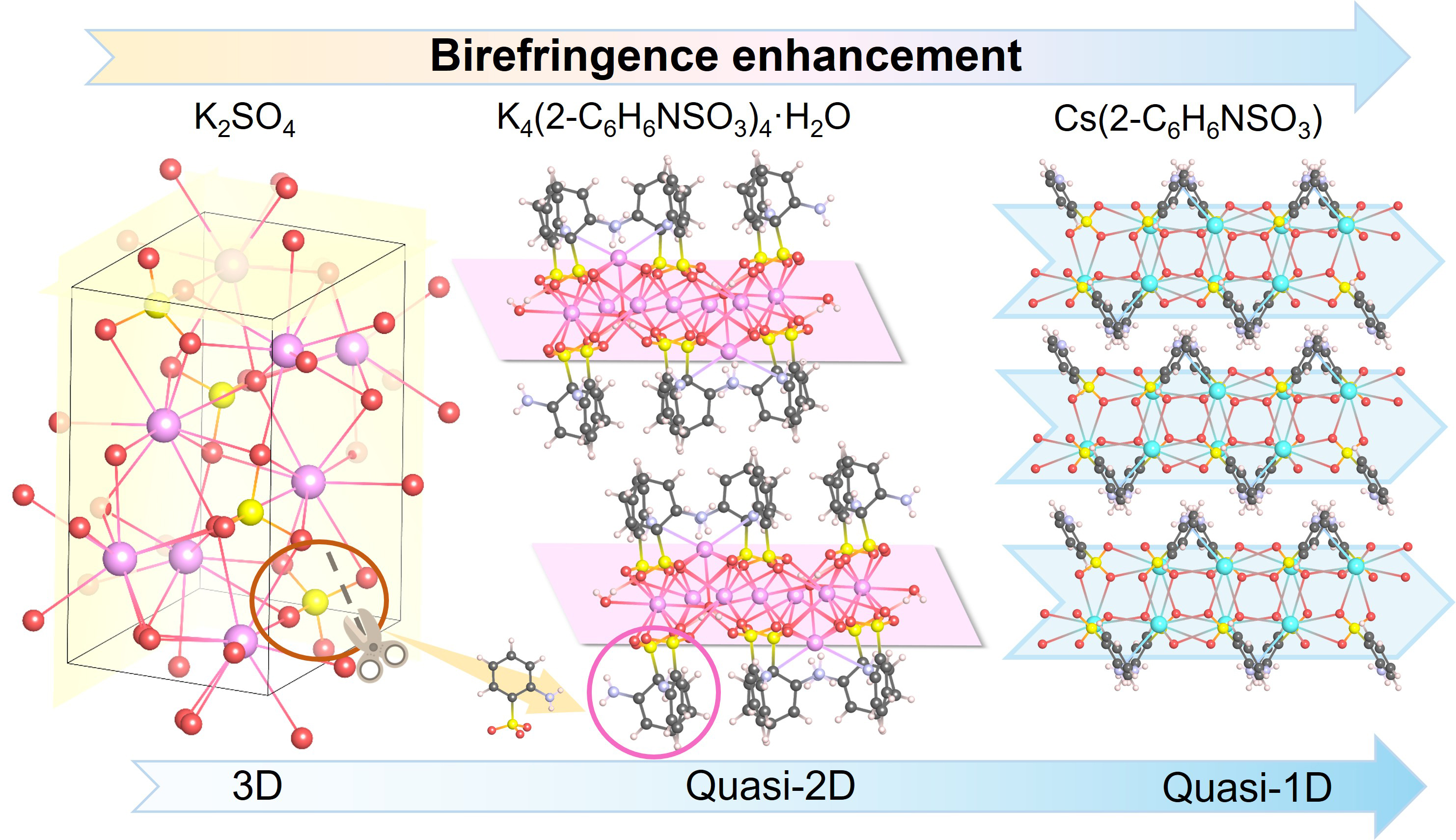
Cation-sulfur-driven dimensional reduction engineering for tailoring sulfonate birefringent crystals with enhanced anisotropy
Hanjing Huang, Longyun Xu*, Wenli Zhao, Huijian Zhao, Xianghao Kong, Ning Ye, Zhanggui Hu, Conggang Li*
Chin. J. Struct. Chem., 2026, 45(9), 100970. DOI: 10.1016/j.cjsc.2026.100970
September 1, 2026
Birefringent crystals; Sulfonate; Dimension engineering
ABSTRACT
Birefringent crystals are critical for advanced photonic technologies, yet achieving substantial optical anisotropy through rational structural design remains a challenge. Herein, we propose a multiscale structural engineering strategy that couples anisotropic functional building units (FBUs) with cation-sulfur mediated dimensional modulation to enhance optical anisotropy. Three new birefringent crystals, K4(2-ABS)4·H2O (I), Rb4(2-ABS)4·H2O (II), and Cs(2-ABS) (III) were identified by mediating the spatial matching between distinct cations and sulfurs to trigger structural evolution. Notably, the structural evolution from a quasi-2D layered arrangement (I and II) to a quasi-1D chain (III) leads to a significant enhancement in birefringence from 0.167 and 0.155 to 0.344 at 532 nm, nearly two orders of magnitude larger than that of K2SO4 and exceeding widely used commercial birefringent crystals. Structural analysis and first-principles calculations reveal a distinct dimensional transition from quasi-2D frameworks (I and II) to a quasi-1D structure (III), where dimensional reduction synergistically cooperates with the intrinsic polarizability anisotropy of [2-ABS]- to markedly enhance birefringence. This work demonstrates the effectiveness and general applicability of multiscale structural modulation as a design principle for birefringent crystal architectures.




- Address: Fuzhou High & New Technology Industrial Zone, Shangjie, Minhou, Fuzhou, Fujian 350108, China
- Tel: (86)-591-63173769, 63173770
- E-mail: cjsc@fjirsm.ac.cn
CN 35–1112/TQ, ISSN 0254–5861, Online ISSN: 2949-768X Copyright @ 2022 Chinese Journal of Structural Chemistry-www.Chinese Journal of Structural Chemistry.net. All Rights Reserved 闽ICP备2022002645号-1