


Poly (triazine imide) single crystals with chlorine-terminated facets enable chlorine-tolerant photocatalytic seawater splitting
Wei Xu, Xiaosheng Dang, Qian Wang, Yidong Hou*, Masakazu Anpo, Guigang Zhang* Submit a Manuscript
Wei Xu, Xiaosheng Dang, Qian Wang, Yidong Hou*, Masakazu Anpo, Guigang Zhang*
Chin. J. Struct. Chem., 2026, 45(9), 100973. DOI: 10.1016/j.cjsc.2026.100973
September 1, 2026
Photocatalysis; Seawater splitting; Poly (triazine imide); Chlorine tolerance; Ion-framework interaction
ABSTRACT
Photocatalytic overall seawater splitting represents
a sustainable route to hydrogen production but is fundamentally limited by
chloride-induced catalyst corrosion and competing chlorine evolution reactions.
Polymeric photocatalysts are attractive for this process; however, intrinsic
chlorine tolerance remains elusive. Here we report that poly (triazine imide)
single crystals with exposed {1010} facets enable efficient and stable photocatalytic
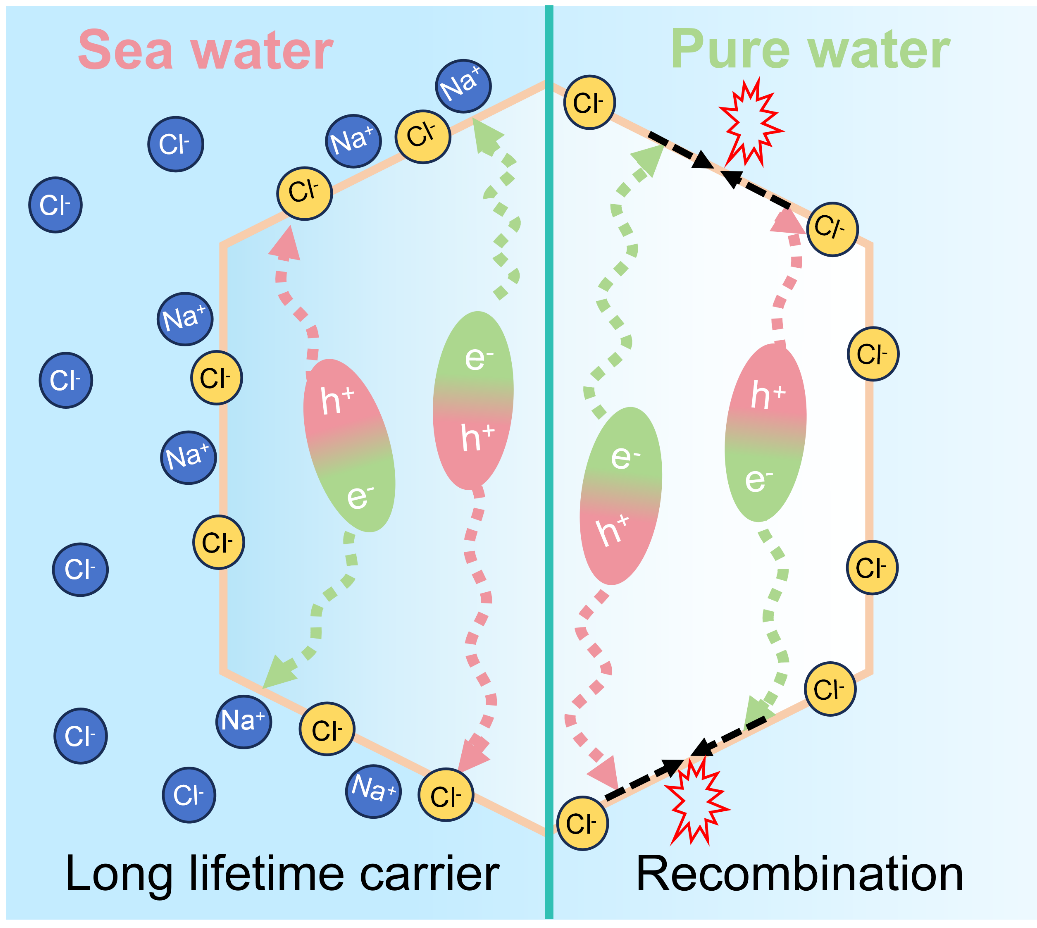
overall seawater splitting. A surface-bound Cl- layer forms an
electrostatic shield that suppresses chloride corrosion, while preferential Na+ adsorption generates
a strong interfacial electric field that enhances charge separation and extends
carrier lifetimes. Consequently, continuous H₂ and O₂ evolution with a
stoichiometric 2:1 ratio and without detectable chlorine by-products is
achieved under irradiation in natural seawater. These results reveal an
ion–framework cooperative mechanism and establish a feasible design principle for
chlorine-tolerant polymeric photocatalysts.




- Address: Fuzhou High & New Technology Industrial Zone, Shangjie, Minhou, Fuzhou, Fujian 350108, China
- Tel: (86)-591-63173769, 63173770
- E-mail: cjsc@fjirsm.ac.cn