


Cover Picture
Poly (triazine imide) single crystals with chlorine-terminated facets enable chlorine-tolerant photocatalytic seawater splitting
Wei Xu, Xiaosheng Dang, Qian Wang, Yidong Hou*, Masakazu Anpo, Guigang Zhang* Submit a Manuscript
Poly (triazine imide) single crystals with chlorine-terminated facets enable chlorine-tolerant photocatalytic seawater splitting
Wei Xu, Xiaosheng Dang, Qian Wang, Yidong Hou*, Masakazu Anpo, Guigang Zhang* Submit a Manuscript
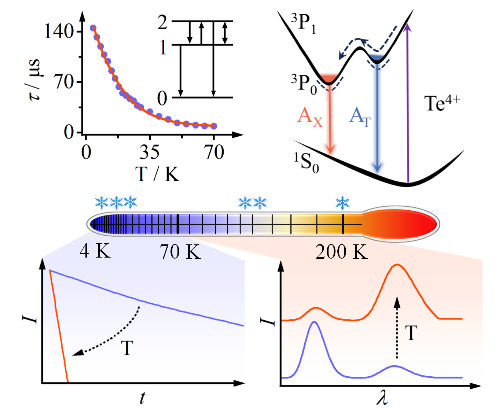
Unveiling the Jahn-Teller effect in the excited-state dynamics of Te4+ in 0D Cs2ScCl5·H2O for cryogenic temperature sensing
Wei Zhang#, Junxiang Liu#, Chenyin Zheng, Zhiqing Shao, Hao Zhang, Dengfeng Yang, Xia Mao, Ping Huang, Xueyuan Chen*, Wei Zheng*
Chin. J. Struct. Chem., 2026, 45(9), 100976. DOI: 10.1016/j.cjsc.2026.100976
September 1, 2026
Tellurium; Jahn-Teller effect; Excited-state dynamics; Fluorescent lifetime thermometry; Cryogenic temperature
ABSTRACT
Fluorescence lifetime (FL)-based thermometry has been widely applied in diverse technological fields owing to its self-referencing capability, high sensitivity, and reliability. However, conventional FL thermometers generally rely on thermally activated nonradiative relaxation processes, limiting their use for cryogenic sensing below liquid nitrogen temperature (77 K). Herein, we report a new FL thermometric method based on Te4+-doped 0D Cs2ScCl5·H2O crystals, which operates independently of nonradiative relaxation and enables accurate and reliable cryogenic temperature detection down to liquid helium temperature (4 K), achieving a maximum relative sensitivity of 8.5% K–1 at 10 K. Specifically, we demonstrate that the photoluminescence (PL) in Cs2ScCl5·H2O: Te4+ originates from the 3P0,1 → 1S0 transitions of isolated Te4+ centers. This is evidenced by the strong temperature dependence of the dual-band emissions at low temperatures (induced by a dynamic Jahn-Teller effect) and the PL lifetime dictated by the interplay between spin-forbidden and spin−orbital allowed transitions. These findings not only provide fundamental insights into the excited-state dynamics of Te4+ in metal halides, but also establish a general approach for ultralow-temperature FL sensing utilizing main-group s-electron ions.




- Address: Fuzhou High & New Technology Industrial Zone, Shangjie, Minhou, Fuzhou, Fujian 350108, China
- Tel: (86)-591-63173769, 63173770
- E-mail: cjsc@fjirsm.ac.cn
CN 35–1112/TQ, ISSN 0254–5861, Online ISSN: 2949-768X Copyright @ 2022 Chinese Journal of Structural Chemistry-www.Chinese Journal of Structural Chemistry.net. All Rights Reserved 闽ICP备2022002645号-1