


Cover Picture
Strengthening hydrophilicity in covalent-organic frameworks to boost CO2 photoreduction
Si-Zhan Feng†, Chong-Jiu Lu†, Ji-Hua Deng*, Tong-Bu Lu, Di-Chang Zhong* Submit a Manuscript
Strengthening hydrophilicity in covalent-organic frameworks to boost CO2 photoreduction
Si-Zhan Feng†, Chong-Jiu Lu†, Ji-Hua Deng*, Tong-Bu Lu, Di-Chang Zhong* Submit a Manuscript
Antimony-activated switchable radiation recombination in a single zinc-based hybrid halide crystal for multispectral image fusion
Peng Gao, Sheng Gao, Haoyu Zhang, Yifan Li, Yameng Chen*, Youchao Wei*, Yongsheng Liu*, Maochun Hong*
Chin. J. Struct. Chem., 2026, 45(10), 100981. DOI: 10.1016/j.cjsc.2026.100981
October 1, 2026
Metal halides; Sb3+ doping; White-light emission; NIR luminescence; X-ray scintillators; Image fusion
ABSTRACT
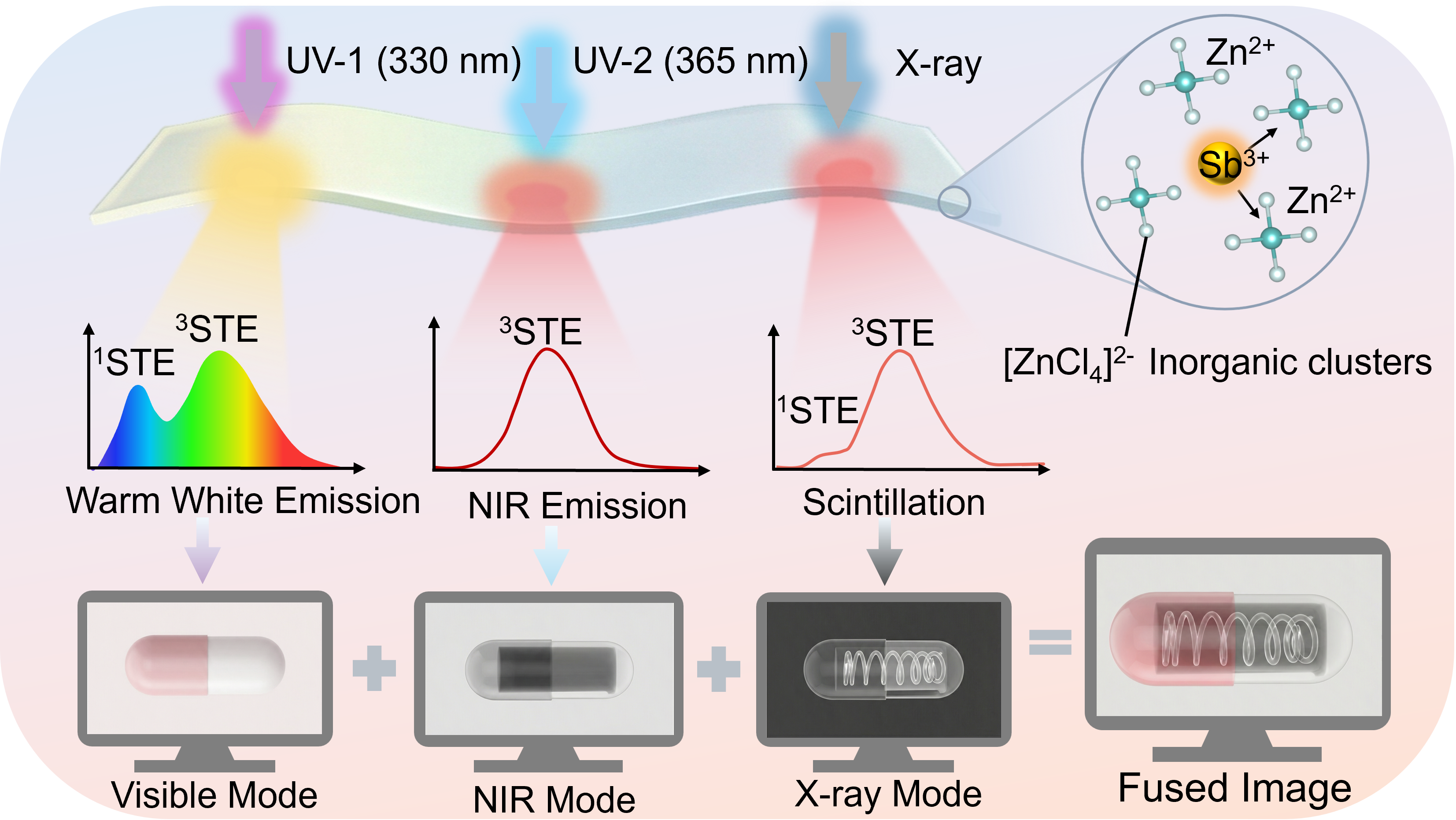
Multispectral image fusion, integrating X-ray, visible, and near-infrared (NIR) signals, is revolutionizing the acquisition of comprehensive structural information. However, conventional multi-detector systems suffer from pixel misalignment and complex integration, limiting practical applications. Herein, switchable radiative recombination is achieved in a single (ATPP)2ZnCl4:Sb3+ (ATPP = acetonyltriphenylphosphonium) crystal through Sb3+ doping, and this can be applied to multispectral image fusion. Notably, the coexistence of singlet and triplet self-trapped excitons induced by the dopant creates distinct radiative pathways, thereby enabling excitation-dependent luminescence switching between visible and NIR emission, in combination with efficient X-ray responsiveness. Consequently, under 330 nm excitation, the optimized material exhibits ultrabroad warm white emission with a near-unity photoluminescence quantum yield (PLQY) of 95.3%. Significantly, the potentially harmful blue-violet component is suppressed to a record-low 7.5%, which ranks among the lowest values reported for single-component white-light emitters. Interestingly, when the excitation is switched to 365 nm, efficient NIR luminescence peaking at 690 nm (PLQY > 60%) is activated, and the crystal simultaneously serves as an effective scintillator for X-ray imaging. Leveraging these versatile multimodal characteristics, we have successfully realized depth-resolved fusion imaging of complex encapsulated structures.




- Address: Fuzhou High & New Technology Industrial Zone, Shangjie, Minhou, Fuzhou, Fujian 350108, China
- Tel: (86)-591-63173769, 63173770
- E-mail: cjsc@fjirsm.ac.cn
CN 35–1112/TQ, ISSN 0254–5861, Online ISSN: 2949-768X Copyright @ 2022 Chinese Journal of Structural Chemistry-www.Chinese Journal of Structural Chemistry.net. All Rights Reserved 闽ICP备2022002645号-1