

Just Accepted
Just Accepted Articles have been posted online after technical editing and typesetting for immediate view. The final edited version with page numbers will appear in the Current Issue soon.
Submit a Manuscript

Unlocking atomic-level insights into TM-O-Ce bridges in MOFs: DFT-guided d-p-f hybridization and electronic reconfiguration for boosted and sustained hydrogenation
Linmeng Wang‡, Juan Chen‡, Jian Hou, Zhiyuan Liu *, Liang Zhang*, Hao Wu*, Hongyi Gao*
https://doi.org/10.1016/j.cjsc.2026.101010
Defective MOFs; TM-O-Ce bridges; Descriptor; Electronic state reconfiguration; DFT-guided synthesis
ABSTRACT
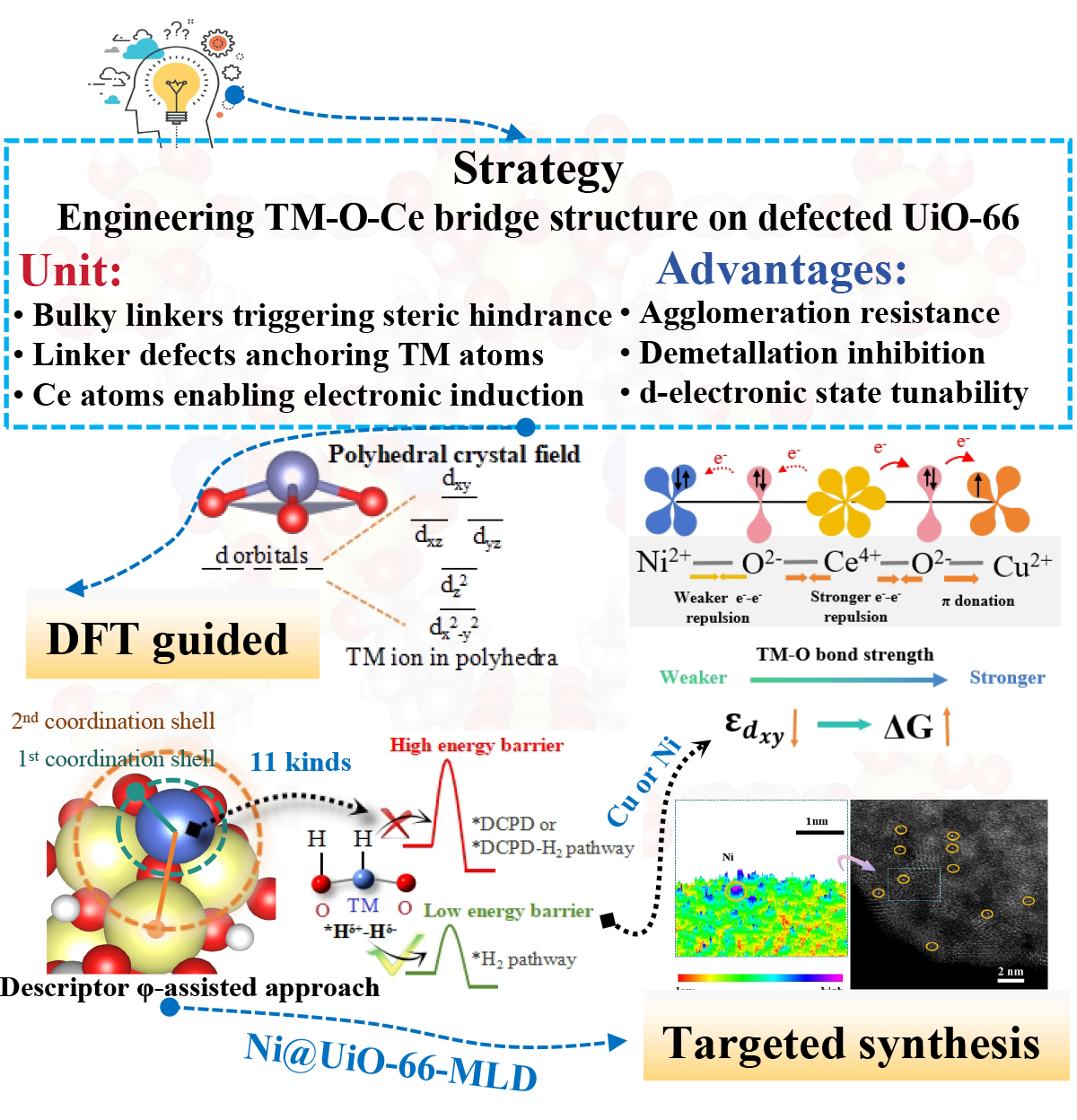
To overcome the drawback of a single regulation mechanism for breaking the activity-stability trade-off in single-atom catalysts (SACs), we propose linker-vacancy-induced TM-O-Ce architecture in Ce-based UiO-66 MOFs for generating a multi-effect synergistic stabilization and enhancement, leveraging a bulky ligand, electronic effects, and orbital overlap. By DFT calculations, we systematically investigated how different TM-O-Ce bridges in MOFs influence competitive adsorption, reaction pathway, and reaction energy barrier, with a focus on geometric and electronic structures, to define criteria for optimal SACs. Crucially, an intrinsic descriptor was constructed to rapidly identify SACs with preferential H2 chemisorption, thereby suppressing deactivation of multiple TM and O sites caused by strong binding to unsaturated hydrocarbons. The resulting beneficial activated species, particularly hydride, trigger the hydrogenation reaction to proceed along a low-barrier pathway. Notably, unlike the strengthened π donation of Cu2+/O2- driven by Coulomb repulsion of Ce4+/O2-, the e--e- repulsion of Ni2+/O2- synergistically weakens the TM-O bond and upshifts the dxy orbital, ultimately achieving a lower reaction energy barrier. Guided by DFT, we successfully synthesized the theoretically predicted optimal Ni-O-Ce bridge in defective UiO-66 using an acetic acid modulator-assisted defect engineering method, as confirmed by advanced characterizations. This work offers a universal paradigm for the rational design and precise synthesis of high-performance catalysts.




- Address: Fuzhou High & New Technology Industrial Zone, Shangjie, Minhou, Fuzhou, Fujian 350108, China
- Tel: (86)-591-63173769, 63173770
- E-mail: cjsc@fjirsm.ac.cn
CN 35–1112/TQ, ISSN 0254–5861, Online ISSN: 2949-768X Copyright @ 2022 Chinese Journal of Structural Chemistry-www.Chinese Journal of Structural Chemistry.net. All Rights Reserved 闽ICP备2022002645号-1