

Just Accepted
Just Accepted Articles have been posted online after technical editing and typesetting for immediate view. The final edited version with page numbers will appear in the Current Issue soon.
Submit a Manuscript

Piezoelectric catalysis in water treatment: Mechanism, Material design and application progress
Yueyue Guan, Hengshan Wei, Zhenhui Hu, Yang Li, Jiashuo Sun, Kai Yao, Xi Chen, Yujie Ke, Yongsheng Yang*, Hongjun Liu*, Jianmin Ma*
https://doi.org/10.1016/j.cjsc.2026.101075
Piezoelectric catalytic; Mechanism; Driving method; Water-pollutant degradation
ABSTRACT
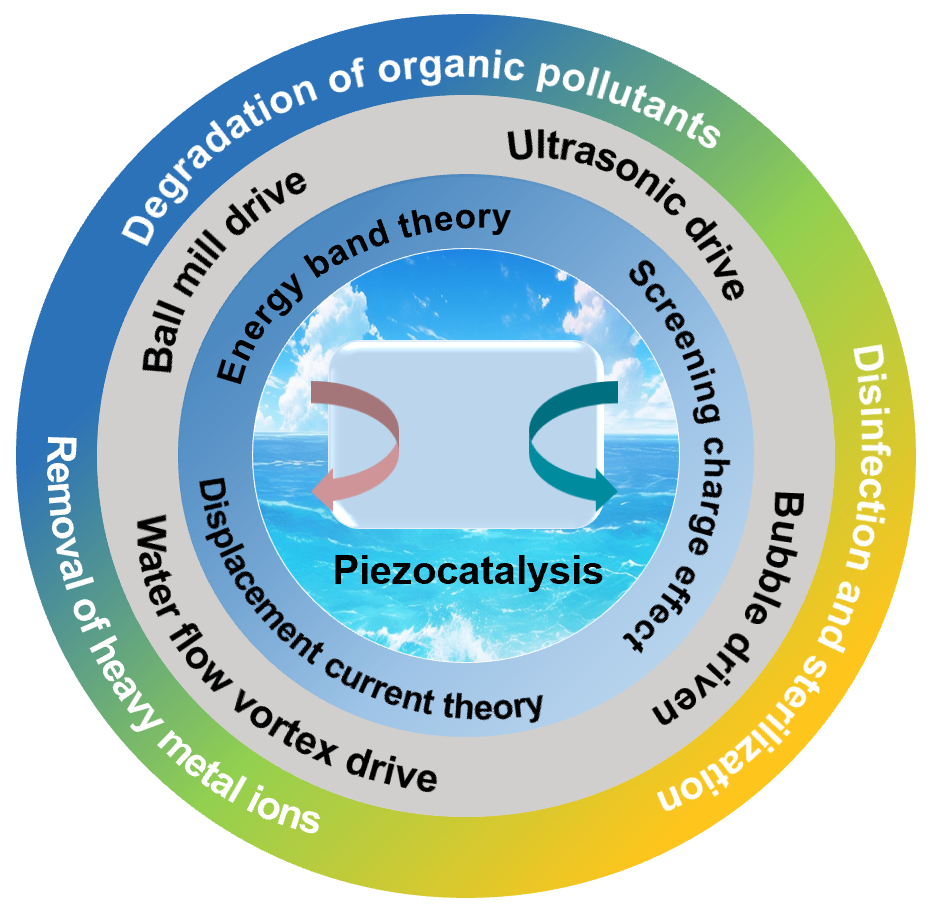
Piezoelectric catalysis is an advanced oxidation technology based on the electromechanical coupling effect, which directly converts mechanical energy in the environment into chemical energy through piezoelectric materials to drive efficient oxidation reactions for water purification. The core mechanism of this technology originates from the piezoelectric polarization field induced by mechanical stress, which can effectively regulate the band structure of materials, promote the separation and migration of charge carriers, and thereby stimulate the generation of reactive oxygen species to achieve efficient degradation of organic pollutants and inactivation of microorganisms. This review summarizes the basic principles of piezoelectric catalysis, focuses on the latest progress in piezoelectric catalysis-driven types, and then sorts out the design ideas of piezoelectric catalytic materials from three major systems: inorganic, organic polymers, and emerging two-dimensional materials. It systematically summarizes the performance optimization strategies of morphology control, defect engineering, heterostructure construction, and noble metal deposition. Finally, it reviews the application exploration in water pollution control, disinfection and sterilization, and heavy metal removal, and proposes current bottlenecks and future development prospects.




- Address: Fuzhou High & New Technology Industrial Zone, Shangjie, Minhou, Fuzhou, Fujian 350108, China
- Tel: (86)-591-63173769, 63173770
- E-mail: cjsc@fjirsm.ac.cn
CN 35–1112/TQ, ISSN 0254–5861, Online ISSN: 2949-768X Copyright @ 2022 Chinese Journal of Structural Chemistry-www.Chinese Journal of Structural Chemistry.net. All Rights Reserved 闽ICP备2022002645号-1