

Just Accepted

Luotong Li, Jun Chen*, Lu Zhang*, Zhe-Ning Chen*
https://doi.org/10.1016/j.cjsc.2026.101077
ABSTRACT
A further
challenge for AI-guided OER discovery is to capture the evolving
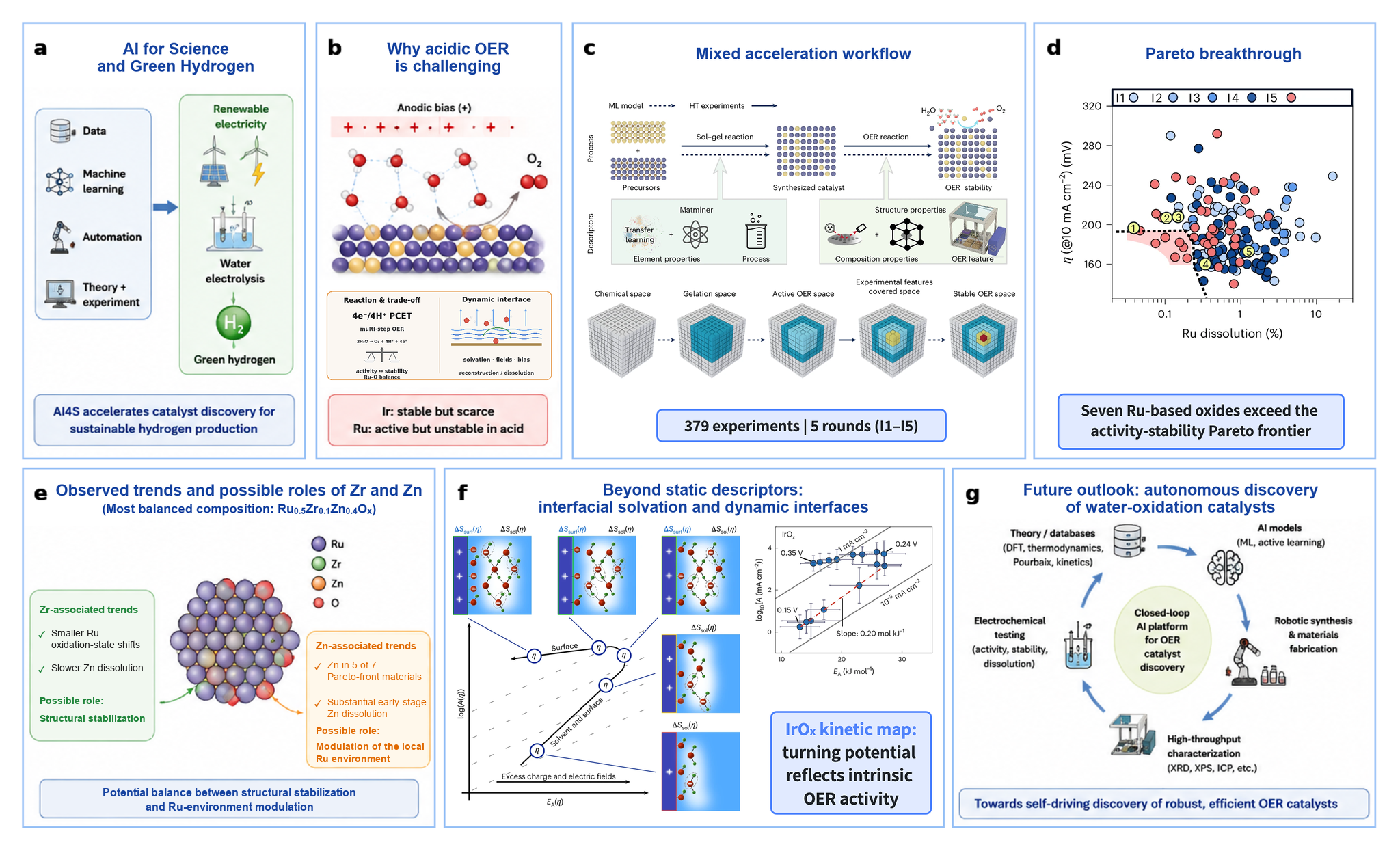
electrochemical interface. Martínez-Hincapié and co-workers showed that
interfacial solvation can pre-organize the OER transition state and influence
the kinetic regime [4]. Their kinetic analysis links a bias-dependent turning
potential to changes in the relative importance of interfacial solvation and
surface energetics: before the turning potential, excess charge and electric
fields may organize the interfacial hydrogen-bond network and influence
activation parameters, whereas beyond it the solvation pre-step becomes less
limiting. The turning potential is largely independent of catalyst loading or
surface area and can therefore inform intrinsic catalytic activity. Accordingly, Fig. 1f combines
the general kinetic-map framework of Ref. [4] with an experimental kinetic map
for OER on IrOx nanoparticles in 0.1 M H2SO4.
For AI models, these insights motivate condition-dependent representations that
complement conventional static descriptors. Applied potential and electrolyte conditions can be
treated explicitly as model inputs, while reconstruction state, phase
fractions, dissolution behavior, kinetic parameters, and operando spectroscopic
features can be encoded as multimodal or time-resolved descriptors. Interfacial
solvation and electric-field effects could additionally be represented through
simulation-derived descriptors or experimentally accessible proxies, enabling
models to learn activity and stability as functions of the evolving catalyst
state and operating conditions. Such hierarchical decision workflows could be
incorporated into closed-loop platforms that combine theory/databases,
AI models, robotic synthesis, high-throughput characterization, electrochemical
testing, and feedback learning, enabling iterative optimization of catalysts
that are active, synthesizable, and durable under bias (Fig. 1g). For water
oxidation, the value of AI lies not simply in larger composition-performance
datasets, but in connecting activity, stability, synthesis, and interfacial
dynamics within an integrated discovery framework.




- Address: Fuzhou High & New Technology Industrial Zone, Shangjie, Minhou, Fuzhou, Fujian 350108, China
- Tel: (86)-591-63173769, 63173770
- E-mail: cjsc@fjirsm.ac.cn