

Just Accepted
Just Accepted Articles have been posted online after technical editing and typesetting for immediate view. The final edited version with page numbers will appear in the Current Issue soon.
Submit a Manuscript

Extra nitrogen-induced charge redistribution over Pd@Pt3Ni heterointerfaces enables superior C1 selectivity and durability in ethanol oxidation reaction
Shupeng Wang, Linzhe Lv, Junlin Cai, Hongpu Huang, Zefeng Xu, Defang Li, Xiankun Song*, Xianmeng Song, Qiuxiang Wang, Zhaoxiong Xie, Shuifen Xie*
https://doi.org/10.1016/j.cjsc.2026.101097
Interstitial N doping; Core-shell electrocatalysts; C1 pathway selectivity; CO oxidation; Structural stability
ABSTRACT
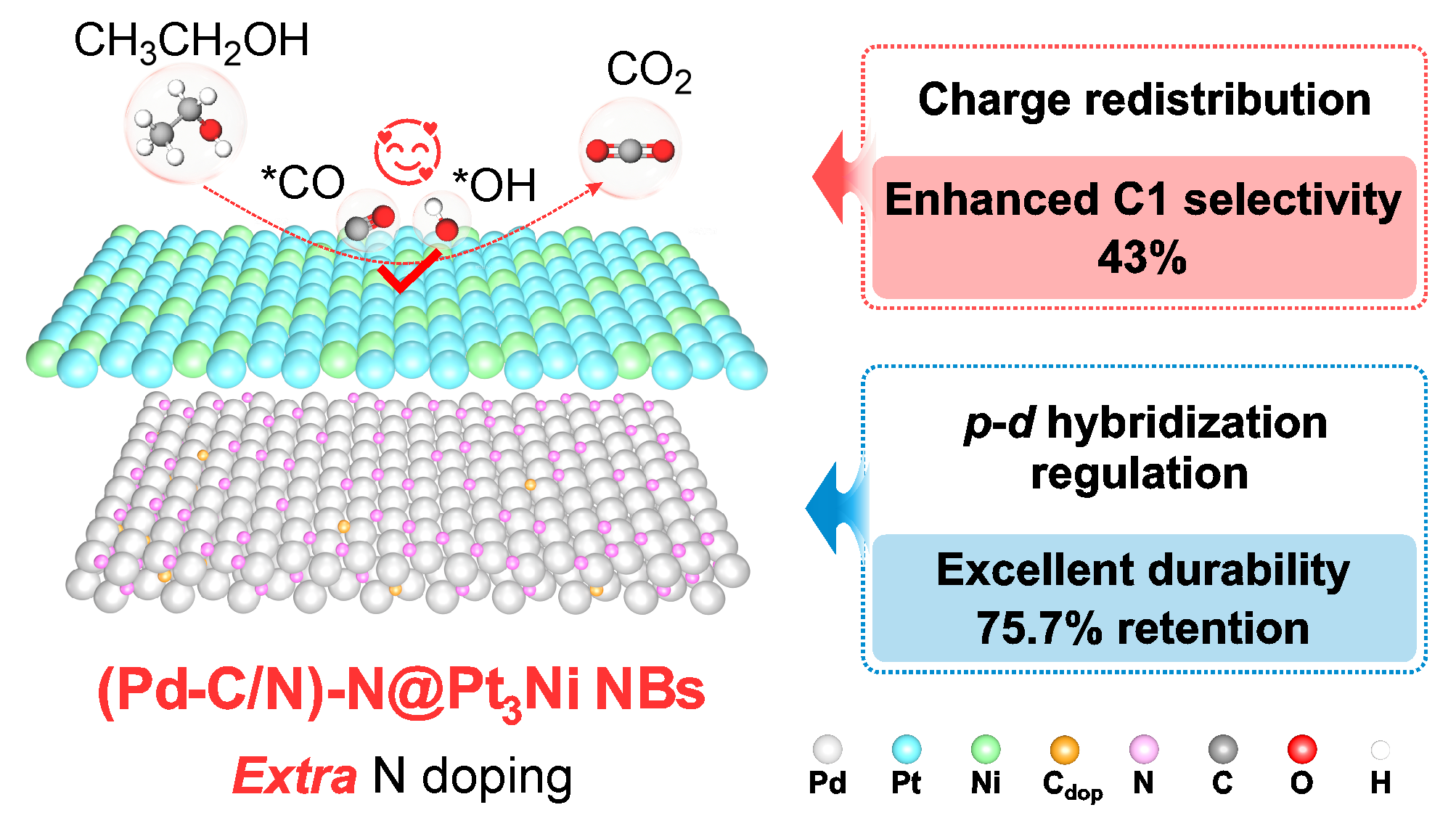
The anodic ethanol oxidation reaction (EOR) is the key anodic reaction in direct ethanol fuel cells, where complete 12-electron oxidation of ethanol enables high energy output. However, the development of efficient EOR catalysts remains challenging because current catalysts exhibit sluggish C–C bond cleavage, severe poisoning by CO-like intermediates, and dissolution degradation. Herein, we employ well-defined Pd@Pt3Ni core–shell nanobranches to investigate how stepwise interstitial light-element incorporation regulates EOR pathways. One-step in situ carbon/nitrogen (C/N) incorporation synthesis yields (Pd-C/N)@Pt3Ni, in which dopants are predominantly confined within the Pd core. Subsequent hydrazine treatment of the pre-formed (Pd-C/N)@Pt3Ni introduces additional interstitial N and yields (Pd-C/N)-N@Pt3Ni with N enriched at the Pd/Pt3Ni heterointerface. The heterointerface-enriched N configuration in (Pd-C/N)-N@Pt3Ni induces pronounced electronic reconstruction between Pd and the Pt3Ni shell, thereby tuning the electronic properties of the Pt3Ni shell, facilitating C–C bond cleavage, and accelerating further CO oxidation. Consequently, (Pd-C/N)-N@Pt3Ni delivers an impressive mass activity of 14.08 A mgPd+Pt−1 and a high C1 pathway selectivity of 43% at 0.7 VRHE. Moreover, strong N–metal p–d orbital hybridization reinforces (Pd-C/N)-N@Pt3Ni core–shell interaction, effectively suppressing metal dissolution and enabling 75.7% activity retention after 10,000 cycles. This work demonstrates that sequence-controlled interstitial light-element incorporation is an effective strategy for enhancing selectivity and durability in multi-carbon electrooxidation.




- Address: Fuzhou High & New Technology Industrial Zone, Shangjie, Minhou, Fuzhou, Fujian 350108, China
- Tel: (86)-591-63173769, 63173770
- E-mail: cjsc@fjirsm.ac.cn
CN 35–1112/TQ, ISSN 0254–5861, Online ISSN: 2949-768X Copyright @ 2022 Chinese Journal of Structural Chemistry-www.Chinese Journal of Structural Chemistry.net. All Rights Reserved 闽ICP备2022002645号-1