

Just Accepted
Just Accepted Articles have been posted online after technical editing and typesetting for immediate view. The final edited version with page numbers will appear in the Current Issue soon.
Submit a Manuscript

Engineering catalytic microenvironments in copper cluster-based MCOF/SWCNT heterostructures for efficient electrocatalytic nitrate reduction
Yiyong Zhao, Pengyue Hao, Shuxin Yuan, Wang Zhang, Jinghui Lyu, Ai-Bao Xia*, Yongwu Peng*
https://doi.org/10.1016/j.cjsc.2026.101099
Electrocatalytic nitrate reduction; Trinuclear copper cluster; MCOF/SWCNT heterostructures; Catalytic microenvironment modulation; Zn-nitrate battery
ABSTRACT
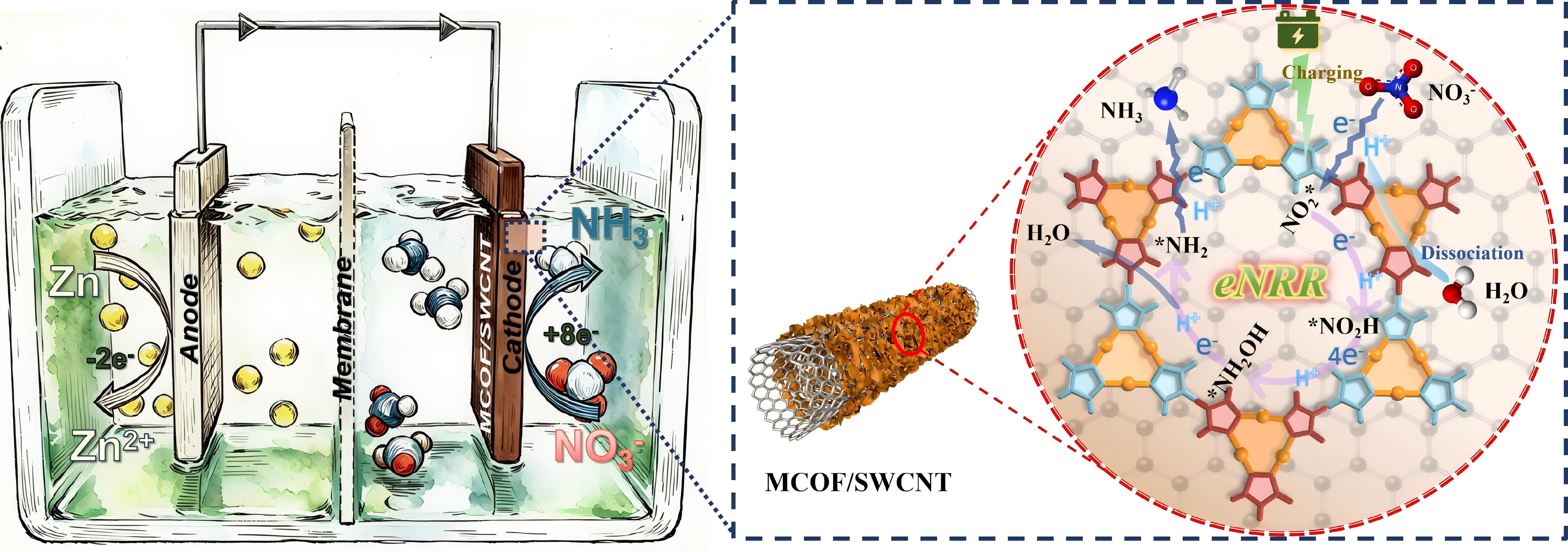
Electrocatalytic nitrate reduction (eNRR) offers a sustainable route for ammonia production and nitrate remediation, yet the application of covalent organic framework (COF)-based electrocatalysts is hindered by poor charge transport and limited site accessibility. Herein, we report the in-situ growth of two trinuclear copper cluster-based metal-covalent organic frameworks (MCOFs) on single-walled carbon nanotubes (SWCNTs), yielding conductive heterostructures with tailored catalytic microenvironments. Systematic structural modulation reveals that methyl-induced steric effects critically regulate active-site exposure and substrate diffusion. Notably, methyl-free MCOF-1/SWCNT exhibits enlarged pore apertures and enhanced site accessibility, whereas methyl-substituted MCOF-2/SWCNT shows narrower pores but a higher surface area and denser active sites, these competing effects lead to a modest overall performance difference. In 1 M KOH with 0.15 M KNO3 at -0.8 V versus RHE, MCOF-1/SWCNT achieves a Faradaic efficiency of 94.67% and an ammonia yield of 4.94 mol g-1 h-1. In-situ Raman spectroscopy and density functional theory calculations validate a stepwise hydrogenation pathway and identify the *NHO-to-*NH2OH protonation as the rate-determining step, with a lower barrier for MCOF-1/SWCNT. Furthermore, MCOF-1/SWCNT functions as an efficient cathode in a Zn-nitrate battery, achieving a peak power density of 13.2 mW cm-2 and stable operation over 140 h. This work establishes a molecular-level framework for modulating steric microenvironments in MCOF electrocatalysts and demonstrates the potential of coupling nitrate valorization with energy storage.




- Address: Fuzhou High & New Technology Industrial Zone, Shangjie, Minhou, Fuzhou, Fujian 350108, China
- Tel: (86)-591-63173769, 63173770
- E-mail: cjsc@fjirsm.ac.cn
CN 35–1112/TQ, ISSN 0254–5861, Online ISSN: 2949-768X Copyright @ 2022 Chinese Journal of Structural Chemistry-www.Chinese Journal of Structural Chemistry.net. All Rights Reserved 闽ICP备2022002645号-1